At Goldrick Elementary in Denver Public Schools↗ET, the newest state test results show a school that kept most of a fast math climb, even though its 2026 rate slipped.
Goldrick's schoolwide math proficiency, the share of students meeting or exceeding expectations on CMAS, was 26.0% in spring 2026. Those are results from the 2025-26 school year, the most recent results the state has published. The rate was down 3.8 points from 29.8% a year earlier, and still 19.4 points above the school's 6.6% in 2022. Colorado's statewide math rate rose 5.8 points over the same four years, to 37.3%.
Standout stat: Among 81 screened Denver elementary schools, Goldrick posted the third-largest math gain from 2022 to 2026.
Goldrick's math gain since 2022 outpaced Colorado's by 13.6 points, even with this spring's step back.
Most of the climb held
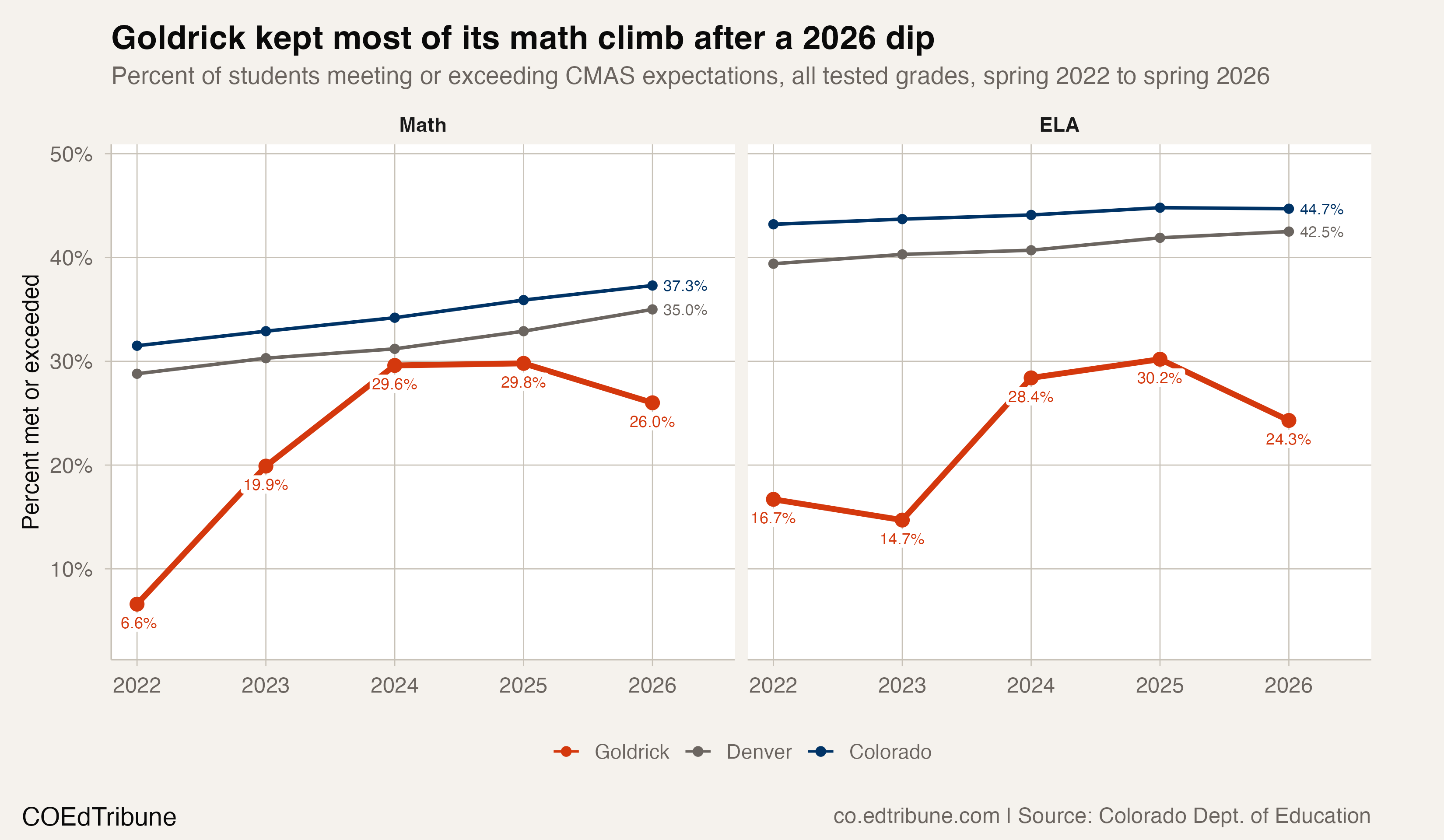
Goldrick's math line rose three years in a row and then turned down: 6.6% in 2022, 19.9% in 2023, 29.6% in 2024, 29.8% in 2025 and 26.0% in 2026. The school gained 23.2 points from 2022 to 2025, and the 2026 rate keeps 19.4 of them.
The 2026 move ran against the district and the state. Denver's districtwide math rate rose 2.1 points this spring and Colorado's rose 1.4 points. Goldrick was not alone in slipping, though: 38 of 82 screened Denver elementary schools posted lower math rates in 2026 than in 2025.
The state's files do not say why a school's rate moves in a given year. Goldrick tested nearly the same number of students in math both springs, 171 in 2025 and 169 in 2026, but these annual schoolwide results do not follow the same children over time.
Goldrick's ELA rate fell from 16.7% in 2022 to 14.7% in 2023, then rose to 28.4% in 2024 and 30.2% in 2025. It fell 5.9 points to 24.3% in 2026, leaving it 7.6 points above 2022.
The figures use CDE's published combined percentages for students meeting or exceeding expectations, including in 2022, when separate Met and Exceeded shares were withheld.
What the school changed
In a written response to The COEdTribune in July, Principal Taryn Rawson traced the math gains to a deliberate shift toward explicit, evidence-based instruction, mirroring what the school had already done in literacy. She pointed to the Eureka Math Squared curriculum, a schoolwide fluency routine and daily targeted small-group instruction, with the students furthest from their goals working with the school's most expert math teachers.
She also described a Math Leadership Team of strong teachers who attended conferences and online trainings and then shared what they learned with the full staff, and a weekly review of math data that tracks which students are on track to proficiency. Students move in and out of the small groups as needed, she said.
When she answered in July, Rawson had already seen the 2026 results and described the school's growth as having stalled a little. For the 2026-27 school year, she said, Goldrick planned more consistent coaching in explicit classroom instruction and better scaffolds and accommodations for students with disabilities. Those are plans she reported, not explanations the test scores can establish.
Asked this fall about the spring 2026 results, Rawson wrote that they "weren't what we wanted them to be, but we know that progress isn't always a straight, upward-sloping line!" The school, she wrote, has "more work to do to improve both the quality of our Tier 1 instruction, and to make sure that students currently performing below grade level receive the intervention they need."
To give teachers "more structured ways to collaborate across tiers of instruction," she wrote, Goldrick is reworking its schedule for teacher planning and data analysis, and it is using a new coaching tool, Steplab.
"We're not giving up; our kids are capable of greatness, and we know we still have a long way to go until our CMAS data reflects their brilliance!" Rawson wrote.
Where Goldrick ranks in Denver
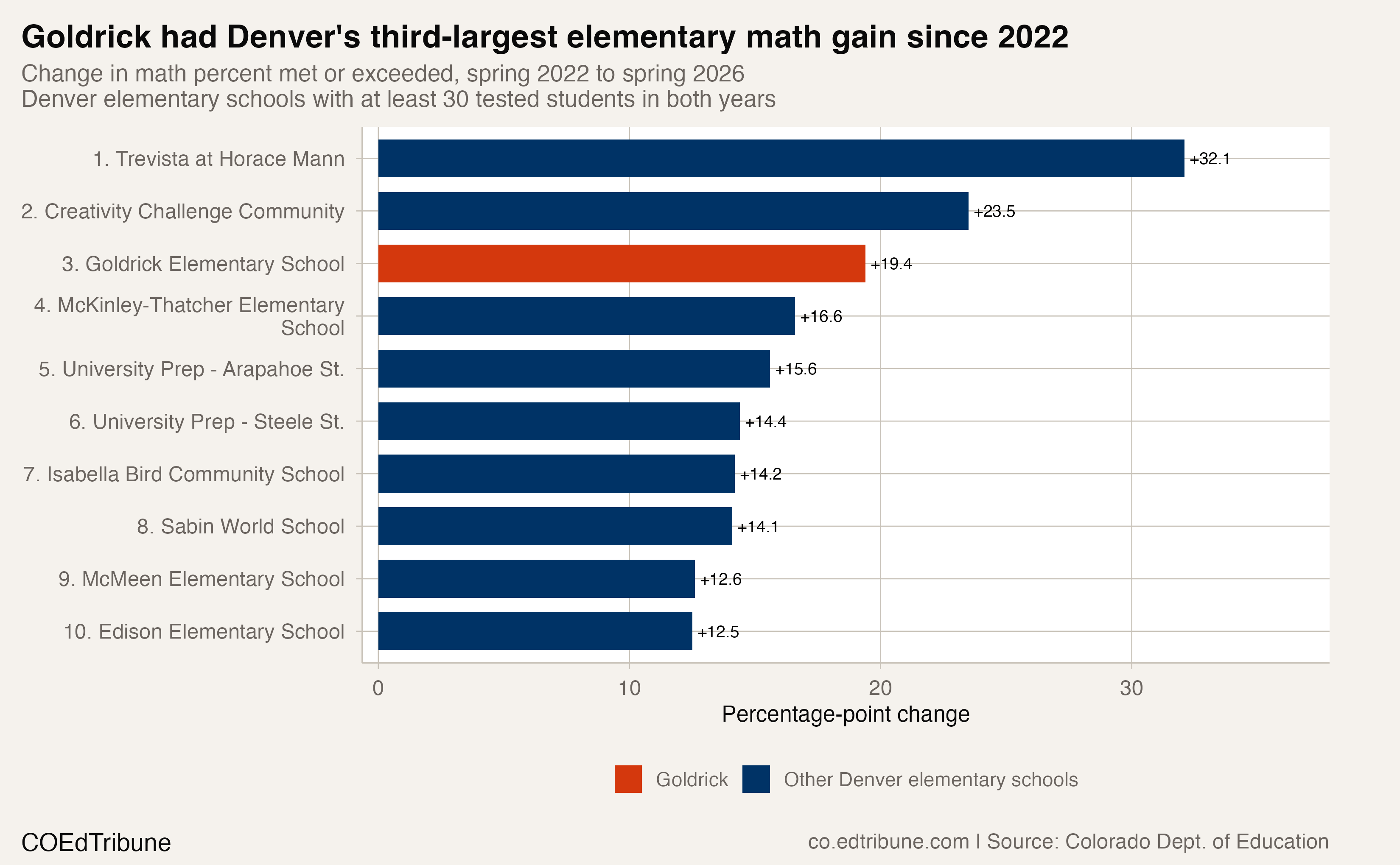
Among 81 Denver elementary schools with at least 30 tested students in both 2022 and 2026, Goldrick's 19.4-point math gain ranked third, behind Trevista at Horace Mann and Creativity Challenge Community. The rank is the same with no tested-student cutoff and with a cutoff of 50.
CMAS is Colorado's standards-based state assessment. CDE says participation rates should be considered because they affect how representative reported results are likely to be, and the results here describe the students who tested.
The distance still to cover
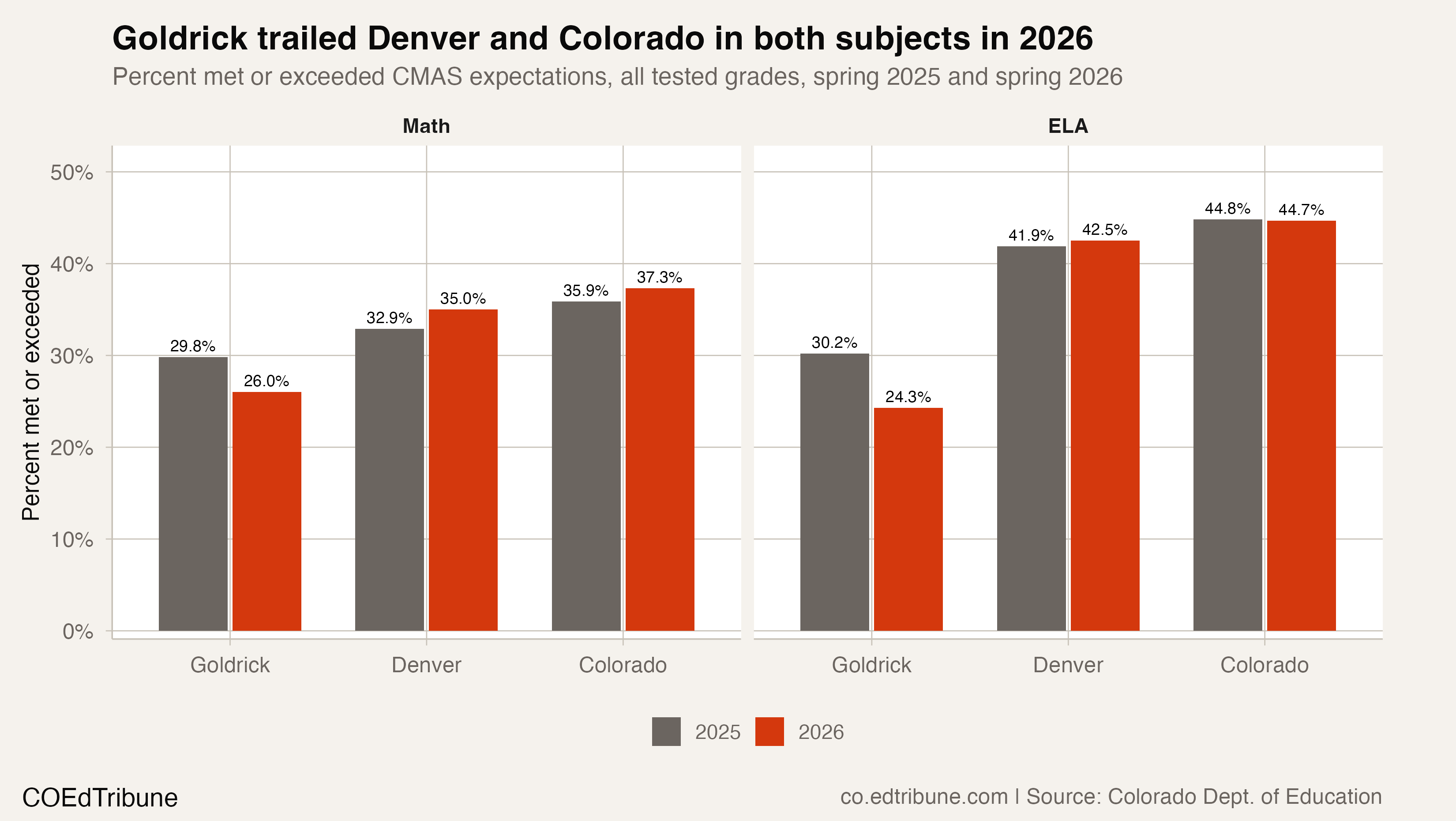
Goldrick's 26.0% math rate in 2026 trailed Denver's 35.0% and Colorado's 37.3%. In ELA, its 24.3% trailed Denver's 42.5% and Colorado's 44.7%.
CBS Colorado has reported on Goldrick celebrating CMAS growth, including staff comments about giving students additional time to master skills.
The 2026 results change the question for Goldrick. A year ago it was whether a school that climbed from 6.6% to 29.8% in math could keep going. Now it is whether the school can return to that level and build on it. Spring 2027 testing will give the first answer.
Detailed code that reproduces the analysis and figures in this article is available exclusively to EdTribune subscribers.
Discussion
Sign in to join the discussion.
Loading comments...