At McKinley-Thatcher Elementary School in Denver Public Schools↗ET, more than half of tested students met or exceeded CMAS math expectations for the third spring in a row.
The school's schoolwide math rate was 52.9% in spring 2026, last school year, 2025-26, and the most recent results the state has published. That was down 2.3 points from 55.2% in 2025, and still 17.9 points above Denver's districtwide rate of 35.0% and 15.6 points above Colorado's 37.3%.
Standout stat: McKinley-Thatcher's math rate rose 16.6 points from 2022 to 2026, the fourth-largest gain among 81 screened Denver elementary schools.
The school started from solid footing. Its 36.3% math rate in 2022 was already above the statewide rate that year.
Three springs above half
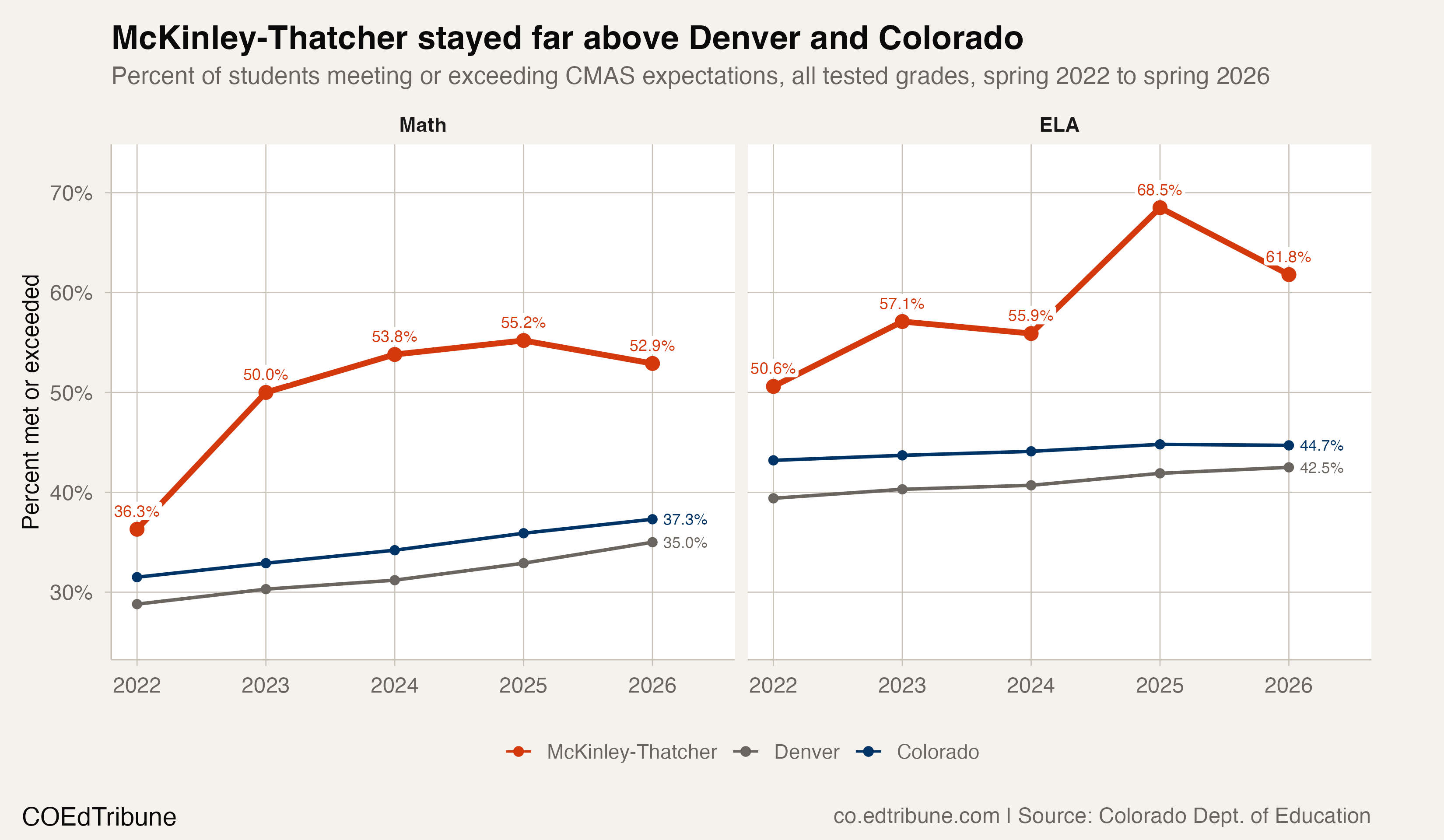
McKinley-Thatcher's math rate climbed through 2025, then slipped in 2026: 36.3% in 2022, 50.0% in 2023, 53.8% in 2024, 55.2% in 2025 and 52.9% in 2026. The 2023 rate was exactly half, so 2024 through 2026 are the springs in which most tested students met the bar.
Over the full window, the school's math gain outpaced Colorado's by 10.8 points. The statewide rate rose 5.8 points from 2022 to 2026.
ELA moved higher too, with a sharper 2026 step back. The school's ELA rate rose from 50.6% in 2022 to 68.5% in 2025, then fell 6.7 points to 61.8% in 2026. That is 11.2 points above its 2022 level, and well above Denver's 42.5% and Colorado's 44.7%.
The tested group has grown. McKinley-Thatcher tested 136 students in math in 2026, up from 105 in 2025 and 80 in 2022. These annual schoolwide results do not track the same children over time. The state's files do not show why the rates moved; changes in who tested are one possible explanation for last spring's dip, but the figures cannot establish that.
A top-four math gain in Denver
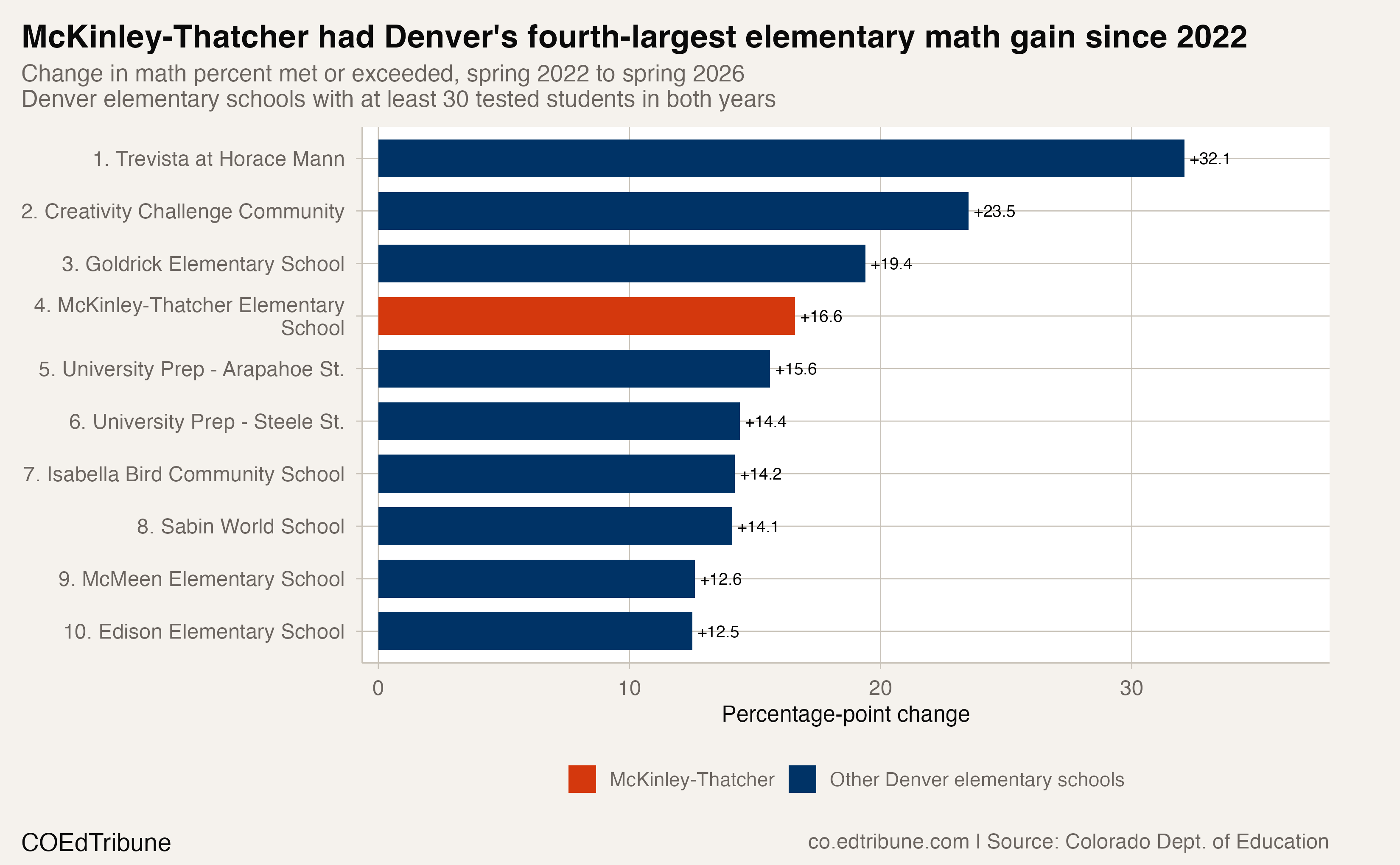
Among 81 Denver elementary schools with at least 30 tested students in both 2022 and 2026, McKinley-Thatcher's math gain ranked fourth. Its ELA gain ranked 15th among 81 schools in the same screen.
That pairing sets the school apart from a single-subject rebound. Both rates sat well above the district and the state in 2026, after four years in which both rose more than Colorado's did.
CMAS is Colorado's standards-based state assessment. CDE says participation rates should be considered because they affect how representative reported results are likely to be, and the results here describe the students who tested.
A wide lead after a down year
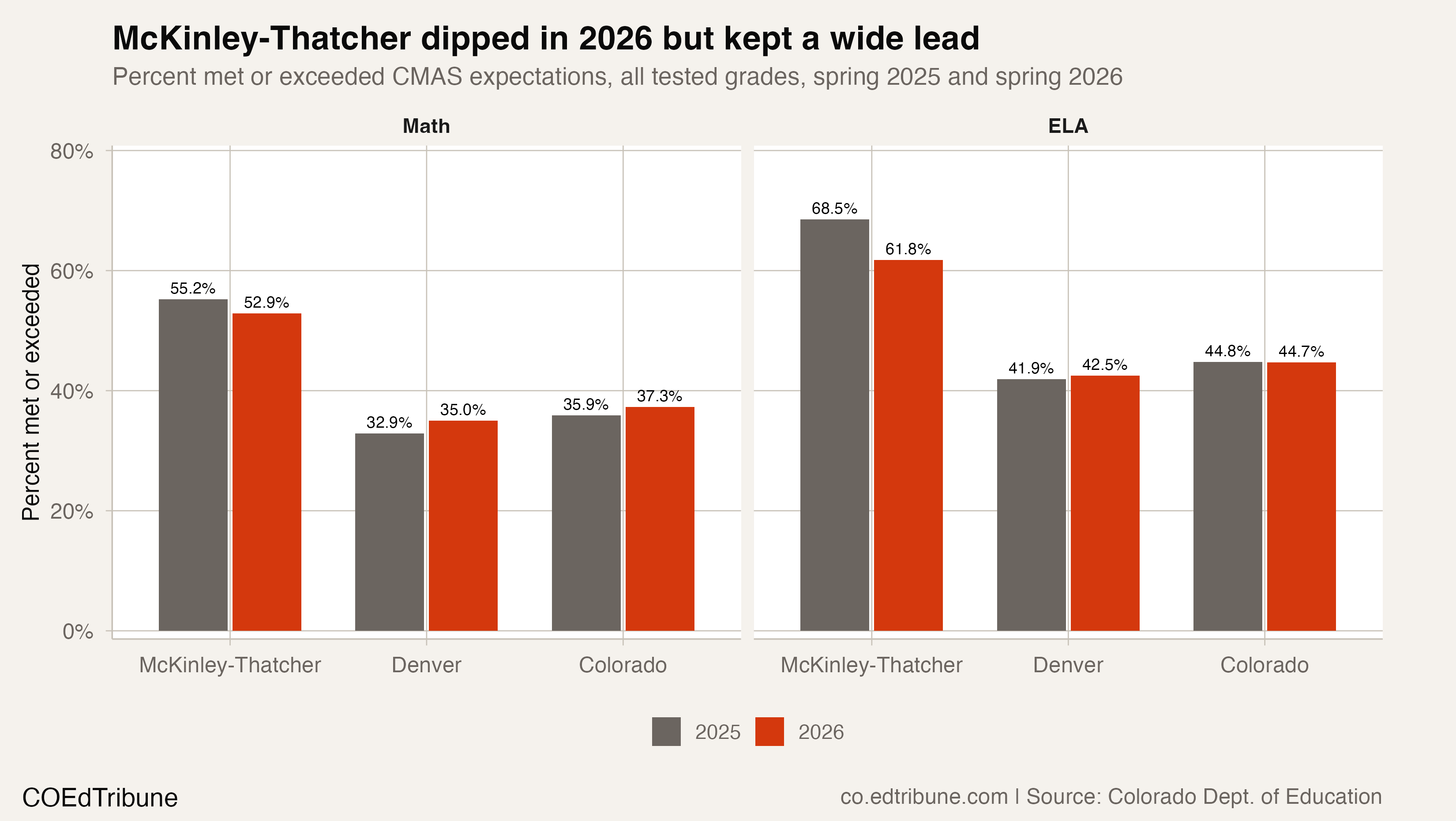
The 2026 comparison shows both halves of the year. Denver's and Colorado's math rates rose while McKinley-Thatcher's fell, and its ELA rate dropped while Denver's rose and Colorado's held nearly flat. Even so, the school's 52.9% in math and 61.8% in ELA kept it far ahead of both.
The question for McKinley-Thatcher is whether math returns to its 2025 level after last spring's dip. A later round of results will test that.
Detailed code that reproduces the analysis and figures in this article is available exclusively to EdTribune subscribers.
Discussion
Sign in to join the discussion.
Loading comments...