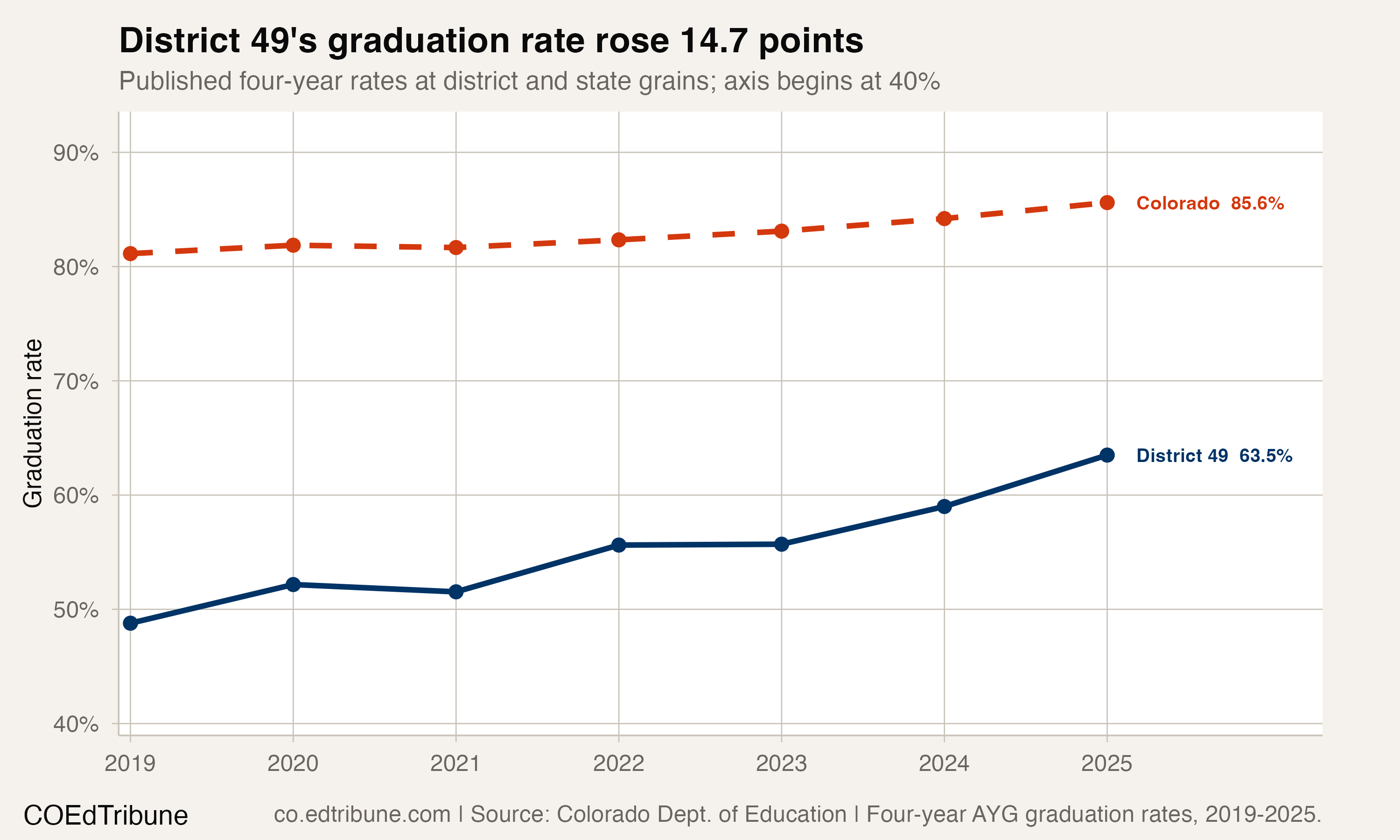
District 49↗ET raised its four-year graduation rate from 48.8% in 2019 to 63.5% in 2025. The 14.7-point gain came while its adjusted cohort grew by 1,185 students, or 48.0%, to 3,653.
The latest rate was the district's highest in the complete seven-year package history. It followed four consecutive annual increases from 51.5% in 2021, a 12.0-point climb. The result still sat 22.1 points below Colorado's 85.6% rate. That gap was 32.3 points in 2019.
District 49's reporting includes a statewide online school. Direct evidence: The district lists GOAL High School as a public charter, describing online instruction with in-person support. GOAL calls itself a statewide, multi-district school with an online curriculum and drop-in centers in its annual report.
A large school row, but no clean subtraction
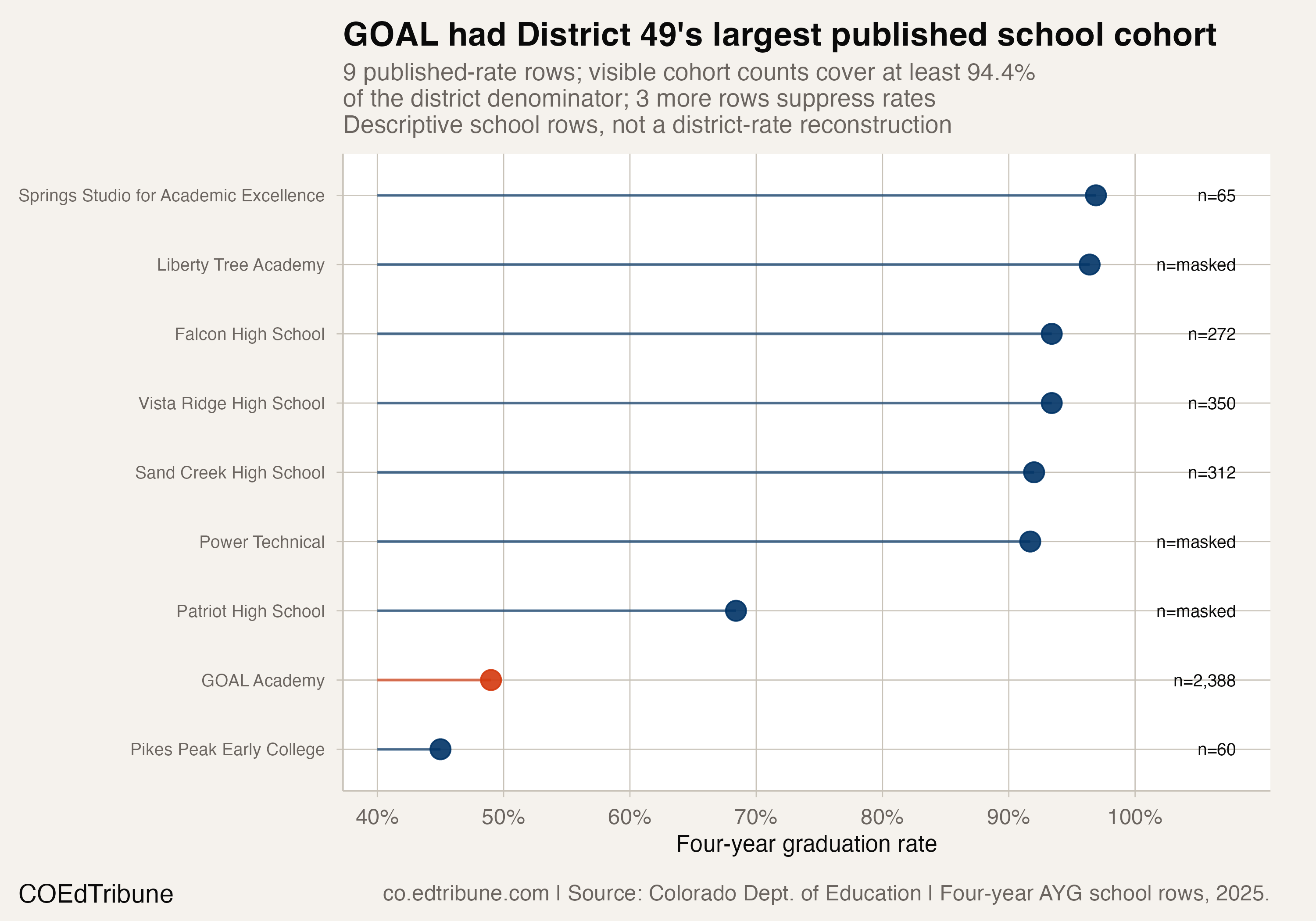
The state data identify GOAL's school row as GOAL Academy. Its published four-year rate rose from 19.2% in 2019 to 49.0% in 2025, a 29.8-point gain. Its adjusted cohort increased from 1,353 to 2,388, or 76.5%.
In 2025, GOAL's reported cohort count equaled 65.4% of District 49's published cohort denominator. The ratio was 54.8% in 2019, a 10.5-point increase. That makes the school row important context. It does not show that GOAL caused the districtwide rate or permit a reliable rate with GOAL removed.
The reason is visible in the reporting grain. Colorado's school file contains a row named “DISTRICT TOTAL” alongside individual school rows. Once that duplicate total is removed, the component schools reconcile exactly to the district cohort and rate from 2019 through 2022. They do not fully reconcile from 2023 through 2025.
The latest file contains 12 component school rows under District 49. Three have a suppressed rate, and five do not publish an exact cohort count. The published component counts account for at least 3,551 of the district's 3,653-student denominator, or 97.2%. The remaining 102 students cannot be assigned to a named component row from the public file. Among rows with a published rate, the visible cohort counts cover at least 94.4% of the district denominator.
Direct evidence: The Colorado Department of Education says public graduation files since 2022-23 apply privacy protections that can mask rates and cohort sizes (CDE definitions and archives). The package output does not identify the reason for each missing cell. Whatever the cause, the public school rows cannot support a complete reconstruction. A claimed “District 49 without GOAL” rate would fill that missing structure with assumptions.
Improvement and distance coexist
District 49's starting point changes the size of the gain. The full 2019 comparison produces 14.7 points. A 2020 baseline produces 11.3 points; a 2022 baseline produces 7.9 points; and the one-year change from 2024 is 4.5 points. The district improved in five of six annual transitions, with its only decline in 2021.
The long comparison is strong in statewide context. Among 87 district-level reporting entities with valid rates, positive cohorts and both 2019 and 2025 records, District 49's gain ranked seventh. Those entities represented 97.4% of the valid statewide 2025 cohort.
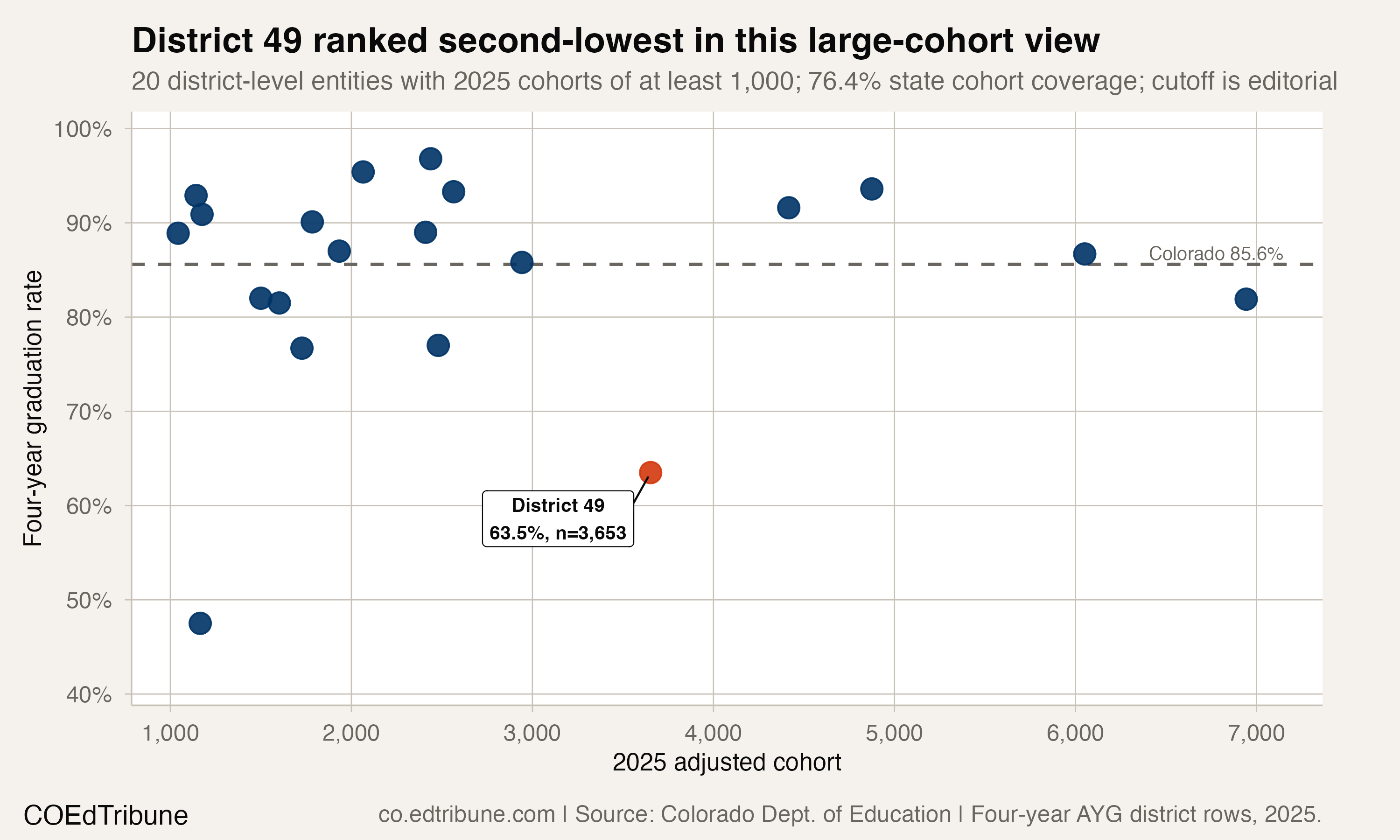
The latest rate comparison is more sensitive to an editorial size cutoff. Among 20 entities with cohorts of at least 1,000 students, District 49 had the second-lowest rate and the fifth-largest cohort; those entities covered 76.4% of the state cohort. With no size cutoff, it had the fourth-lowest rate among 87 entities covering 97.4%.
Those ranks describe published four-year outcomes at district grain. They are not school-quality ratings, and they do not adjust for program mission or student circumstances. Direct evidence: Colorado defines the denominator around an anticipated year of graduation and keeps students in a school cohort until they re-enroll elsewhere or document another status. Interrupted coursework can therefore affect the published measure, while later completion appears in extended-year rates, according to the state's graduation guidance.
Suggestive context: GOAL attributes recent progress to mentoring, personalized support and re-engagement in its annual report. That self-description is not a causal test. The graduation records show that both GOAL's school row and District 49's district row improved; they cannot isolate which practices moved either result.
Direct evidence: District 49 says its charter-authorizing mission is to balance school autonomy with accountability for outcomes. The unresolved reporting question is how to keep that authorizer accountability visible while showing a statewide online school's results and the suppressed component rows clearly enough that readers do not mistake a juxtaposition for a subtraction.
Graduation rates and adjusted cohort counts come from the Colorado Department of Education's official graduation and completion statistics for anticipated graduation years 2019 through 2025. The analysis uses four-year rates for state, district-level and school-level reporting rows; it does not use dropout or extended-year graduation rates.
Detailed code that reproduces the analysis and figures in this article is available exclusively to EdTribune subscribers.
Discussion
Sign in to join the discussion.
Loading comments...