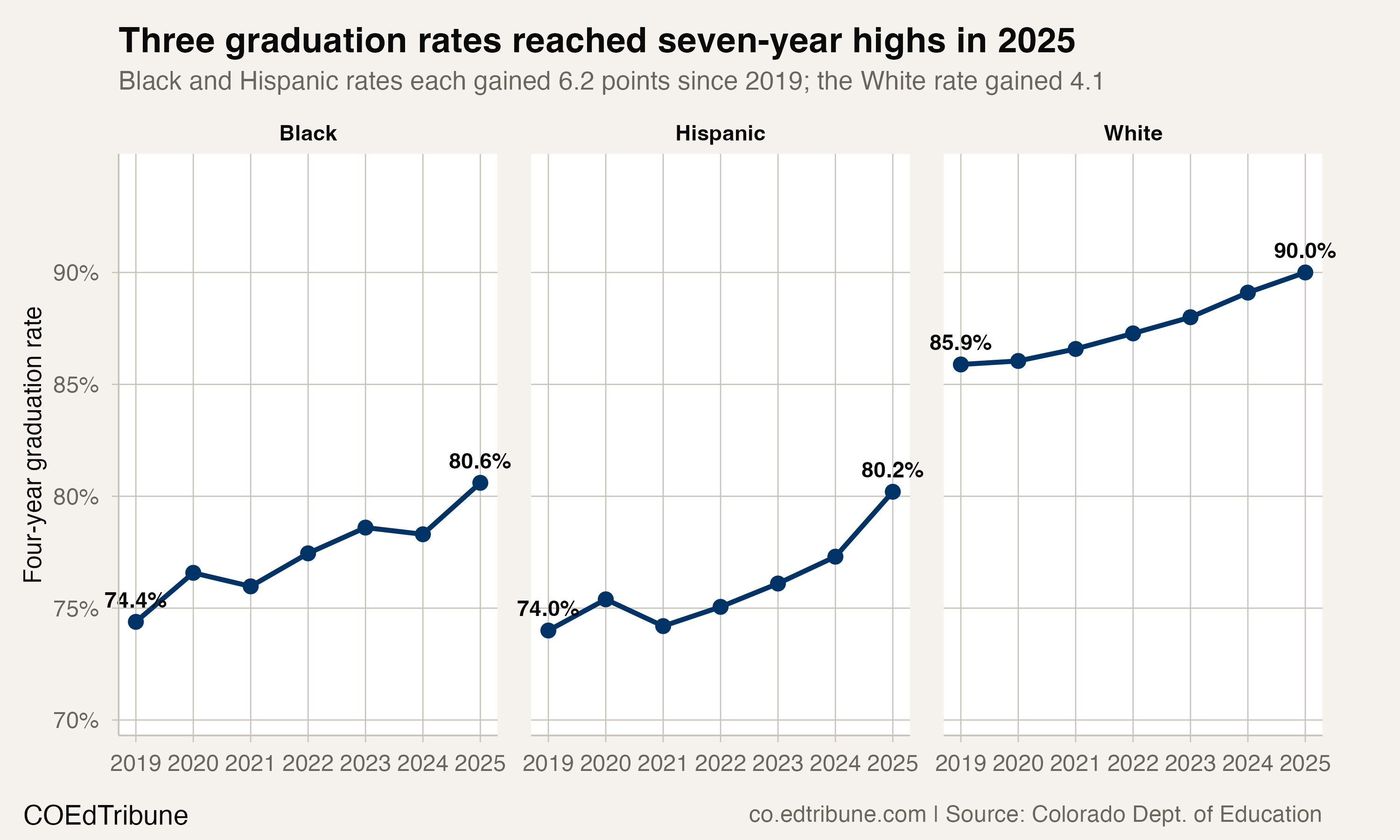
Colorado's four-year graduation rates for Black and Hispanic students each rose 6.2 percentage points from 2019 to 2025, reaching 80.6% and 80.2%. The rate for White students rose 4.1 points to 90.0%. That difference in gains narrowed both racial gaps by 2.1 points, though the latest gaps still exceeded nine points.
The statewide average contains different local paths. In Denver County 1↗ET, both gaps narrowed between 2019 and 2025. In Cherry Creek 5↗ET, both widened. Neither district establishes a statewide cause, but their contrast is a warning against treating one Colorado average as a program diagnosis.
The denominators also changed. The 2025 statewide cohorts included 3,288 Black students, 26,317 Hispanic students and 34,659 White students. Those are three mutually exclusive race and ethnicity categories within a 70,554-student statewide cohort, not separate populations to be added to overlapping service groups.
A milestone and a gap can be true together
The 2025 rates were the highest in the seven-year record for all three groups. It was the first year in that span that the Black and Hispanic rates reached 80%, and the first that the White rate reached 90%.
The White-Hispanic gap moved from 11.9 points in 2019 to 9.8 points in 2025. The White-Black gap moved from 11.5 points to 9.4 points. Both narrowed, but neither did so in a straight line.
The White-Hispanic gap narrowed in five of the six annual transitions and widened once. The White-Black gap narrowed four times and widened twice. Most recently, each difference contracted in 2025: by 2.0 points for Hispanic students and 1.4 points for Black students.
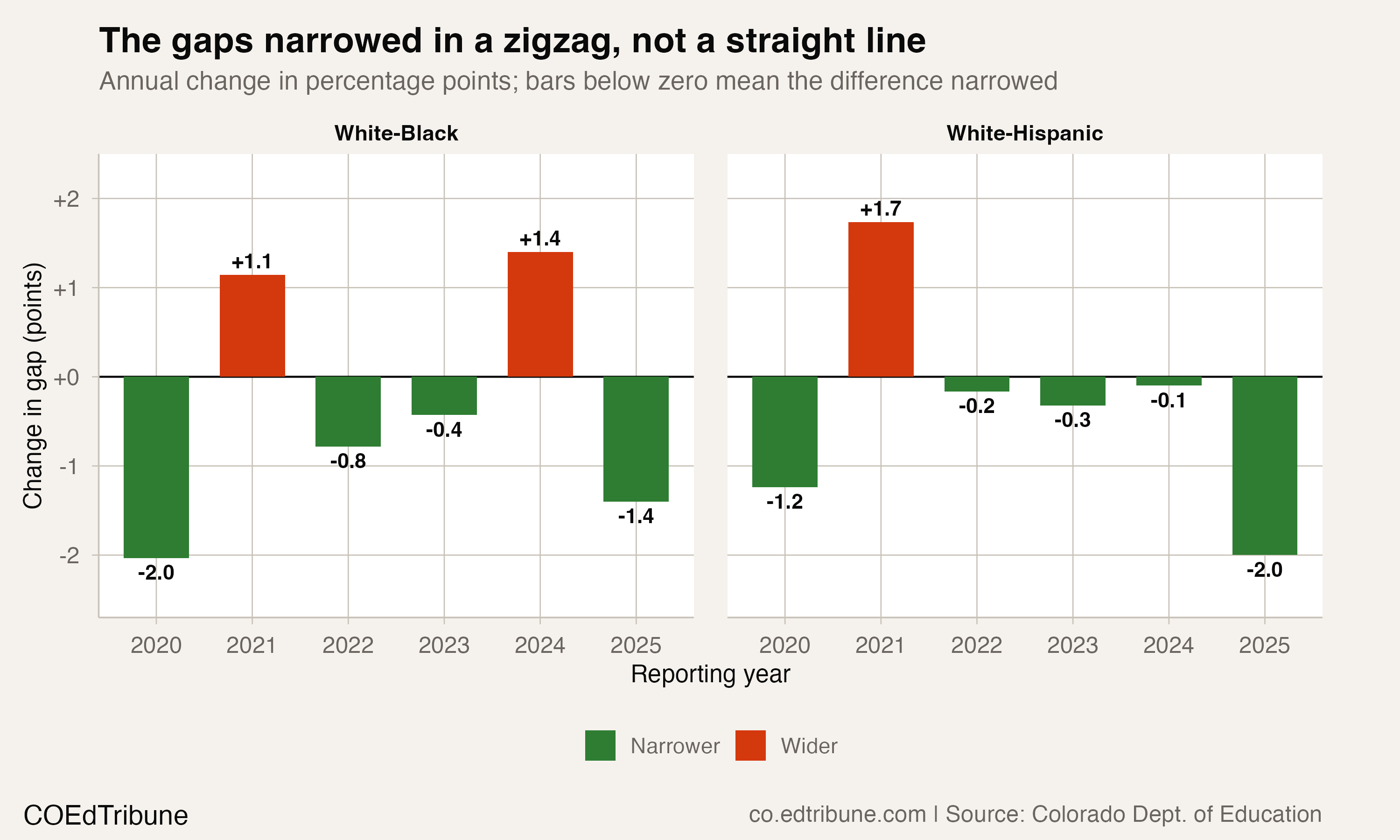
That full history changes the original premise for this story. A 2020 baseline makes the White-Black gap look nearly flat and the White-Hispanic gap only modestly narrower. Starting in 2019, however, each gap narrowed by 2.1 points. "Barely budged" would erase measurable progress; "closed" would erase the 9.8-point and 9.4-point differences still present in 2025.
Direct evidence: The Colorado Department of Education's current graduation release treats improvement and persistent student-group gaps as simultaneous findings. That framing shows how the department describes the result, not what caused it.
Two districts show why the average is not a prescription
Denver's Black graduation rate rose from 68.3% to 79.4%, while its Hispanic rate rose from 68.0% to 79.0% and its White rate rose from 81.0% to 90.8%. The White-Black gap narrowed from 12.8 points to 11.4 points. The White-Hispanic gap narrowed from 13.0 points to 11.8 points.
Cherry Creek began and ended higher, but its groups did not move together. Its Black rate rose from 88.4% to 91.1%, its Hispanic rate slipped from 84.9% to 84.5%, and its White rate rose from 91.3% to 95.0%. The White-Black gap widened from 2.9 points to 3.9 points; the White-Hispanic gap widened from 6.3 points to 10.5 points.
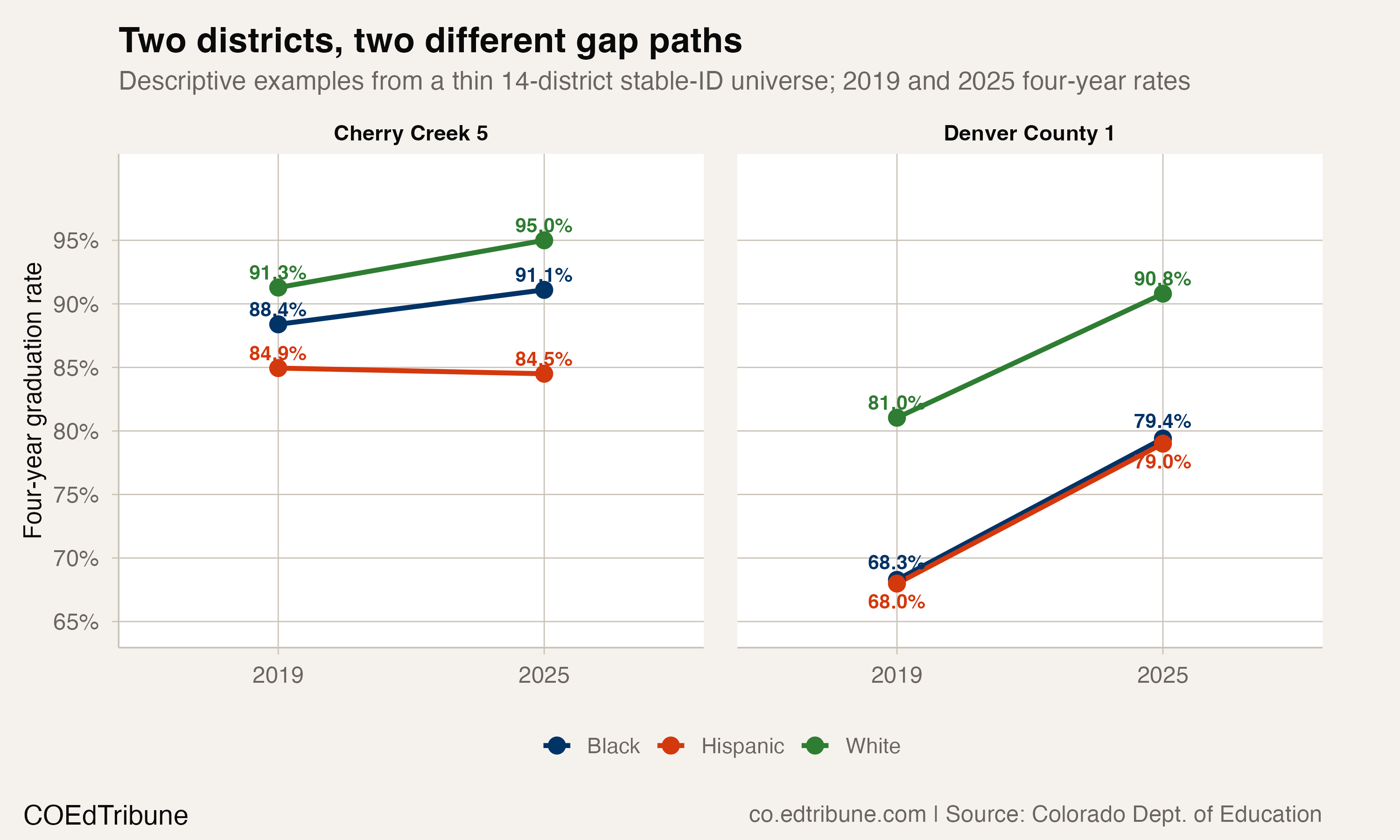
Those district comparisons have a hard reporting limit. Valid district rows for Black students fell from 71 in 2019 to 14 in 2025. Hispanic coverage fell from 169 districts to 51, and White coverage fell from 183 to 54. Only 14 stable district IDs had valid rates and positive cohort denominators for all three groups in both endpoint years. The two examples describe local paths; they cannot support a claim about how common either path was statewide.
The next question belongs below the statewide line
Direct evidence: Colorado's graduation guidance defines the published cohort measure around regular diplomas earned within an anticipated graduation cohort. The denominator begins when students enter high school, then accounts for transfers in and verified transfers out. It does not identify which course, school practice or student support changed an outcome.
That limit matters at a budget table. A statewide gap can prompt scrutiny, but it cannot tell a board whether the next dollar belongs in counseling, credit recovery, transportation, graduation coaching or another support. Leaders need school-, course- and program-level evidence before moving money on the assumption that one intervention produced the statewide pattern.
The immediate decision is more specific than whether Colorado improved. It did. The unresolved question for Denver, Cherry Creek and every district with usable local data is which students are still missing an on-time diploma, where they lost ground, and which funded support can be tested against that record.
Detailed code that reproduces the analysis and figures in this article is available exclusively to EdTribune subscribers.
Discussion
Sign in to join the discussion.
Loading comments...