Correction (Aug. 20, 2026): An earlier version omitted the state rows for English learners and students receiving free or reduced-price lunch from the subgroup comparison. The corrected comparison and chart include every valid state subgroup. Foster care still has the widest gap under the stated rule.
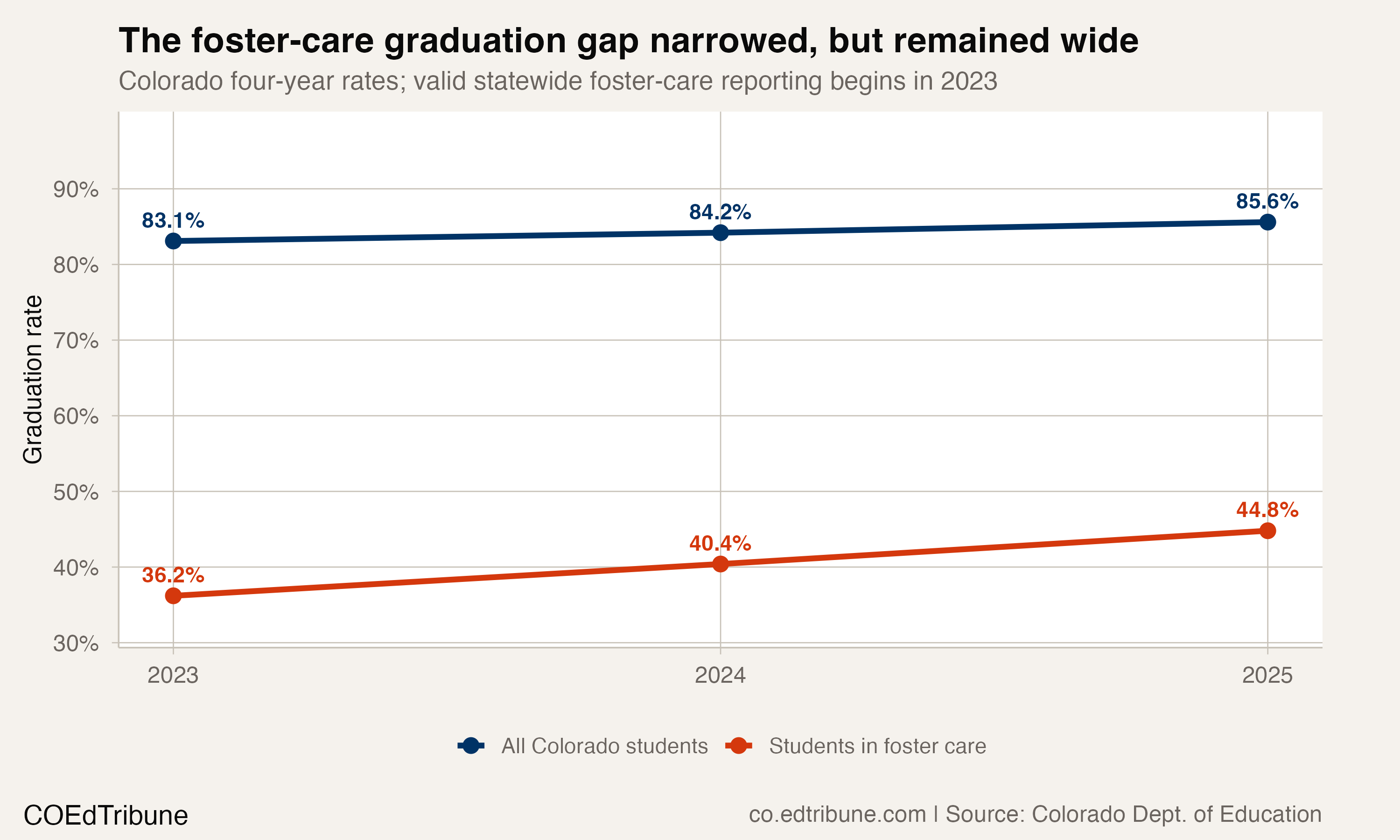
Colorado's four-year graduation rate for students in foster care rose from 36.2% in 2023 to 44.8% in 2025. The 8.6-point gain narrowed the gap with the statewide rate by 6.1 points, but a 40.8-point difference remained.
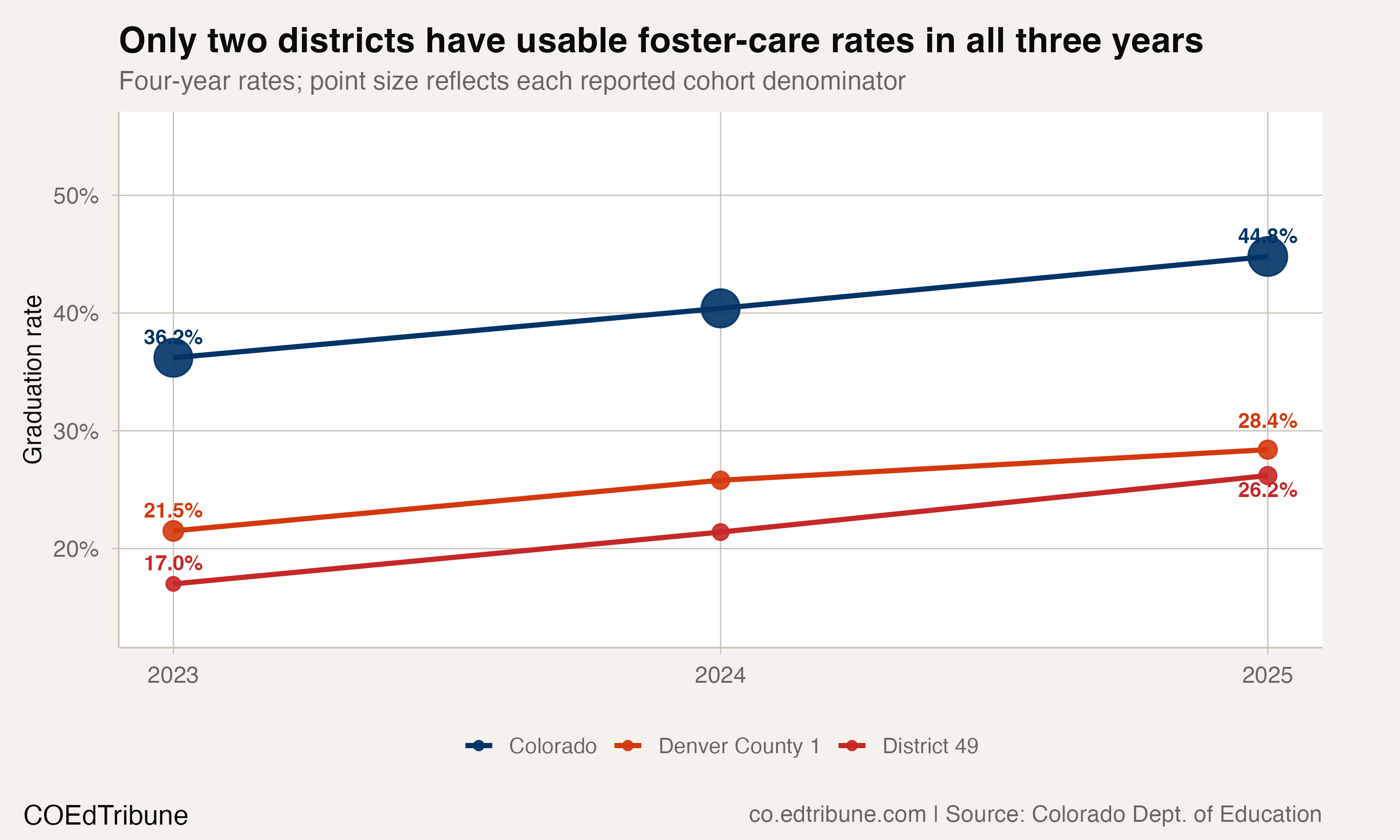
The local data are much thinner. Denver County 1↗ET and District 49↗ET were the only districts with a valid foster-care rate and positive cohort denominator in each of those three years. Denver's rate rose from 21.5% to 28.4%; District 49's increased from 17.0% to 26.2%. Two districts cannot stand in for the state.
The 2025 statewide foster-care cohort included 509 students. The all-student cohort included 70,554. The foster-care group sits within the statewide cohort; the two denominators are not separate populations.
A gain inside a three-year window
The valid statewide foster-care series starts in 2023, not 2025. It contains three rates: 36.2%, 40.4% and 44.8%. That is two consecutive annual gains, with the latest year adding 4.4 points.
The gap with Colorado's overall rate moved in the same direction. It narrowed from 46.9 points in 2023 to 43.8 points in 2024 and 40.8 points in 2025. The foster-care cohort grew from 478 students to 509 during that span.
Three years establish the observed rise, not a long-term trajectory. The data do not support calling 2023 the first year Colorado ever measured the group, only the first year with a valid statewide foster-care row in the seven-year package window. The source does not provide graduate counts for those three state rows, so the analysis does not convert the rates into diploma counts.
The widest gap in a defined comparison
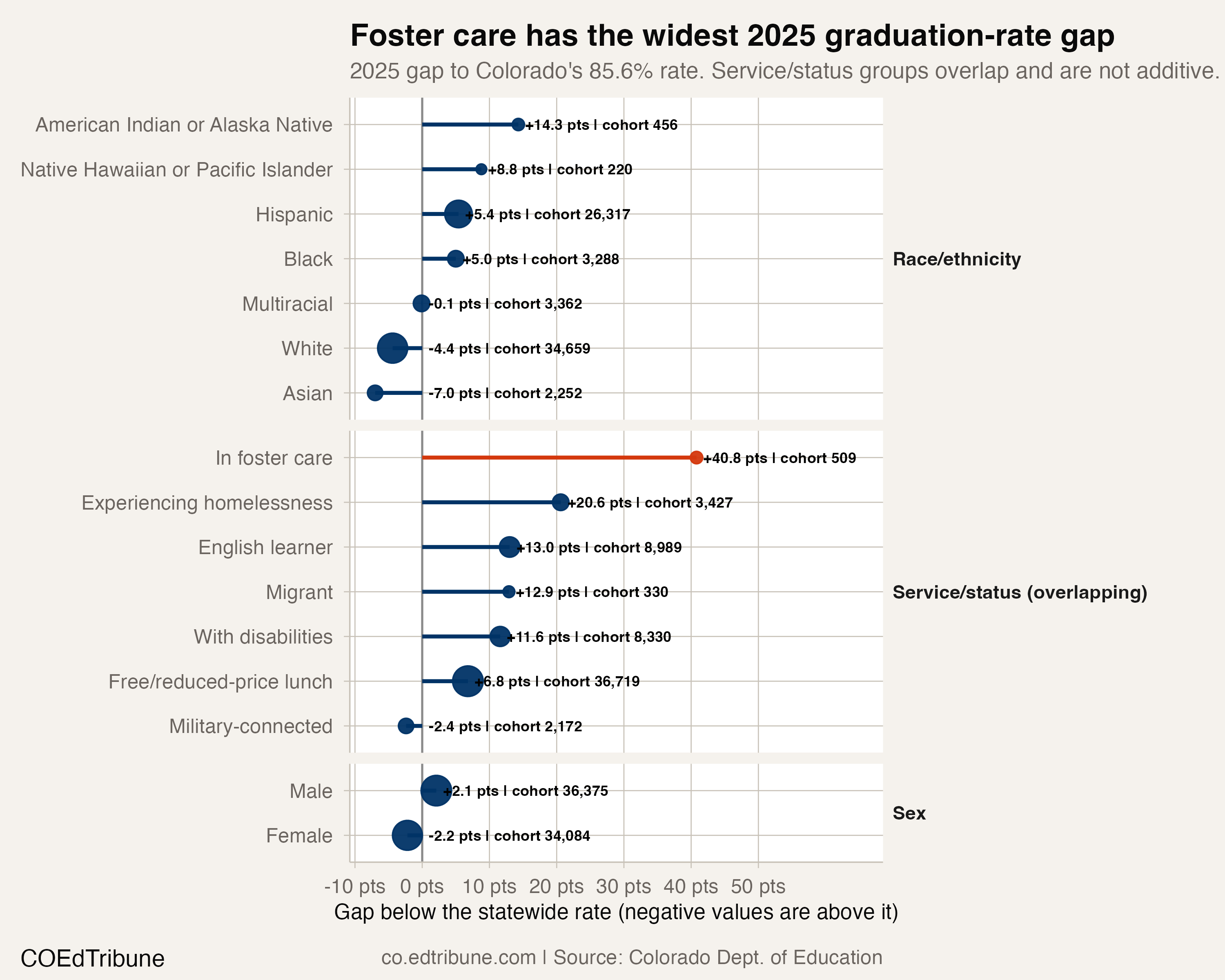
Students in foster care had the widest 2025 gap with Colorado's overall rate among 16 valid state-level subgroup rows. The comparison includes every reported subgroup other than all students that had both a nonmissing rate and positive cohort denominator. No subgroup was excluded from that rule.
The categories do not form one population breakdown. Colorado reports race and ethnicity separately from service or status groups; foster-care status and the other service groups can overlap with race, sex and one another, according to the state's graduation data documentation. The chart separates those category families, and their cohort counts should not be added together.
The 509-student foster-care denominator is larger than the 478-student denominator in 2023, but it is small beside the statewide cohort. That makes the exact denominator important whenever the rate changes. Different annual cohorts, identification practices and verified transfers are competing explanations for year-to-year changes. The graduation data cannot separate those possibilities.
School stability is the operating question
Colorado's measure assigns students an anticipated year of graduation and counts regular diplomas earned within four years. The adjusted cohort adds transfers in and removes verified transfers out, according to the state's graduation methodology. It is not a measure of every route to high school completion.
The policy work around that measure centers on continuity. The Colorado Department of Education says students in foster care have the right to remain in their school of origin when placements change, or to enroll immediately when a move is in their best interest. The department also assigns every district a Child Welfare Education Liaison to coordinate school transfers and school-of-origin transportation with county agencies, according to its Foster Care Education overview.
Direct evidence supports those responsibilities, not a causal explanation for the 8.6-point gain. The graduation series does not show whether transportation agreements, liaison staffing, counseling or another support changed during the period. It also cannot show how consistently districts carried out those duties.
That leaves a concrete budget and management test. District leaders can ask whether the liaison role has enough protected staff time, whether transportation agreements survive placement changes and whether a transfer reaches counselors before credits are lost. Colorado's rate for students in foster care is moving upward. The unresolved decision is whether districts will fund the continuity work needed at the moment a student's school placement is at risk.
Graduation rates and cohort counts come from the Colorado Department of Education's official graduation and completion statistics for anticipated graduation years 2019 through 2025. The analysis uses four-year rates for the state, districts and student groups; it does not use dropout rates or national comparisons.
Detailed code that reproduces the analysis and figures in this article is available exclusively to EdTribune subscribers.
Discussion
Sign in to join the discussion.
Loading comments...