This article is part of EdTribune's series on Colorado districts that are beating chronic absenteeism.
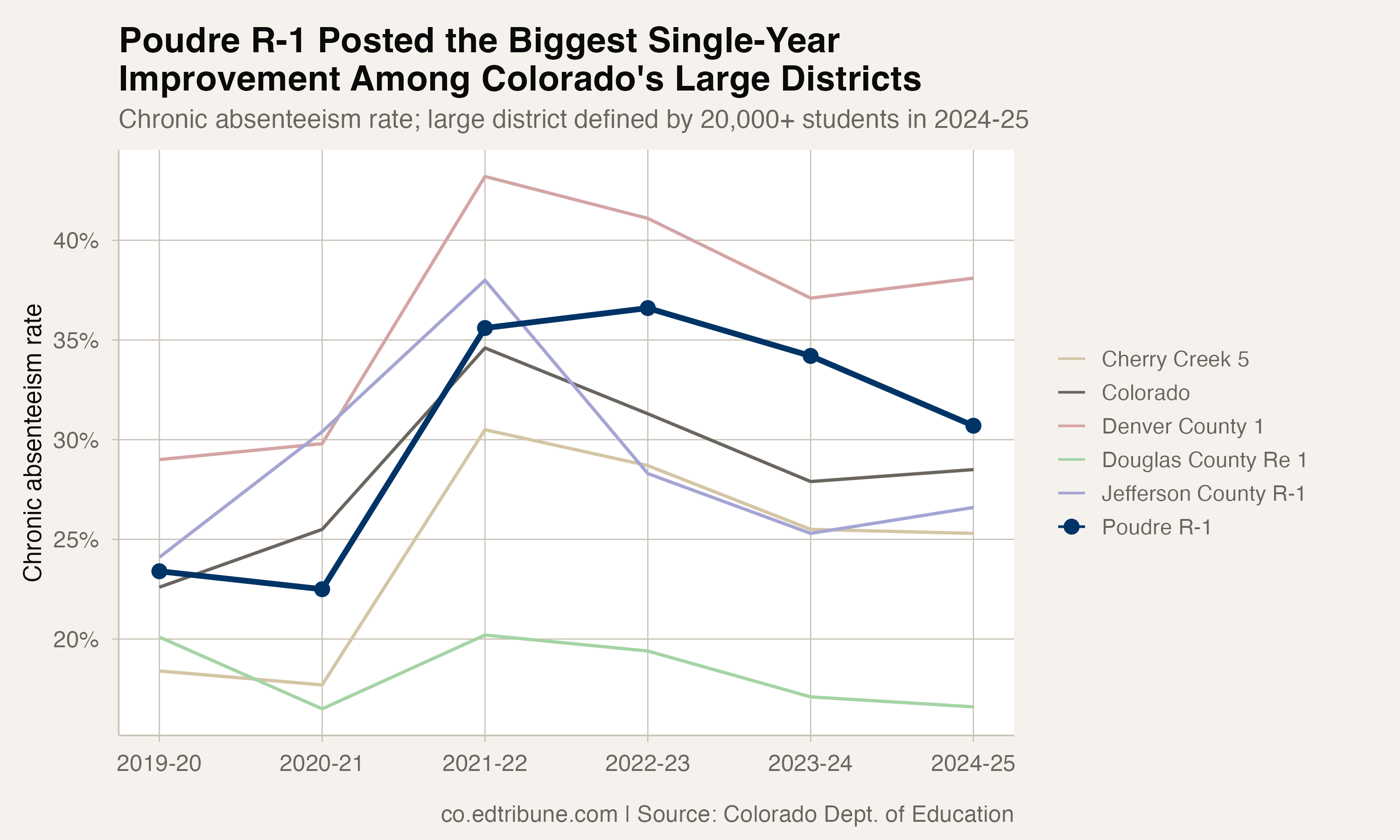
Colorado's chronic absenteeism rate reversed course in 2024-25, climbing from 27.9% to 28.5%. Nine of the state's 15 districts enrolling at least 20,000 students also worsened. Colorado Springs D11↗ET rose 16.6 percentage points, Jefferson County↗ET rose 1.3 points, and Denver↗ET rose 1.0 point.
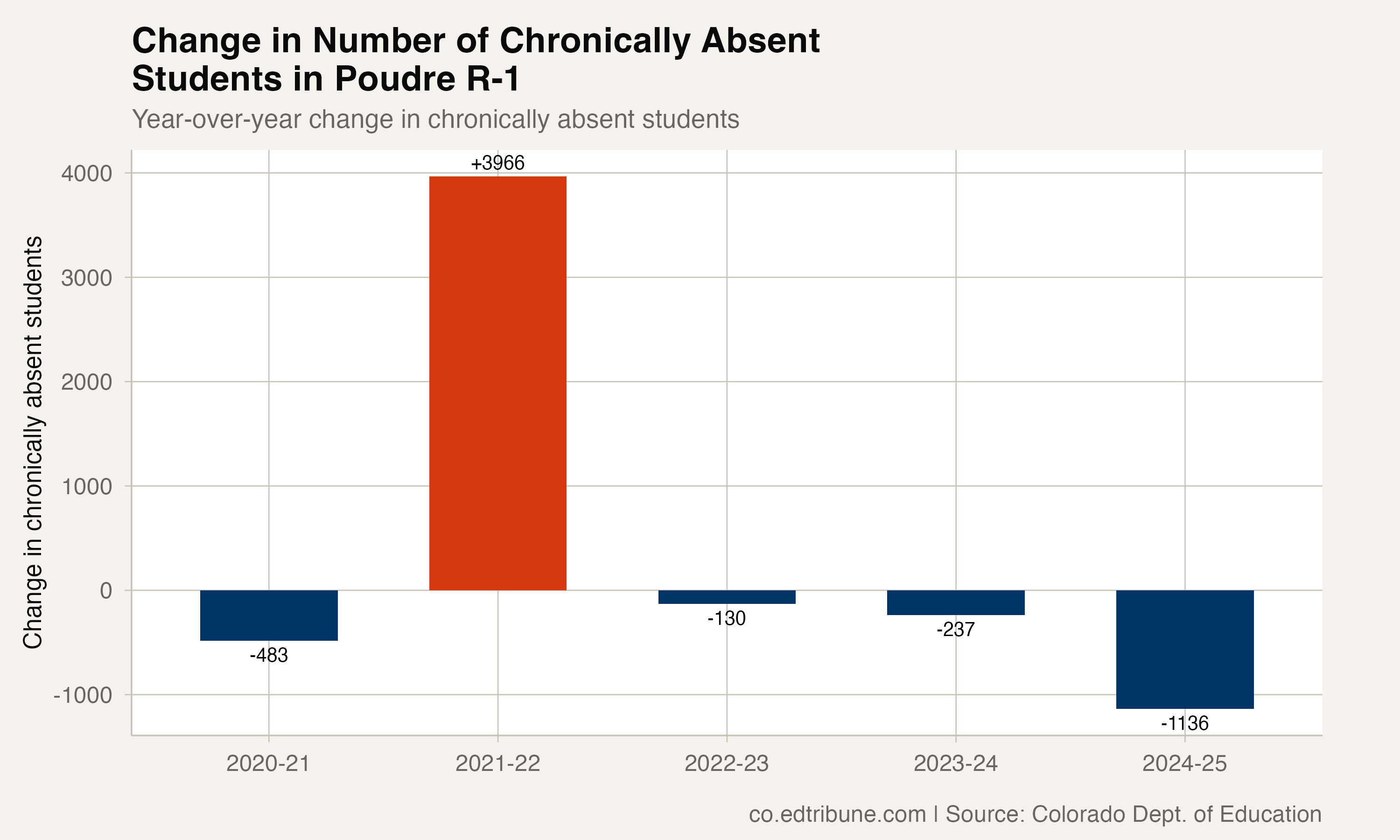
Poudre R-1↗ET went the other direction. The Fort Collins district, Colorado's eighth-largest with 29,461 students in 2024-25, dropped from 34.2% to 30.7%. That 3.5-point improvement meant 1,136 fewer students were chronically absent than a year earlier. No other district in the 20,000-plus group improved by more than 1.2 points.
Two years of worsening, then a reversal
Poudre's recent history puts the 2024-25 result in context. The district worsened by 1.0 point in 2022-23, reaching 36.6%, its highest rate in the six-year state dataset. That was 5.3 points above the Colorado rate. In 2019-20, the gap had been 0.8 point.
The trajectory then shifted. Poudre's rate fell 2.4 points in 2023-24 and another 3.5 points in 2024-25. Across those two years, the district's rate dropped 5.9 points and its count of chronically absent students fell by 1,373.
A mentoring pilot is context, not proof of cause
Poudre had begun testing one attendance intervention before the two-year decline. In January 2024, KUNC reported that Poudre High School was piloting Check & Connect, pairing chronically absent students with mentors. The University of Minnesota describes Check & Connect as a structured mentoring intervention in which mentors monitor engagement, meet with students and use personalized interventions.
Suggestive context: The pilot makes mentoring one plausible part of Poudre's attendance work. It does not establish that Check & Connect caused the district-wide decline. KUNC's participant figure predates the 2024-25 district result, and the state dataset contains no program-participation field or comparison group that could isolate the pilot's effect.
The equity gap remains wide
All six student subgroups examined here improved in 2024-25, but their rates remained far apart.
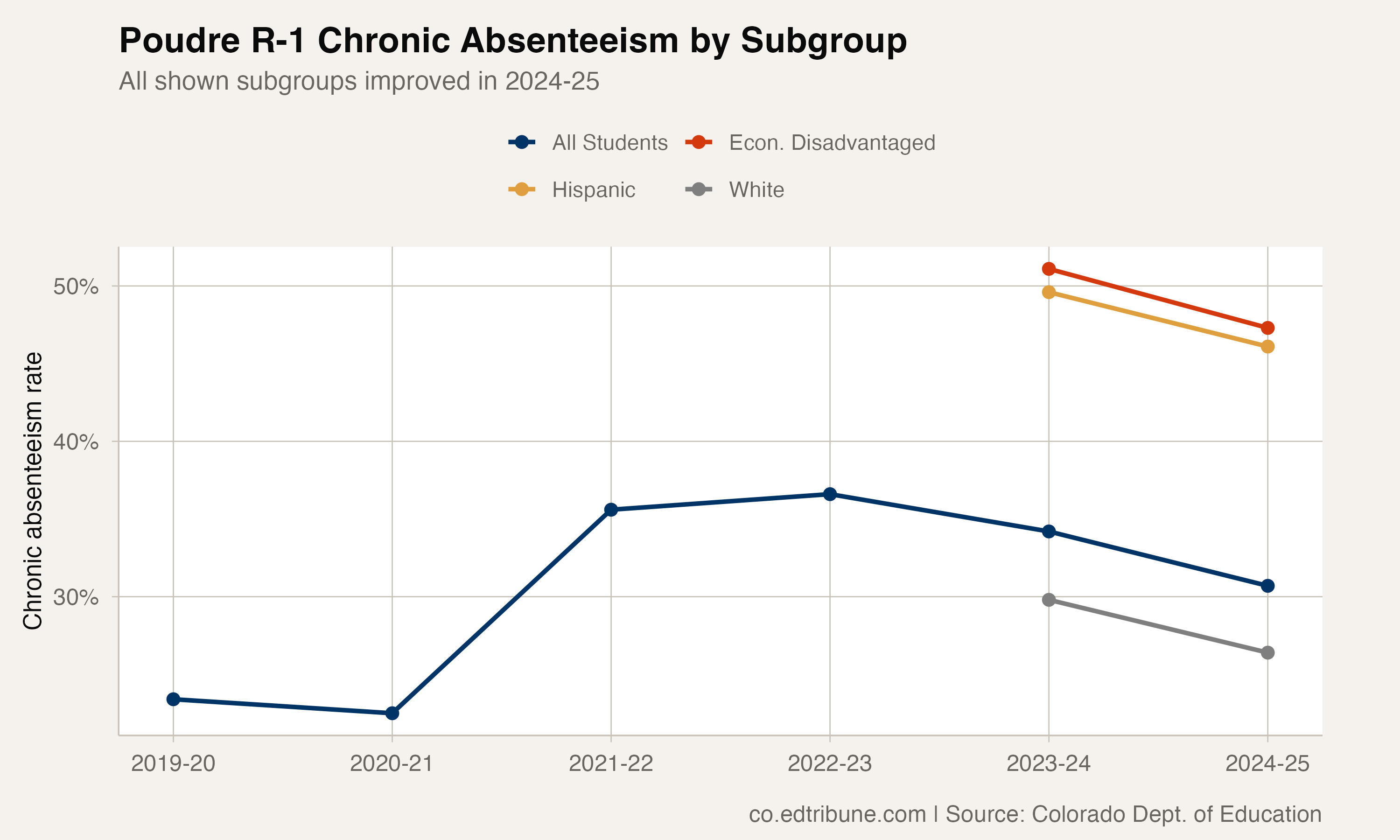
White students had a 26.4% chronic absenteeism rate in 2024-25. The Hispanic student rate was 46.1%, a 19.7-point gap. Students experiencing homelessness had a 61.5% rate, meaning more than three in five were chronically absent.
Economically disadvantaged students improved from 51.1% to 47.3%, still close to half. Students with limited English proficiency had a 41.7% rate, while students receiving special education services had a 42.1% rate.
The district-wide 3.5-point improvement therefore describes a broad change, not an equal outcome. The rate for Hispanic students remained nearly 20 points above the white student rate, and the rate for students experiencing homelessness remained more than double Poudre's overall rate.
Still above the state average
Poudre remained 2.2 points above Colorado's 28.5% rate in 2024-25. Its gap narrowed sharply from 6.3 points a year earlier but did not close.
Grade-level results show where attendance problems were most concentrated. Rates in grades 1 through 5 ranged from 17.6% to 18.9%. The rate reached 31.0% in seventh grade and 56.2% in 12th grade.
Those figures identify a secondary-school challenge, but they do not identify its cause or show which grades, if any, were served by the mentoring pilot.
What the large-district comparison reveals
Among the 15 Colorado districts enrolling at least 20,000 students in 2024-25, six improved from the prior year and nine worsened. Douglas County↗ET reached 16.6% after a third consecutive annual decline. Adams-Arapahoe 28J↗ET also recorded a third consecutive decline, reaching 38.9%.
Poudre's 3.5-point drop was the largest in that stable large-district group. The next-largest improvement was Adams-Arapahoe's 1.2-point decline, making Poudre's change 2.9 times as large.
The comparison establishes that Poudre was an outlier among its large-district peers. It does not distinguish among mentoring, other district actions, changes in the students enrolled or ordinary year-to-year variation. The Check & Connect pilot is a useful question for follow-up, not a causal conclusion from the attendance data.
Chronic absenteeism rates and counts come from the Colorado Department of Education's official chronic absenteeism reports, covering the 2019-20 through 2024-25 school years.
Detailed code that reproduces the analysis and figures in this article is available exclusively to EdTribune subscribers.
Discussion
Sign in to join the discussion.
Loading comments...