Correction (July 21, 2026): The original article treated summed district counts as though they were the separately counted statewide total, said four districts had overwhelmed every improving district without defining the comparison, and published a blank concentration chart caused by a missing-value error. Its 55.3% figure is the top 10's share of the summed counts in 177 matched district rows with reported counts—not a share calculated from the statewide row. This version repairs the chart, labels each denominator, adds a D11 sensitivity check and removes unsupported policy and causal conclusions.
Chronic absenteeism rates fell in 102 of 178 matched Colorado district-level rows from 2023-24 to 2024-25. Rates rose in 75 rows and were unchanged in one. The median change was a decline of 0.6 percentage point.
Over the same period, Colorado's separately reported statewide rate rose from 27.9% to 28.5%. The statewide count increased by 4,005 students.
Those results can coexist because a statewide rate weights students, not districts. They also require a counting qualification: CDE says state, district and school levels use distinct counts, so summing district rows does not necessarily reproduce the state row. That warning appears on the Colorado Department of Education's attendance statistics page.
Most District-Level Rates Fell
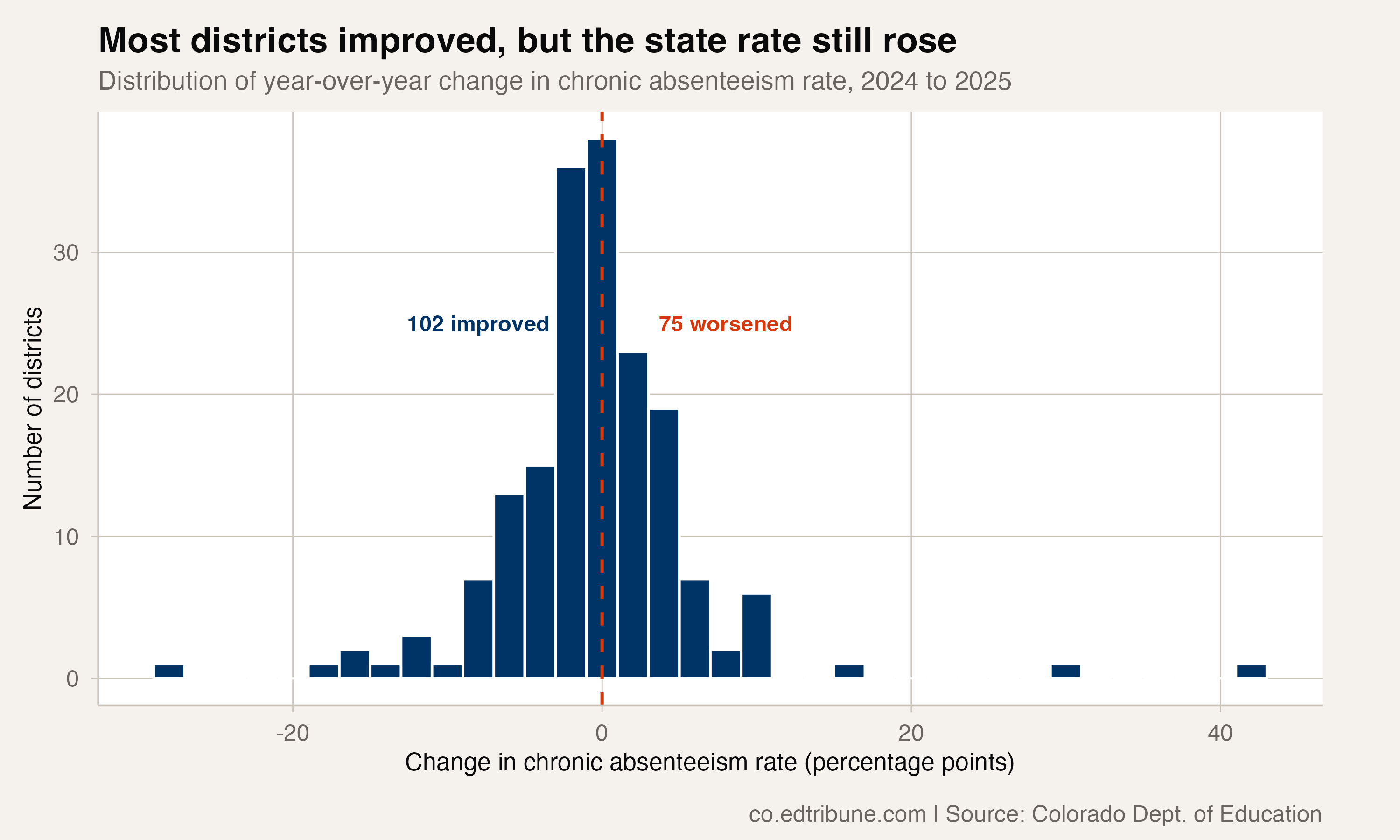
The distribution was tilted toward improvement, but the size of the changes varied. Colorado Springs 11↗ET rose from 29.2% to 45.8%, a 16.6-point increase. Its reported chronically absent count increased by 3,955.
School District 27J↗ET added 964 chronically absent students in its district rows. Denver County 1↗ET added 857, and Jefferson County R-1↗ET added 688. Together, the four district-row changes totaled 6,464.
Across the 102 rows with lower rates, chronically absent counts changed by a net -5,929. Across the 75 rows with higher rates, the net change was +10,136. These are sums of matched district rows, not a decomposition of the CDE state total.
D11 Was Important, but Not the Only Source of the Increase
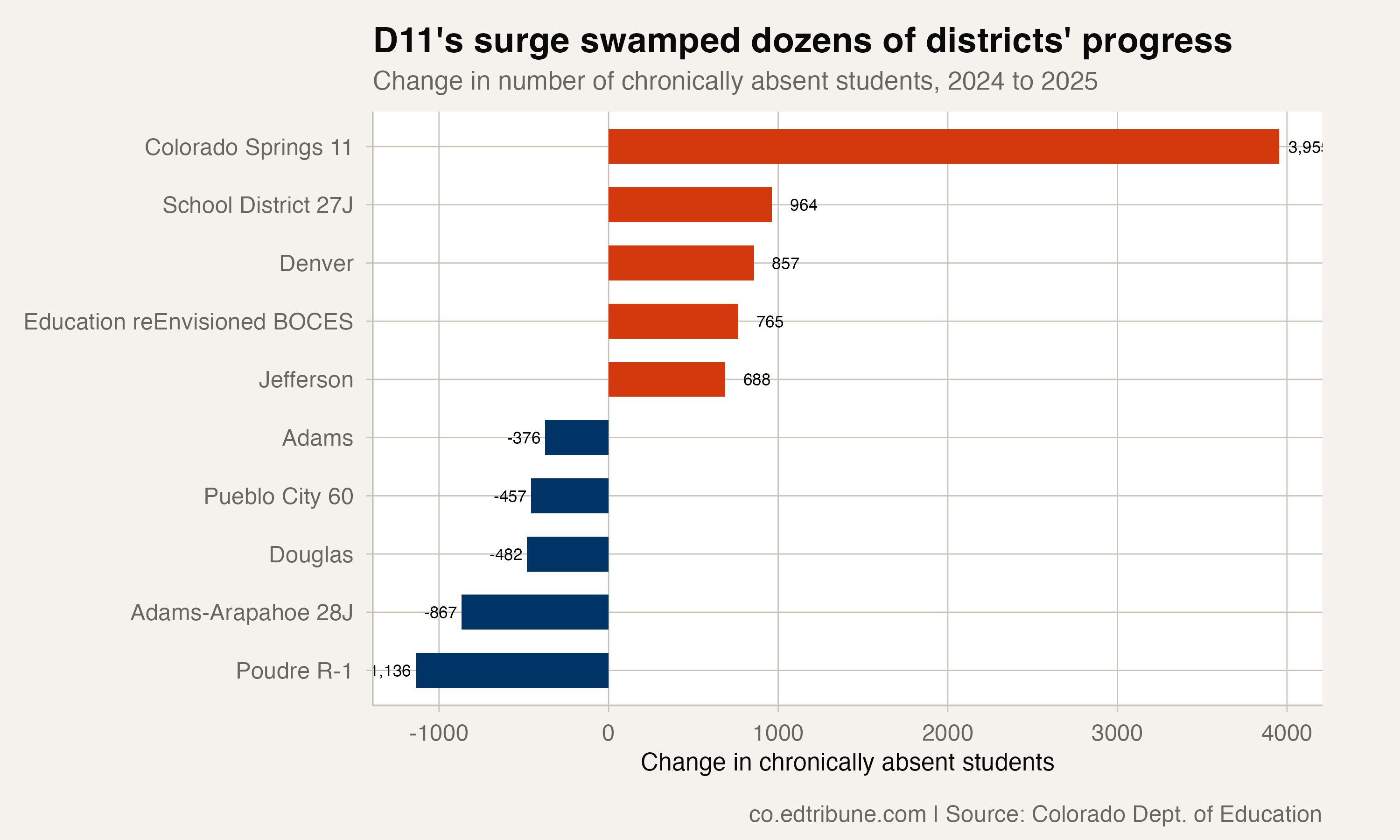
D11's count increase of 3,955 was close to the statewide count increase of 4,005, but that comparison does not show that D11 singlehandedly caused the statewide rate to rise. The state and district levels are distinctly counted, and other districts moved in both directions.
A sensitivity calculation reinforces that limit. Subtracting D11's counts from the statewide numerator and denominator produces a constructed rate of 27.8% in 2023-24 and 28.1% in 2024-25. Even without D11 in that calculation, the rate rises.
The constructed figures are not official CDE rates. They are an arithmetic check showing why the original single-district explanation was too strong.
Concentration Among Reported District Rows
Among 177 matched district rows with a reported 2024-25 chronically absent count, the top 10 represented 55.3% of the summed district-row count. The cumulative share crossed 50% at the ninth row.
That is evidence of concentration within the district-level table. It is not a claim that those districts account for exactly 55.3% of the separately counted statewide total.
Where Rates Fell
Manitou Springs 14↗ET posted a 7.3-point decline on an enrollment of 1,154. Its chronically absent count fell by 104, compared with Denver's increase of 857.
Poudre R-1↗ET declined 3.5 points on an enrollment of 29,461. Adams County 14↗ET declined 5.0 points on 5,483 students. Summit RE-1 fell 6.4 points, and Montezuma-Cortez RE-1 fell 5.6.
Those are meaningful changes in their reported district rows. The file does not identify which program, health condition, transportation pattern, reporting practice or other mechanism produced them.
What the Data Support
Colorado defines a chronically absent student as one absent for at least 10% of the days enrolled during the school year, according to its attendance policy definitions.
The supported finding is descriptive: most matched district-level rates fell, while a smaller number of higher-rate rows posted enough count growth that the sum of matched district counts increased. The official statewide rate also rose, but its distinct-count methodology prevents treating the district sum as an exact state-level decomposition.
Detailed code that reproduces the analysis and figures in this article is available exclusively to EdTribune subscribers.
Discussion
Sign in to join the discussion.
Loading comments...