At Goldrick Elementary in Denver Public Schools↗ET, the CMAS math line moved fast enough to make the school a Denver standout.
Goldrick's math proficiency rose from 6.6% in 2022 to 29.8% in 2025. Colorado's statewide math rate rose from 31.5% to 35.9% over the same period. That means Goldrick improved 18.8 points faster than the state and ranked first among screened Denver elementary schools for math improvement.
Standout stat: Goldrick's schoolwide math proficiency rose 23.2 points from 2022 to 2025, the largest gain in the Denver elementary screen.
Taryn Rawson is Goldrick's principal. Her school now sits at the top of Denver's elementary math-improvement list, even with 2025 proficiency still below the state average. The signal is the speed: Goldrick moved from a low starting point to Denver's largest screened math gain.
The rebound was real
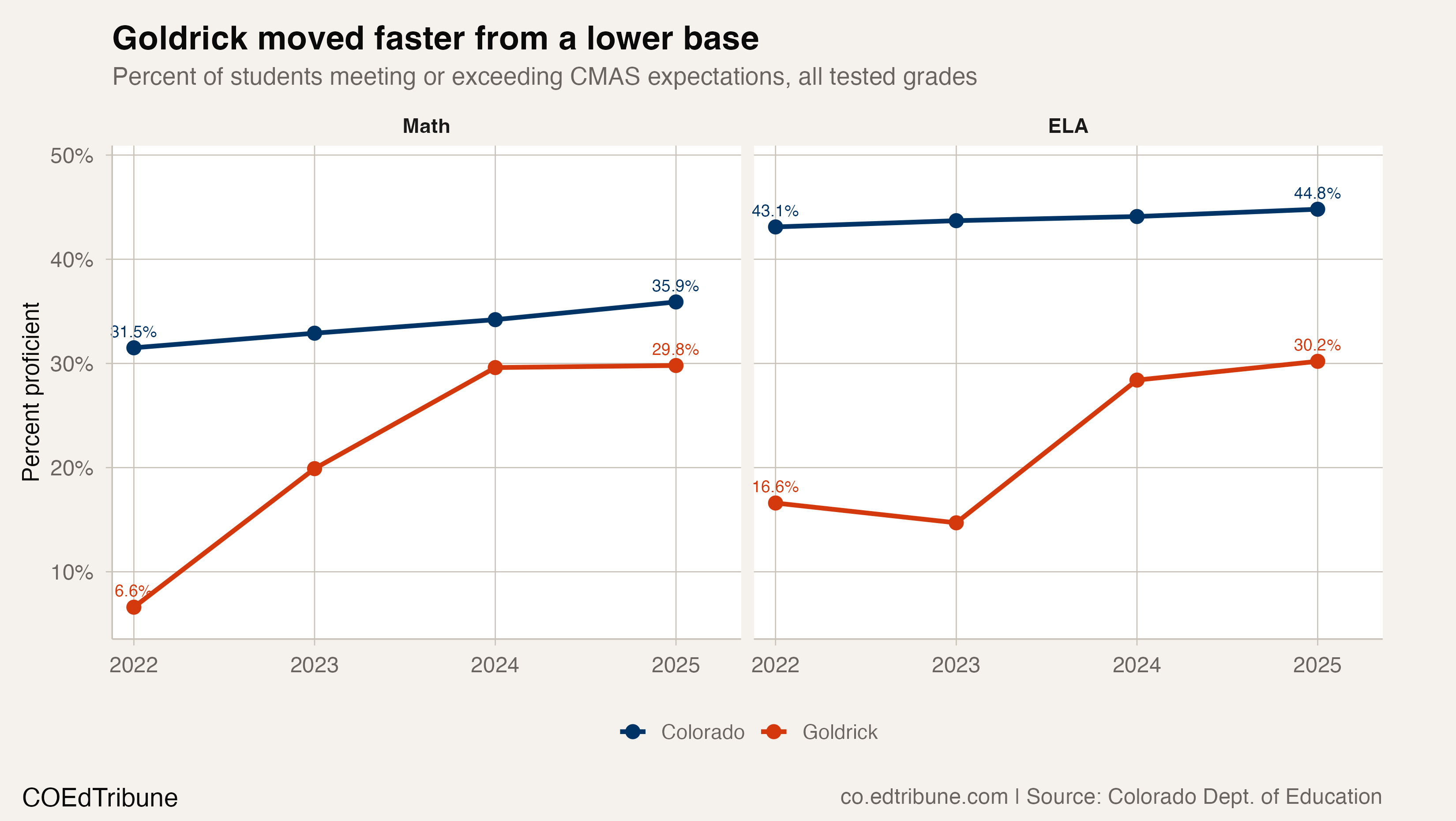
Math is the cleanest signal. Goldrick started from 6.6% proficient in 2022, then climbed to 19.9% in 2023, 29.6% in 2024 and 29.8% in 2025. Colorado's statewide math recovery was steadier and much smaller, rising 4.4 points from 2022 to 2025.
Goldrick's ELA pattern was also positive, but less clean. ELA rose from 16.6% in 2022 to 30.2% in 2025, a 13.6-point gain. Colorado's ELA rate moved from 43.1% to 44.8%, a 1.7-point gain. Most of Goldrick's ELA improvement came in 2024, followed by a smaller 2025 increase.
CMAS is Colorado's standards-based state assessment, and CDE describes the results as one measure of academic progress against state standards. Goldrick's 2022-to-2025 record gives the school a clear improvement profile, especially in math.
The schoolwide Goldrick figures here use CDE's all-tested-grade school rows for CMAS ELA and math, the same level used for the Denver and Colorado comparisons. Small grade-level cells can have suppressed performance-level distributions, while the schoolwide row remains reportable.
What changed at Goldrick
Principal Taryn Rawson traces the math gain to a deliberate shift toward explicit, evidence-based instruction, mirroring what the school had already done in literacy.
Rawson attributed the math gain in a written response to The COEdTribune to explicit instruction, the Eureka Math Squared curriculum, a schoolwide fluency routine, and daily targeted small-group instruction. She said the students furthest from their goals get the school's most expert math teachers.
Two other pieces mattered, Rawson said: teacher-led professional learning and weekly data review. The school built a Math Leadership Team of strong teachers, sent them to conferences and online trainings, and had them share what they learned with the full staff. "We also look at our math data on a weekly basis, tracking which students are on track to proficiency, and who needs extra help," she said. "Our small groups are fluid, and students move in and out of them as needed."
Rawson is candid that the work is unfinished. She said the school is proud of its progress but still has a long way to go, and that its current proficiency level is nowhere near acceptable.
Denver's spread makes Goldrick stand out
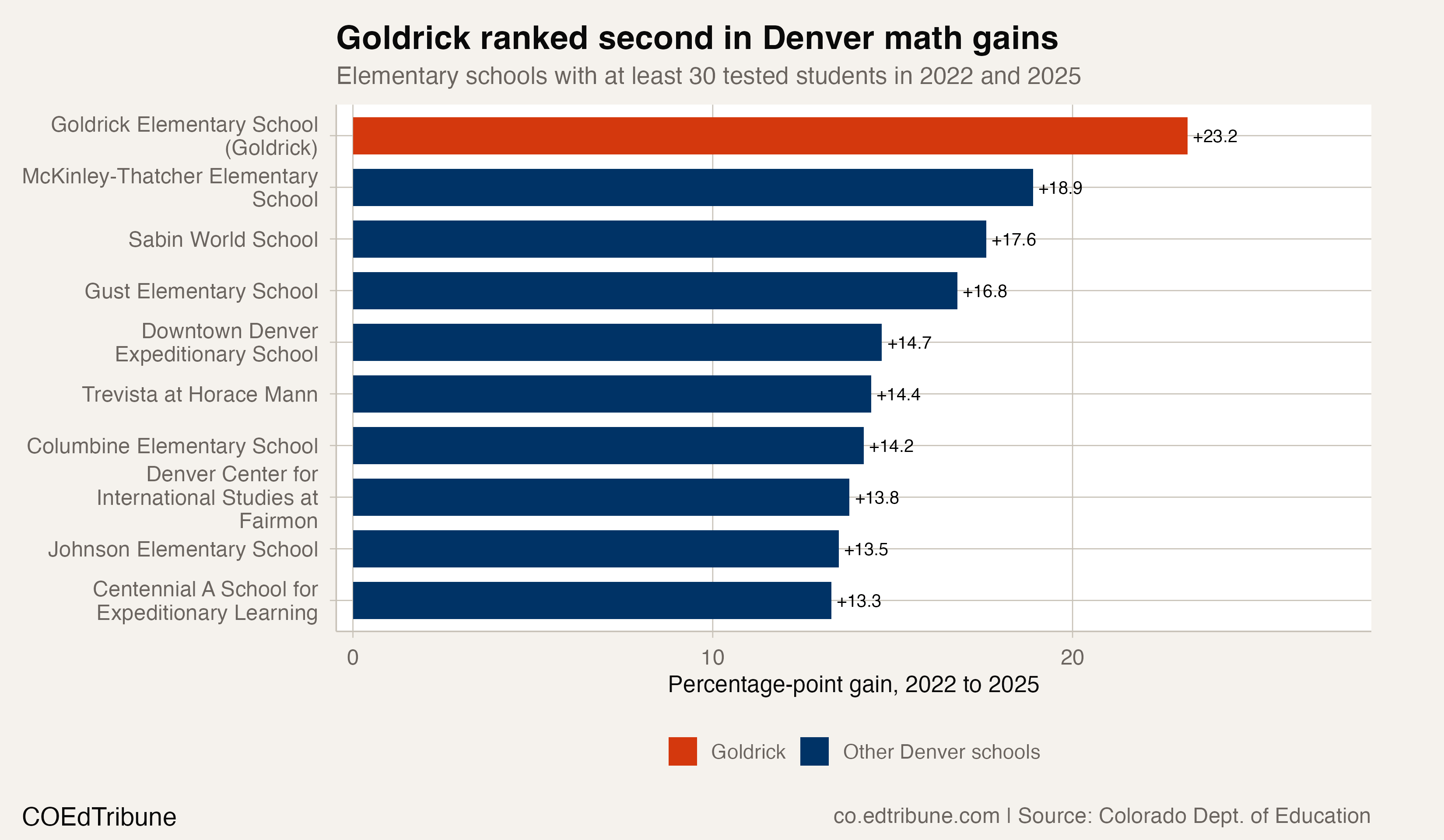
Among Denver elementary schools with at least 30 tested students in both 2022 and 2025, Goldrick ranked first in schoolwide math improvement, posting a 23.2-point gain.
The same schoolwide screen puts Goldrick fifth among 80 Denver elementary schools in ELA improvement. That rank is useful because it keeps the comparison local: same district, same broad grade span, same post-pandemic window.
It also shows why the school-level view matters. Denver's screened elementary schools ranged from a 12.0-point math decline to a 23.2-point math gain. In ELA, the range ran from a 15.4-point decline to an 18.3-point gain. Goldrick sits near the top of a district spread where individual schools moved in sharply different directions.
The next benchmark
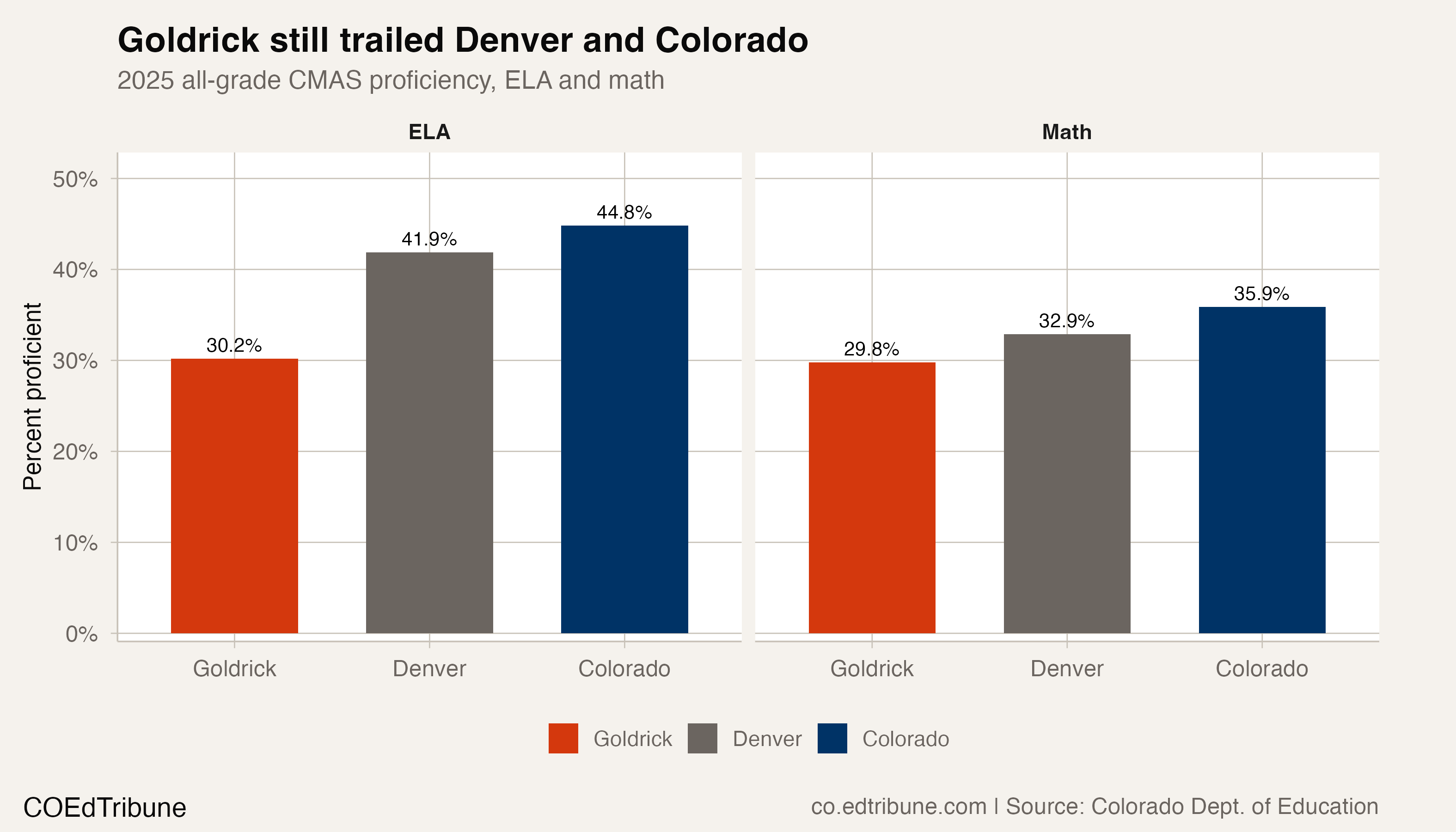
The 2025 standing chart shows the next benchmark. Goldrick's 29.8% math proficiency trailed Denver's 32.9% and Colorado's 35.9%. In ELA, Goldrick's 30.2% trailed Denver's 41.9% and Colorado's 44.8%.
Goldrick's schoolwide CMAS results show rapid improvement from a low base, with room for the school to turn that rebound into sustained performance.
Participation is part of the context. CDE says participation rates should be considered because they affect how representative reported results are likely to be. The data used here screens out tiny tested-count rows for school rankings and describes the tested students in each comparison year.
CBS Colorado has reported on Goldrick celebrating CMAS growth, including staff comments about giving students additional time to master skills. That reporting gives useful school context for a result that already stands out in the CMAS file.
For Goldrick, the 2025 math result is a new baseline. A school can make a large early recovery and still face the harder work of pushing from its current proficiency level toward district and statewide levels. Another year of CMAS data will show whether the climb continues.
Detailed code that reproduces the analysis and figures in this article is available exclusively to EdTribune subscribers.
Discussion
Sign in to join the discussion.
Loading comments...