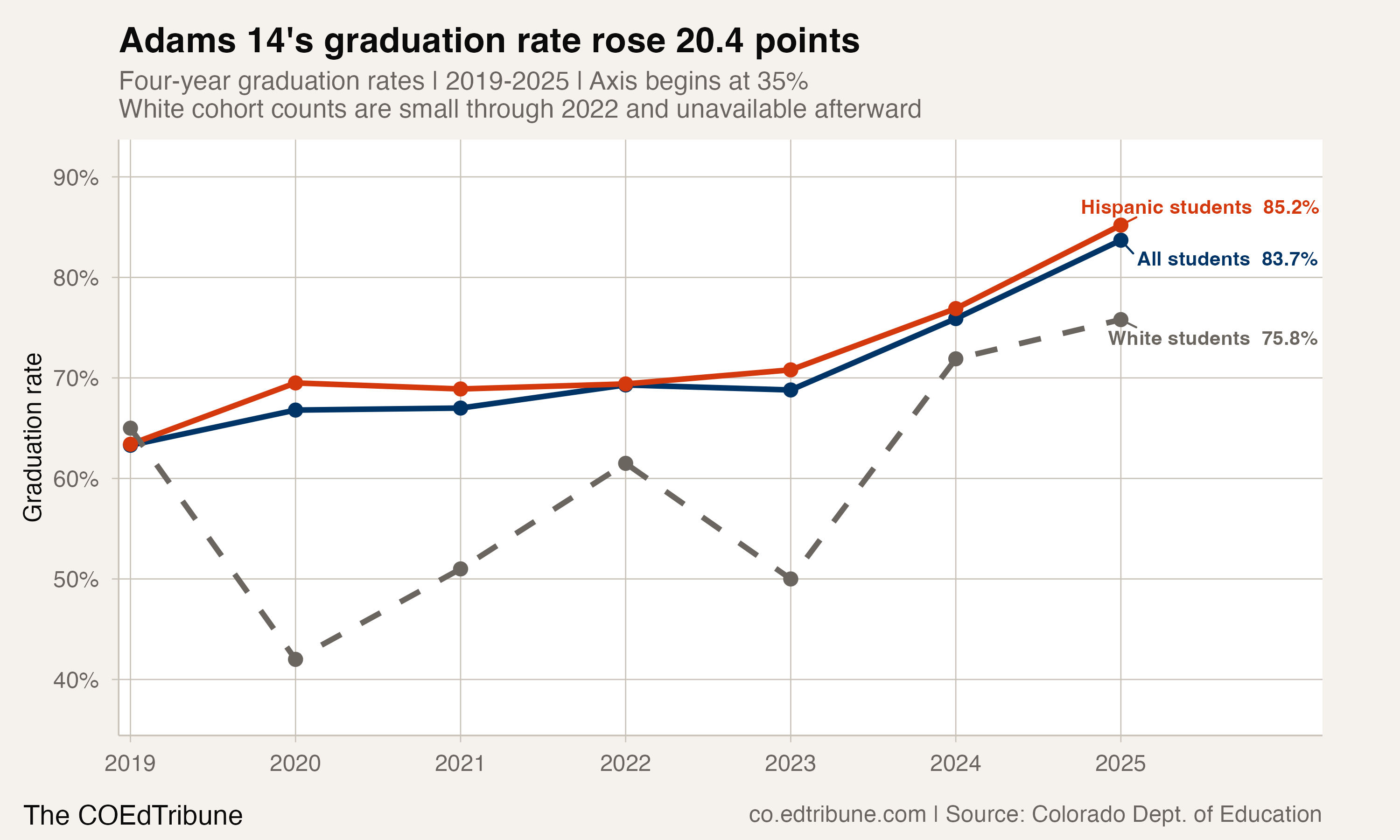
Adams County 14↗ET raised its four-year graduation rate by 20.4 points from 2019 to 2025. The rate for Hispanic students rose 21.8 points over the same span, reaching 85.2%. The most recent published figures describe the class of 2025, from the 2024-2025 school year, two school years ago.
Both 2025 rates were the highest in the complete record of seven graduating classes. The district's all-student rate reached 83.7%, up from 63.3% in 2019. The 2025 Hispanic rate was 5.0 points above the statewide rate for Hispanic students, reversing a 10.6-point deficit at the start of the period.
During that span, Adams County 14's all-student adjusted cohort fell from 550 to 486 students, a decline of 64 students or 11.6%. A changing denominator can affect an aggregate rate, so the trend does not by itself show which district practice moved the result.
Two late gains changed the line
Adams County 14 improved in five of the six annual transitions. Its rate edged down 0.5 points in 2023, then rose 7.1 points in 2024 and 7.8 points in 2025. Those final two gains together produced the 14.9-point increase from 2023 to 2025.
The finding survives other starting points. The district gained 16.9 points from 2020, 16.7 from 2021, 14.4 from 2022 and 7.8 from 2024. The 2019 comparison captures the full available record; it is not a claim that progress began with a particular program or leader.
Adams County 14’s Superintendent Dr. Karla Loría addressed the gains in written answers provided on her behalf by Dr. Nathan Boughton.
Loría said: “Graduation begins long before senior year. We aligned our curriculum, strengthened instructional leadership through 360 learning walks, and improved support for students and teachers. Our academies helped students see where their education could take them. We are seeing the results of work our teachers and leaders have sustained for several years.”
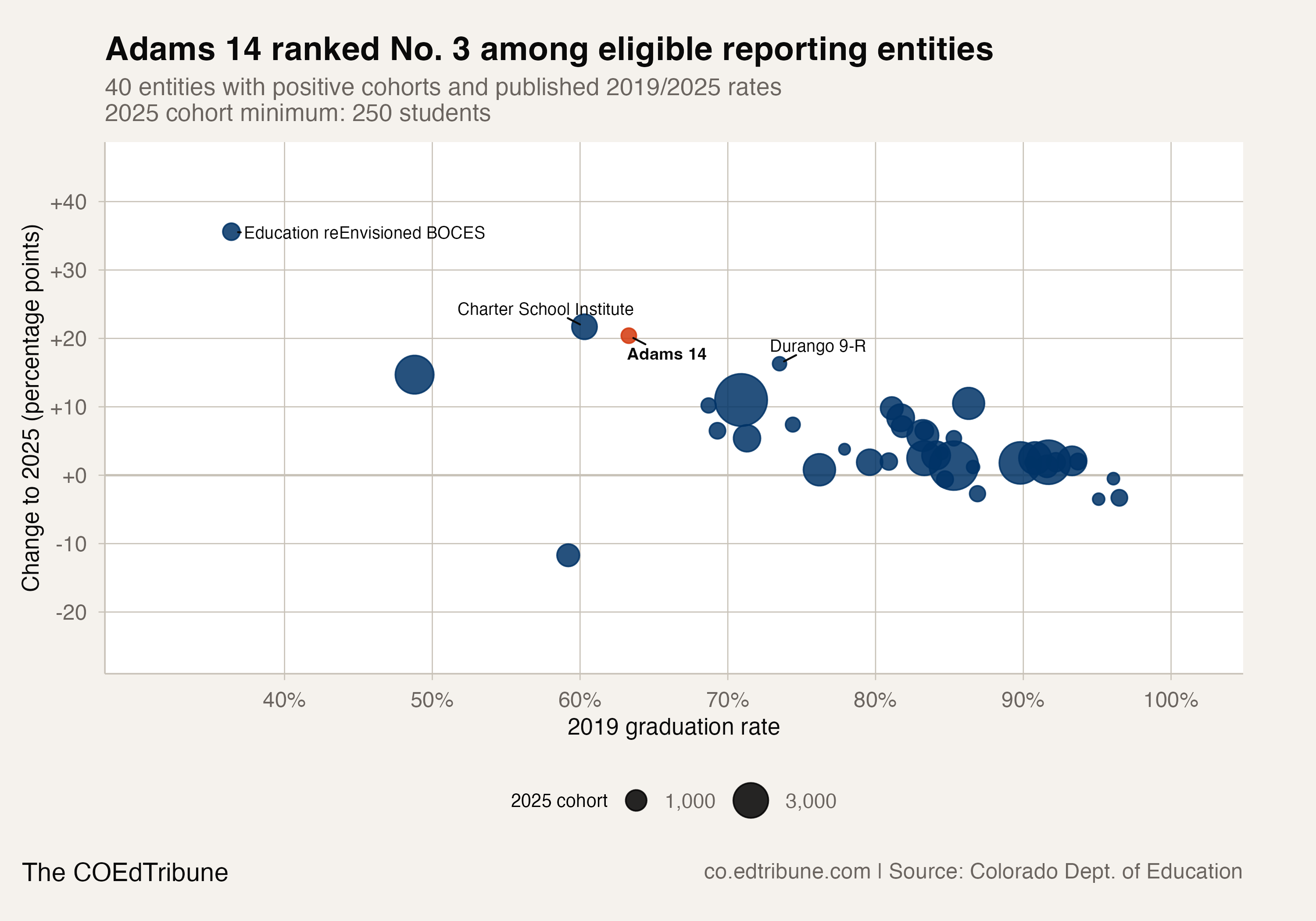
Among 40 district-level reporting entities with published rates and positive cohorts in both 2019 and 2025 and at least 250 students in the 2025 cohort, Adams County 14's gain ranked third.
The cutoff is an editorial comparison tool, not a natural definition of a peer. Without a size cutoff, Adams County 14 ranked fourth among 87 entities with published rates and positive cohorts at both endpoints. At a 100-student cutoff it ranked third among 60. A 500-student cutoff excludes the district because its 2025 cohort had 486 students.
Hispanic students made up most of the cohort
The Hispanic-student rate rose from 63.4% in 2019 to 85.2% in 2025, a 21.8-point gain. Colorado's statewide Hispanic rate rose 6.2 points over the same period. Adams County 14 moved from 10.6 points below the statewide Hispanic rate to 5.0 points above it.
Loría said: “The class of 2025 gives Commerce City something to celebrate. Our Hispanic students graduated five percentage points above the statewide Hispanic rate. Behind those numbers are students’ determination, families’ commitment, and educators who kept believing in them. They are showing the students coming behind them what is possible.”
The Hispanic cohort was large relative to the district total in every year. It declined by 25 students, from 465 to 440, while its share of the all-student cohort increased from 84.5% to 90.5%. Race and ethnicity groups are mutually exclusive in these records; the all-student row contains those groups and is not an additional category to sum.
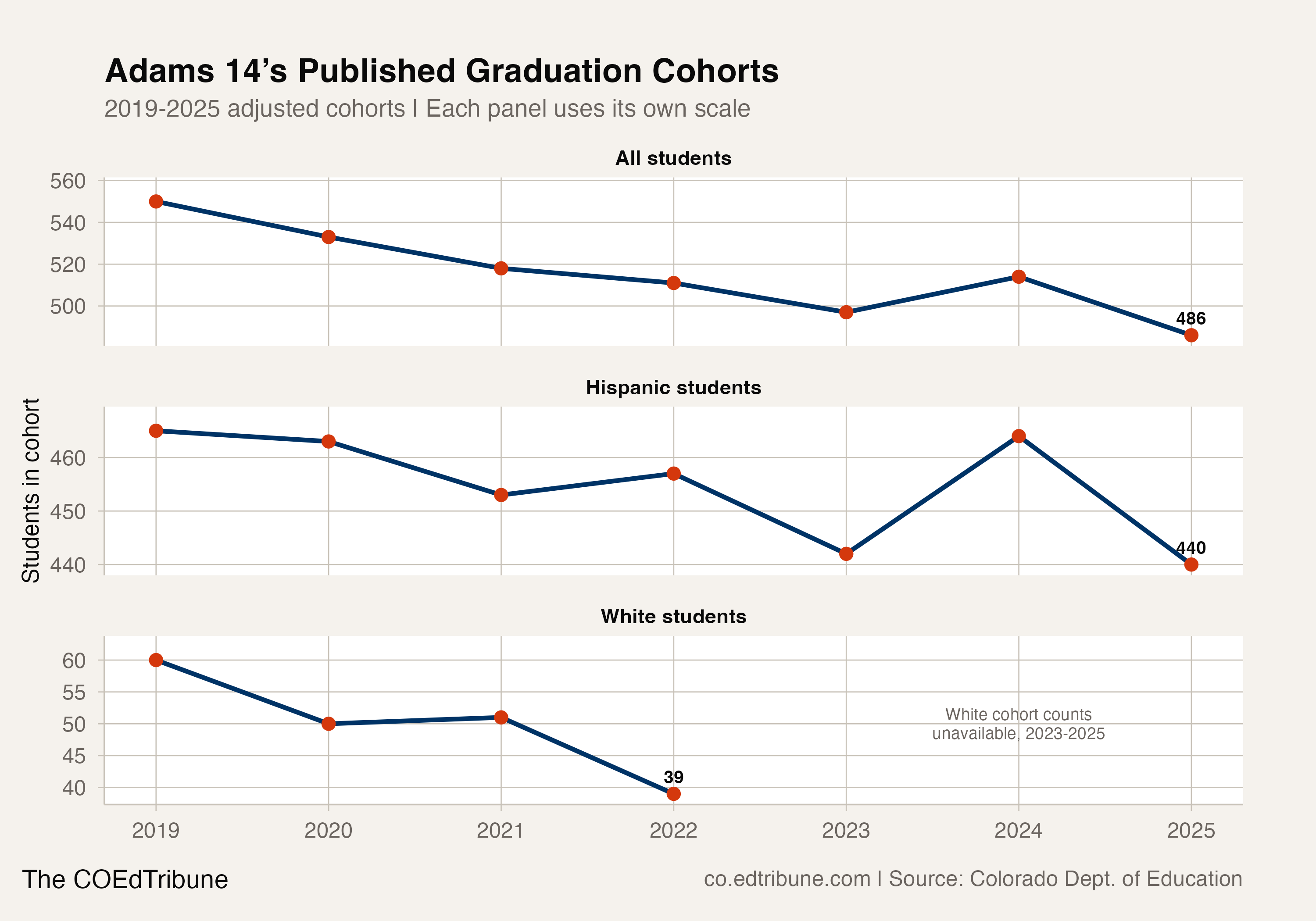
The published rate for Hispanic students exceeded the white rate in each year from 2020 through 2025. In the 2025 class, the rates were 85.2% and 75.8%, a 9.4-point difference. That comparison deserves restraint. The available white cohorts contained 39 to 60 students through 2022, meaning one student represented roughly 1.7 to 2.6 percentage points. White cohort counts are unavailable from 2023 through 2025, so the 2025 small-base sensitivity cannot be calculated from the public file.
The pattern also appeared elsewhere. Among 76 district-level entities with valid all-student cohorts and published Hispanic and white rates in 2025, 24 had a higher Hispanic rate. The comparison describes published rates, not student experiences or the effect of any program.
The next question is durability
Colorado assigns students an anticipated year of graduation when they enter a public high school, then groups students with the same year into a cohort, according to the state's graduation definitions. The cohort provides the denominator for the four-year rate; a student's anticipated graduation year remains fixed even if the student takes longer to finish.
Asked how much of the rate change reflected student movement, Loría said the district would need a closer look at cohort records.
She said: “Every graduating class is different, and student movement is part of that picture. Understanding its contribution would require looking more closely at the cohort records. We want this progress to continue, class after class, with every student supported to reach graduation and leave with a plan for the future.”
Graduation rates and adjusted cohort counts come from the Colorado Department of Education's official graduation and completion statistics for anticipated graduation years 2019 through 2025, the most recent published cohort year when this article was fact-checked. The analysis uses four-year rates for the state and district-level reporting entities; it does not use dropout rates or extended-year graduation rates.
Detailed code that reproduces the analysis and figures in this article is available exclusively to EdTribune subscribers.
Discussion
Sign in to join the discussion.
Loading comments...