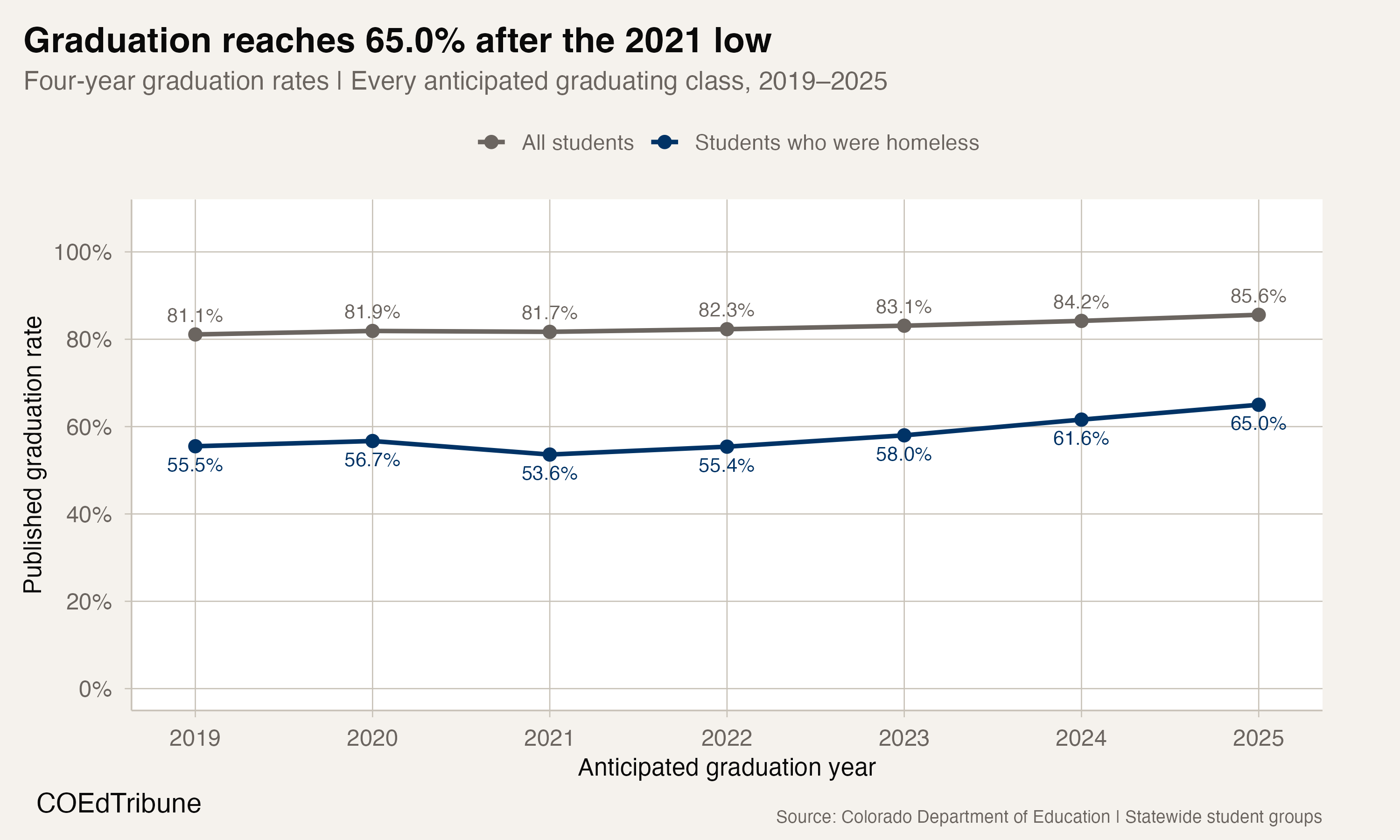
Colorado’s four-year graduation rate for students experiencing homelessness rose from 55.5% in 2019 to 65.0% in 2025, a 9.5-point gain. A 20.6-point gap with all students remained in the latest class.
The statewide improvement followed a downturn. The rate reached its lowest point in the seven-class record in 2021, then rose in four consecutive annual comparisons. The full history shows both the setback and the recovery.
Four gains after the low
The 2021 rate was 53.6%, with a 28.1-point gap against all students. It then rose to 55.4%, 58.0%, 61.6% and 65.0%. The gain from the low was 11.4 points, and the gap narrowed by 7.5 points.
A different baseline changes the size of the gain: 9.5 points from 2019, 8.3 points from 2020 and 3.4 points in the latest annual comparison. The 2025 rate was the highest across the complete 2019–2025 history.
Colorado’s reported graduation cohort for students experiencing homelessness contained 3,427 students in 2025, compared with 3,210 in 2019. These are anticipated graduating classes, not a count of every student who experienced homelessness during a school year. Different students make up each class.
Improvement across overlapping groups
Among five service and status groups with published rates and positive cohort counts at both endpoints, students experiencing homelessness had the second-largest gain. Only students with disabilities improved more. The other groups were students who were economically disadvantaged, English learners and migrant students.
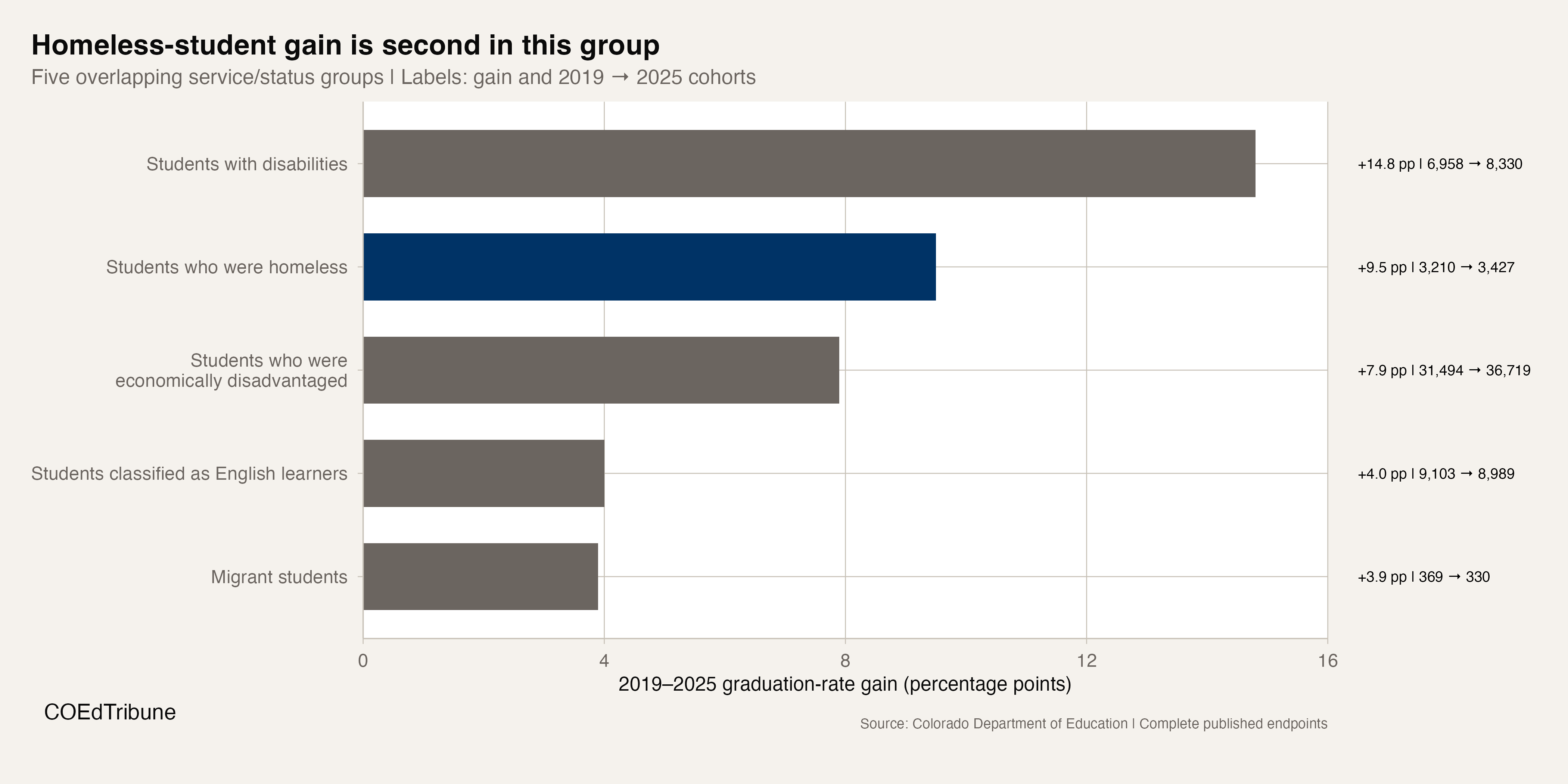
These categories overlap with one another and with race and ethnicity. Their cohort counts cannot be added as separate parts of the student body. The comparison describes reported outcomes, not the effects of particular services.
Local comparisons have narrower coverage
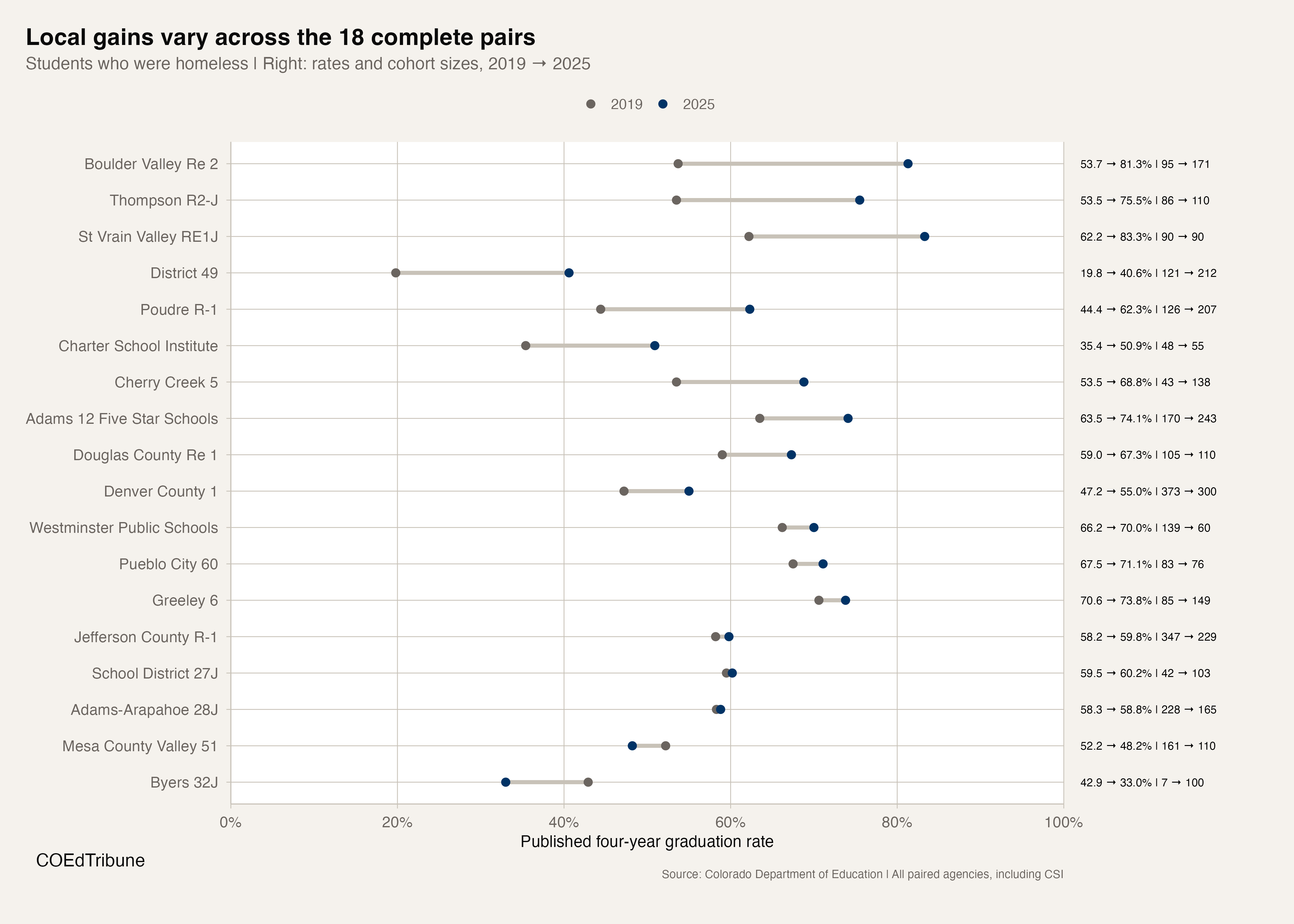
The number of agencies with a published homeless-student graduation rate and a positive cohort count fell from 119 in 2019 to 18 in 2025. All 18 latest agencies also had usable observations under the same stable ID in 2019. Sixteen improved and two declined. Those local records cannot stand in for agencies with missing information or establish how many unique students the comparison covers statewide.
Boulder Valley Re 2↗ET had the largest gain in this paired group: 53.7% to 81.3%, up 27.6 points. Its published cohort grew from 95 to 171 students. Requiring at least 50 students at both endpoints leaves 14 agencies, with Boulder Valley still first by gain. A 100-student minimum excludes Boulder Valley because of its smaller starting class.
Thompson R2-J↗ET gained 22.0 points, and St. Vrain Valley RE1J↗ET gained 21.1 points. Mesa County Valley 51↗ET declined by 4.0 points. Byers 32J↗ET declined by 9.9 points, but its starting cohort had only seven students, compared with 100 in 2025. A rate change across those differently sized classes needs that context.
Boulder Valley’s current McKinney-Vento information lists immediate enrollment, school stability, transportation when appropriate, referrals and fee waivers. That describes available support; the graduation tables do not identify which students used it or how much it contributed to the district’s gain.
Randy Barber, the district’s chief communications officer, tied the change to the Marshall Fire. In an email to The COEdTribune, he wrote that “The increase in the number of McKinney Vento students and the corresponding changes in student performance are tied to the Marshall Fire.” By his account, “We had about 1,000 students who lost their homes because of the natural disaster and, as a result, were added to our McKinney Vento list.” That figure is the district’s own and does not come from the state tables behind this comparison.
Barber said the district’s McKinney-Vento liaison, longtime staff member Ema Lyman, who has since retired, “was instrumental in helping the students navigate the difficult days and months following the disaster.” He added that the community “wrapped their arms around the impacted students to ensure they had what they needed directly following the fire, but also all the way through graduation.” The graduation tables show the larger class and the higher rate; they do not record why students are counted in a cohort.
A four-year measure has limits
Colorado publishes separate graduation windows in its graduation and completion statistics. This comparison uses the four-year measure. Students who did not graduate within that window cannot be described as students who never graduate. The newer tables used here do not publish graduate counts, so the rate is not converted into a diploma count.
CDE’s current homeless-education guidance describes district liaisons, transportation to the school of origin and Title I funding set-asides for services. Those are concrete supports for local leaders to examine. The remaining question is which supports reached students during the improvement, while the statewide gap remained 20.6 points.
Graduation rates and cohort counts come from the Colorado Department of Education for anticipated graduation years 2019 through 2025.
Detailed code that reproduces the analysis and figures in this article is available exclusively to EdTribune subscribers.
Discussion
Sign in to join the discussion.
Loading comments...