Correction: An earlier version of this article misstated the Denver homeless student counts. Of roughly 1,307 students who are currently homeless in the data, 996 were chronically absent, rather than 996 counted with 759 chronically absent. It also stated that 33 districts report homeless chronic absenteeism data and three fall below 45%; the correct figures are 93 districts, of which 29 fall below 45%. The article has been updated.
In Denver Public Schools↗ET, 76.2% of students experiencing homelessness were chronically absent in 2024-25. That is not a misprint. More than three in four students who are currently homeless in the state's largest district missed at least 10% of the school year.
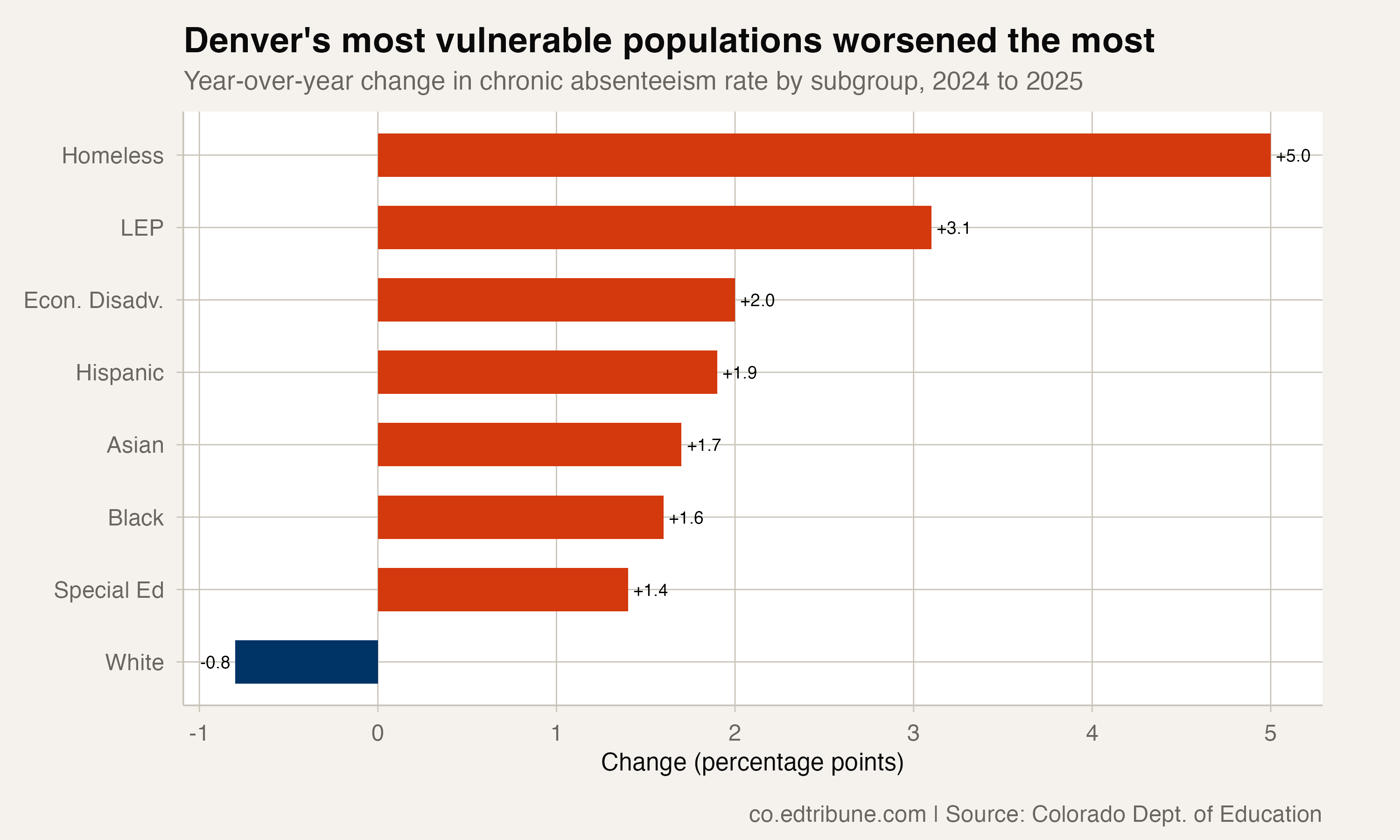
The rate worsened by 5.0 percentage points from the prior year, when it stood at 71.2%. Of roughly 1,307 students who are currently homeless counted in the data, 996 were chronically absent. Homelessness in Denver schools is not just a housing problem. It is, functionally, a schooling problem.
A widening gap across every group
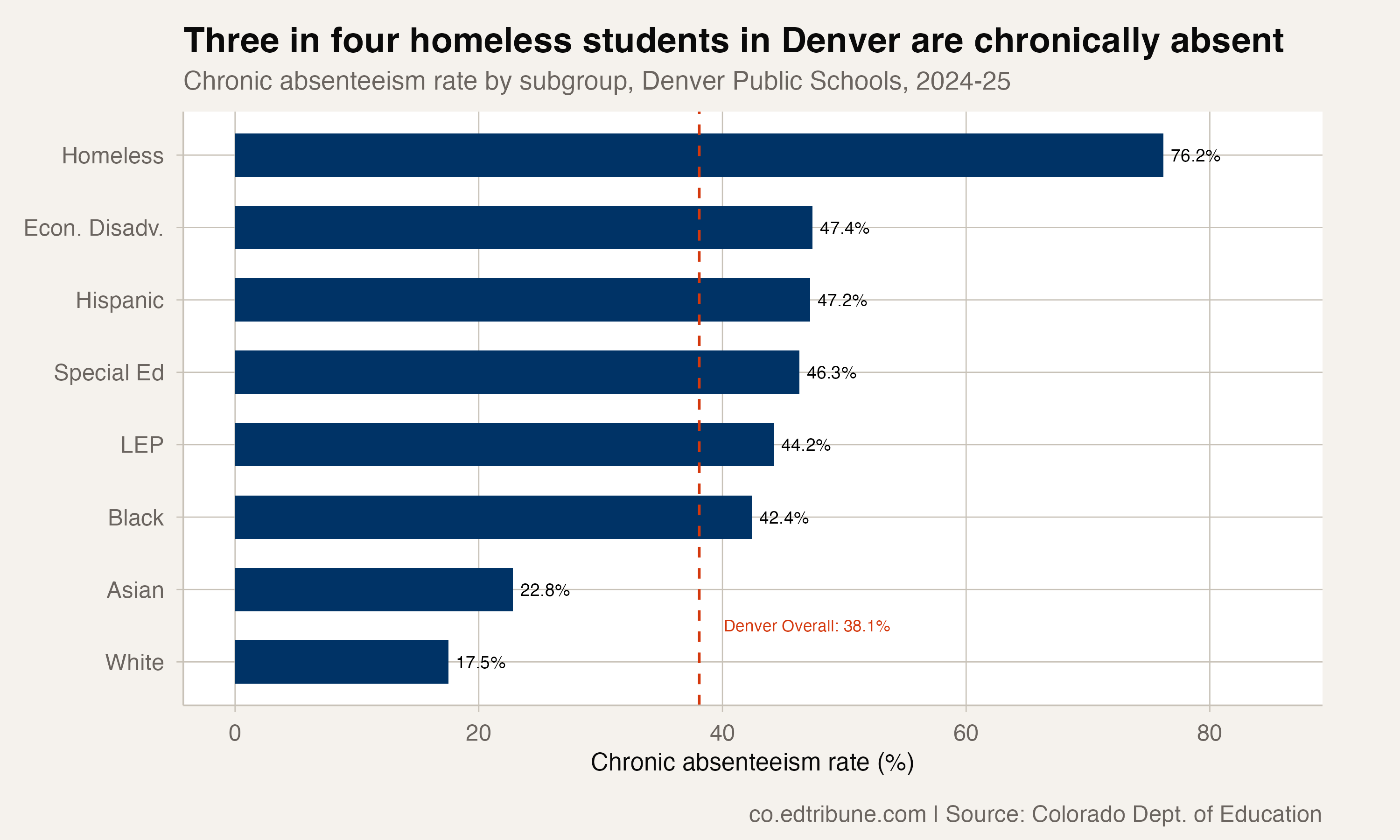
Denver's overall chronic absenteeism rate rose from 37.1% to 38.1% in 2024-25, a 1.0 percentage point increase that added roughly 857 chronically absent students. But the headline number masks a starker story within subgroups.
Students who are currently homeless worsened the most, gaining 5.0 points. LEP students rose 3.1 points to 44.2%. Economically disadvantaged students climbed 2.0 points to 47.4%. Hispanic students, who make up the largest share of Denver's enrollment, increased 1.9 points to 47.2%.
The one group that improved: white students, who dropped 0.8 percentage points to 17.5%. The gap between white and students who are currently homeless in the same district is now 58.7 percentage points.
Immigration enforcement and LEP absenteeism
The 3.1 point increase in LEP chronic absenteeism stands out partly because Denver Public Schools itself attributed part of the worsening to "Presidential Executive Orders and ICE activity in the community in the spring." Nearly 13,601 LEP students in Denver were chronically absent in 2024-25.
Denver enrolls a significant immigrant population, many from Central and South American countries. When immigration enforcement activity escalates, families with mixed documentation status sometimes keep children home, fearing encounters with federal agents at or near schools. The data cannot distinguish between students who missed school due to direct enforcement actions and those whose families preemptively withdrew from daily attendance.
Hispanic chronic absenteeism tells a parallel story. At 47.2%, nearly half of Denver's Hispanic students are chronically absent. The 1.9 point increase tracks closely with the LEP worsening, though the two populations overlap significantly.
Denver among peers
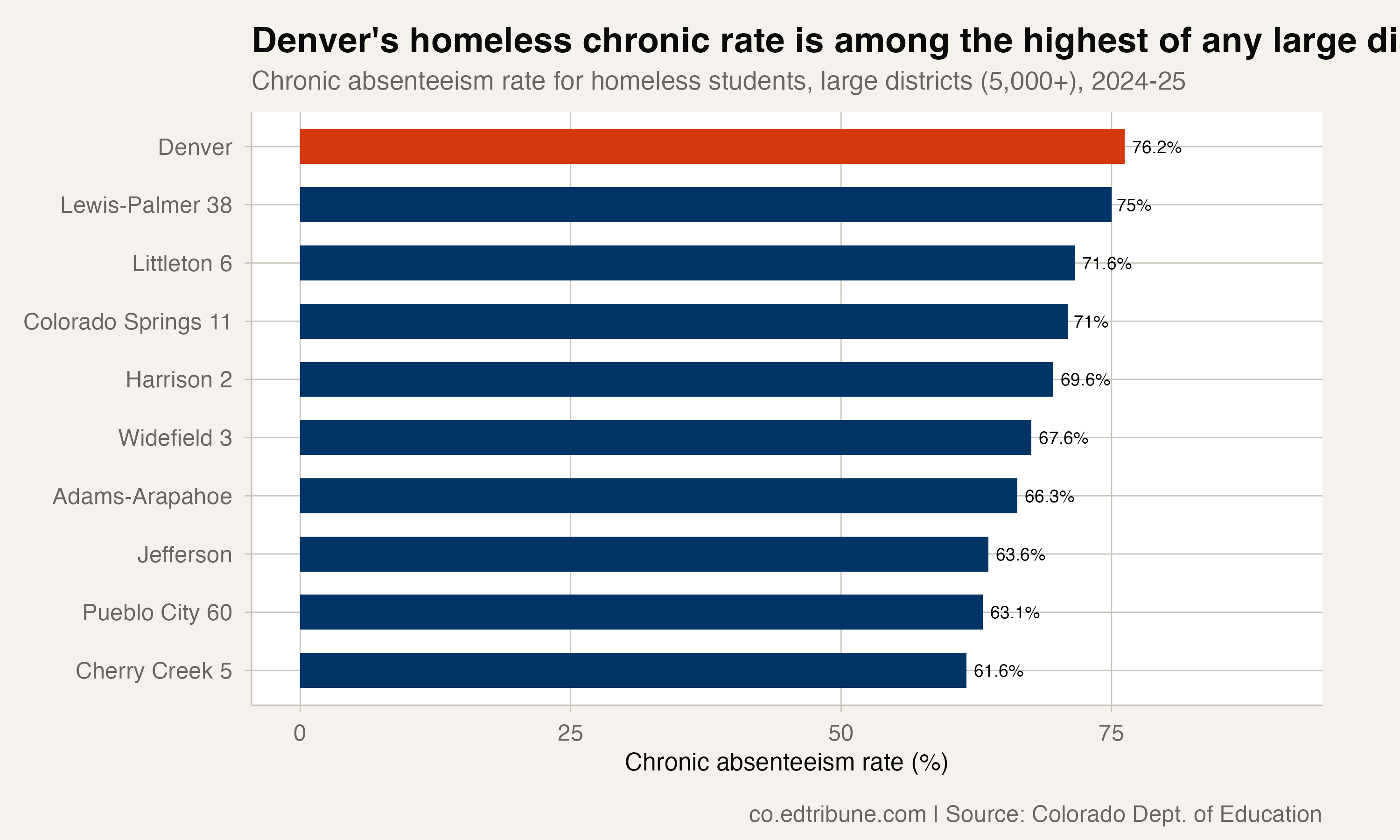
Denver's 76.2% homeless chronic absenteeism rate is the highest among large Colorado districts, though the problem is not unique to Denver. Colorado Springs D11 sits at 71.0%. Littleton at 71.6%. Adams-Arapahoe 28J↗ET (Aurora), which enrolls the state's second-largest student who is currently homeless population, posts 66.3%.
Across the 93 districts that report homeless chronic absenteeism data, only 29 fall below 45%. Nearly everywhere the data exists, students who are currently homeless are chronically absent at rates that far exceed their peers.
The severity of homeless chronic absenteeism transcends geography, district philosophy, and demographics. It is the most consistent pattern in Colorado's absence data: wherever students who are currently homeless are counted, they are overwhelmingly chronically absent.
A compounding crisis
Chronic absenteeism compounds. A student who misses 10% of school days in one year falls behind academically, making the next year harder, which makes attendance feel less rewarding, which makes missing more days feel less consequential. For students who are currently homeless, this cycle operates on top of the instability of housing itself: changing shelters means changing transportation, which can mean changing schools, which resets relationships with teachers and peers.
In Denver, nearly 23,000 students experienced homelessness during the 2023-24 school year according to Kids Count data, driven partly by rising housing costs and newcomer families. The chronically absent population within that group represents a subset that the traditional school system is structurally failing to reach.
Colorado funds schools based on enrollment rather than attendance, so districts do not lose money when chronically absent students miss days. The financial incentive to address absenteeism is therefore primarily academic and social, not fiscal. For students who are currently homeless, that distinction may matter less than whether anyone is knocking on doors, not because they want a body in a seat, but because a 76% chronic absence rate means the system has lost contact with the students who need it most.
Detailed code that reproduces the analysis and figures in this article is available exclusively to EdTribune subscribers.
Discussion
Sign in to join the discussion.
Loading comments...