Five years after COVID-19 disrupted attendance patterns across Colorado, only 19 of 93 measurable districts have chronic absenteeism rates at or below where they stood in 2019-20. That is a 20.4% recovery rate, meaning nearly four in five districts remain worse off than before the pandemic, and the baseline year itself was partially disrupted by spring 2020 school closures.
The non-recovery is not a small-district phenomenon. Among districts enrolling more than 5,000 students, the list of those still above their pre-COVID rates includes Denver↗ET, Cherry Creek↗ET, Adams-Arapahoe 28J↗ET, Jefferson County, Adams 12, Poudre, and nearly every other major district in the state.
Who recovered
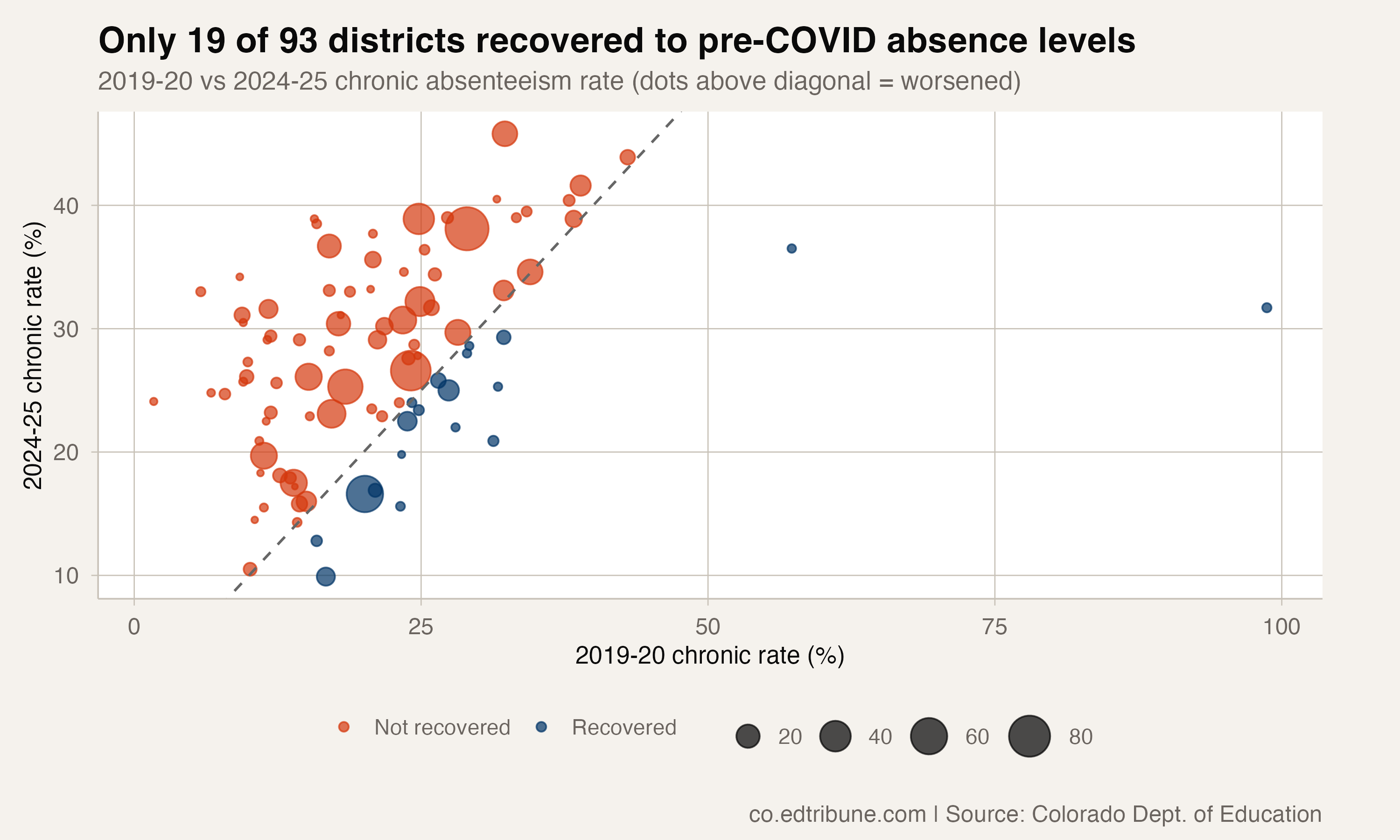
The 19 recovered districts tend to fall into two categories. The first is affluent suburban systems that had moderate pre-COVID rates and returned to them: Douglas County↗ET (20.1% in 2019-20, 16.6% now), Eaton RE-2 (15.9% to 12.8%), Johnstown-Milliken (21.0% to 16.9%).
The second is a handful of districts where specific interventions appear to have driven improvement. Woodland Park Re-2 posted the largest gap in the recovered group, dropping from 31.3% to 20.9%, a 10.4 point improvement. Garfield Re-2 went from 12.7% to 18.1%, which technically is not a recovery but represents a massive turnaround from a 55.2% peak.
Thompson R2-J↗ET (Loveland) is the largest traditional district to recover, with 14,442 students and a rate of 25.0% against a 2019-20 baseline of 27.4%.
The presence of Byers 32J (9.9%, down from 16.7%) and Education reEnvisioned BOCES (22.5%, down from 23.8%) on the recovered list comes with a caveat: both include significant virtual school populations where attendance tracking operates differently than in traditional brick-and-mortar schools.
The gap for large districts
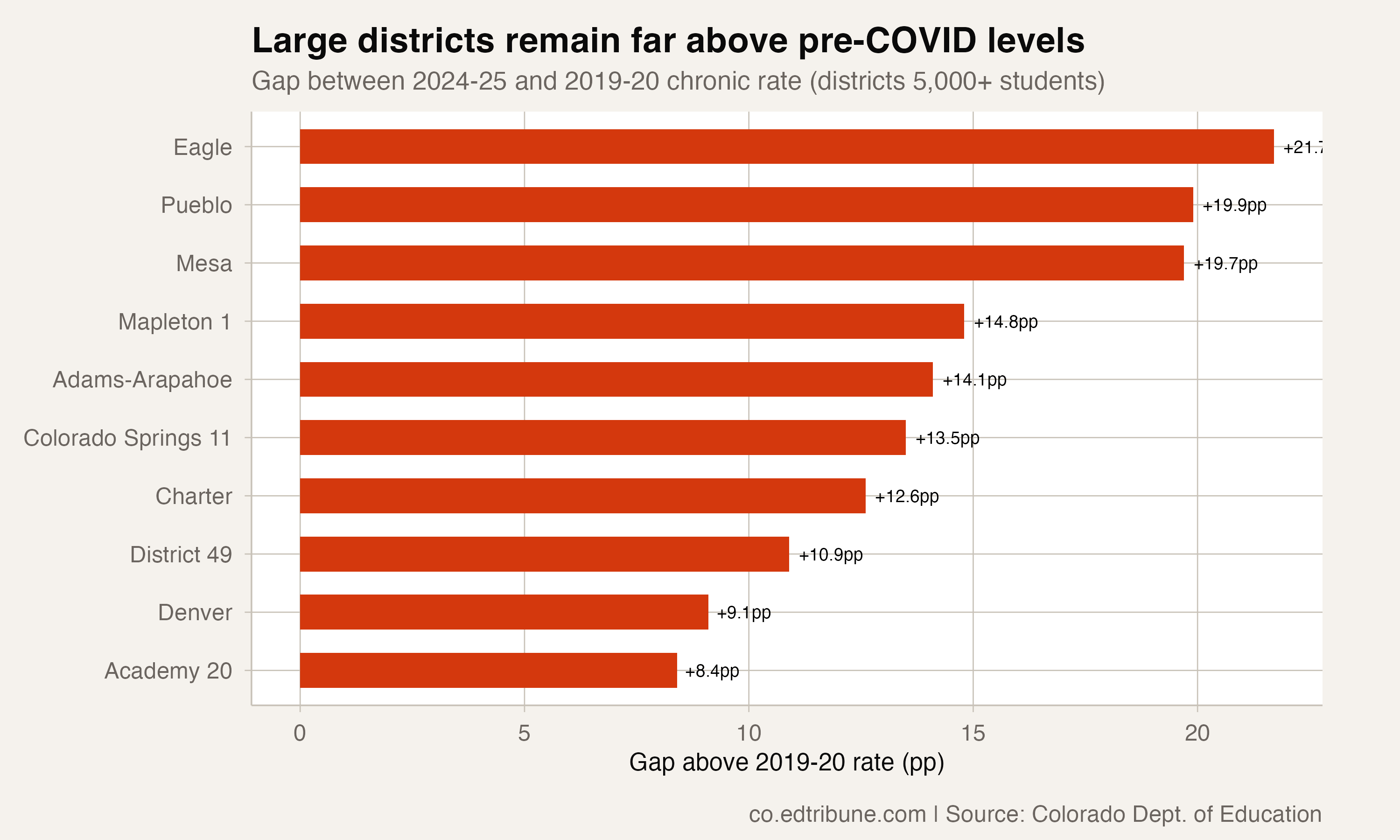
The gaps are largest among the districts that enroll the most students. Adams-Arapahoe 28J sits 14.1 percentage points above its 2019-20 rate. District 49 is 10.9 points higher. Denver is 9.1 points above baseline. Academy 20, a relatively affluent district in the Colorado Springs area, is 8.4 points above where it started.
These are not marginal shortfalls. A 14-point gap means Adams-Arapahoe 28J would need to cut its chronic rate by more than a third just to return to its pre-pandemic baseline, which was already 24.8%, hardly a success story.
The distribution of non-recovery
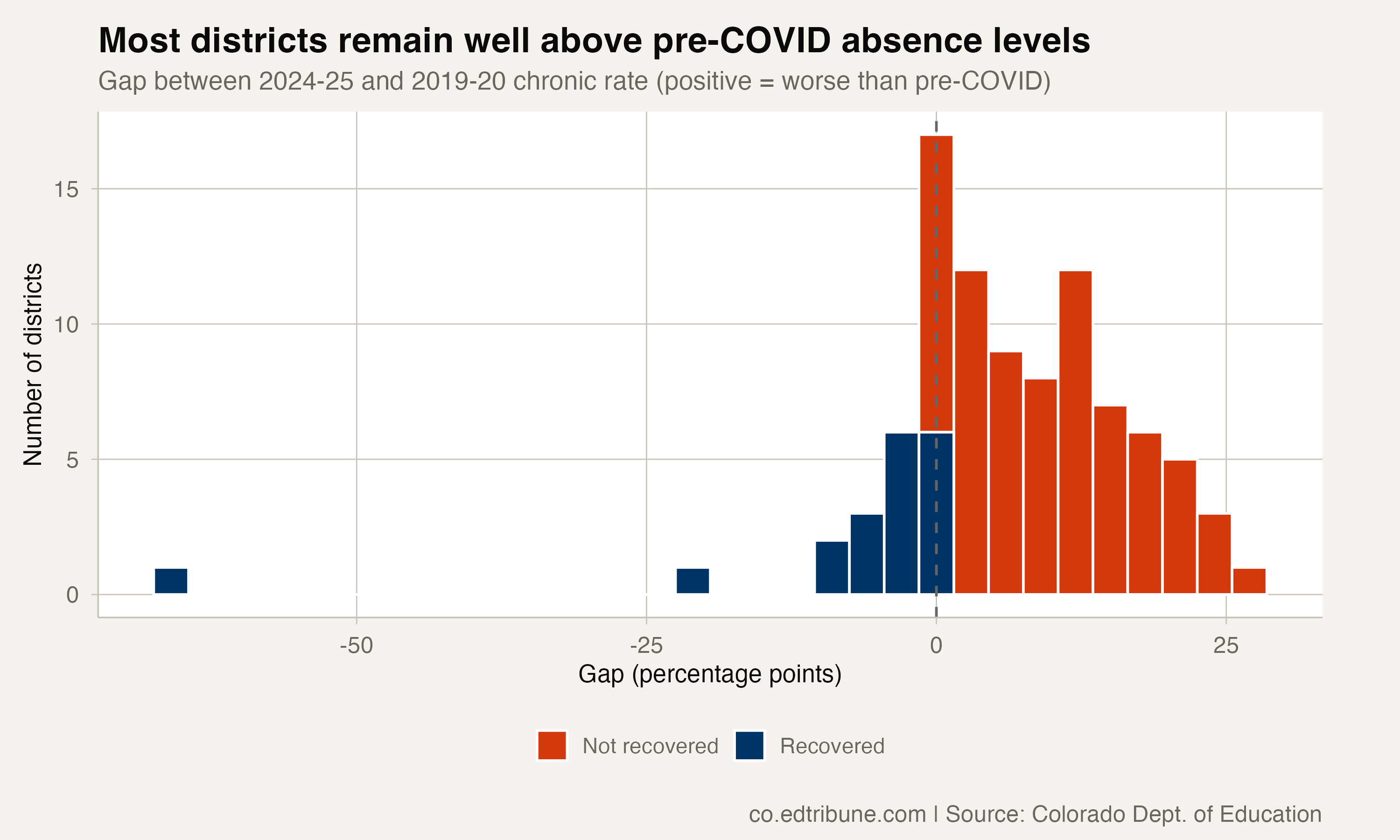
The distribution of gaps skews heavily positive, meaning most districts are worse off. The median gap is roughly 5 percentage points above the 2019-20 baseline. A cluster of districts sits in the 5-to-10 point range, representing systems that made partial but incomplete recoveries.
A smaller but concerning group shows gaps exceeding 10 points. These are districts where the pandemic did not just temporarily elevate absence rates but appears to have permanently shifted baseline behavior. Whether the mechanisms are cultural (families developed different attitudes toward daily attendance), structural (changed work patterns reduced parents' ability to ensure attendance), or institutional (schools changed how they track and respond to absence) varies by community.
The baseline problem
All of this analysis uses 2019-20 as the comparison year, which itself was disrupted by COVID closures in spring 2020. Colorado's pre-COVID reference rate, based on CDE's 2018-19 data, was approximately 22.6%. The 2019-20 rate was also 22.6%, suggesting the spring closures did not significantly inflate that year's chronic absence calculation.
But this means that the 19 districts classified as "recovered" have merely returned to a rate that was already considered concerning before the pandemic. Recovery to pre-COVID levels is a low bar. The state's goal of 15% by 2027-28 represents a far more ambitious target, one that only a handful of Colorado's most affluent districts currently meet.
Detailed code that reproduces the analysis and figures in this article is available exclusively to EdTribune subscribers.
Discussion
Sign in to join the discussion.
Loading comments...