A majority of Colorado's Native American students attended class regularly in 2024-25. But just barely. Of the 5,090 Native American students enrolled statewide, 2,305 missed at least 10% of the school year — a 45.3% chronic-absence rate, more than double that of white students and the second-highest of any racial group after Pacific Islanders.
The rate also worsened. Native American chronic absenteeism rose 1.6 percentage points from 2023-24, the largest year-over-year increase of any racial group in the state. While most groups held roughly steady or edged up by fractions of a point, Native American students moved decisively in the wrong direction.
Where Native American students face the highest rates
The district-level data reveals chronic absenteeism rates above 50% for Native American students in multiple communities. In Denver↗ET, 269 of 451 Native American students were chronically absent, a rate of 58.6%. In Colorado Springs D11, the rate hit 59.0% (69 of 112 students). In Mesa County Valley 51, 59.1% (75 of 115).
In Ignacio 11 JT, which serves the Southern Ute Indian Reservation, 104 of 186 Native American students were chronically absent, a rate of 56.2%. In Montezuma-Cortez RE-1, near the Ute Mountain Ute Reservation, 311 of 563 Native American students were chronically absent, a rate of 51.0%.
The geographic pattern is not exclusively rural or reservation-based. Urban districts in Denver, Colorado Springs, and Adams County all post rates above 50% for Native American students. The challenge follows Native American students across geography in Colorado's public school system.
The racial hierarchy
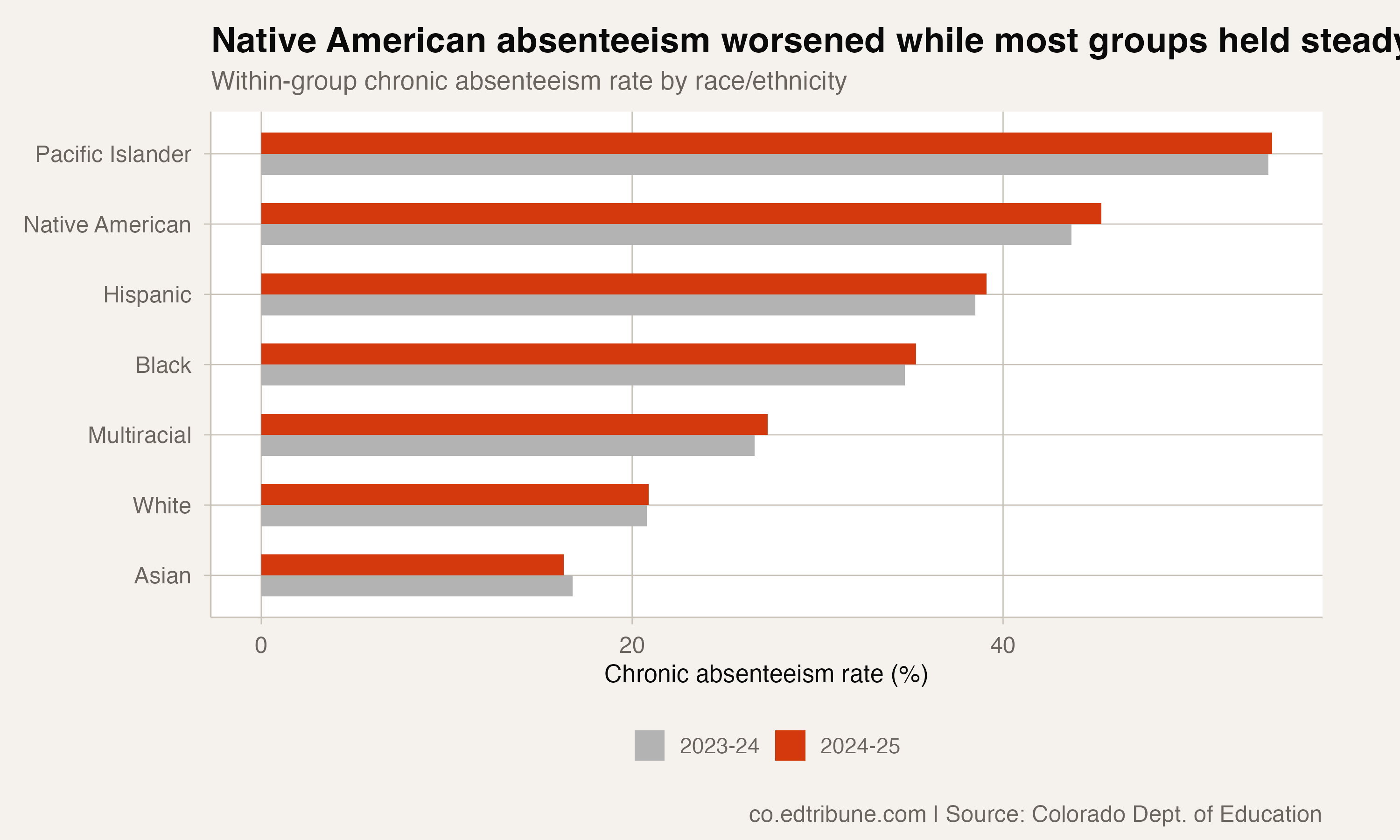
Colorado's racial hierarchy of chronic absenteeism is steep and consistent. Pacific Islander students sit highest at 54.5%. Native American students follow at 45.3%. Hispanic students at 39.1%. Black students at 35.3%. Multiracial, white, and Asian students cluster at the lower end.
The hierarchy barely shifted from 2023-24 to 2024-25. The rank order remained identical. The gaps widened slightly as Native American rates rose faster than others.
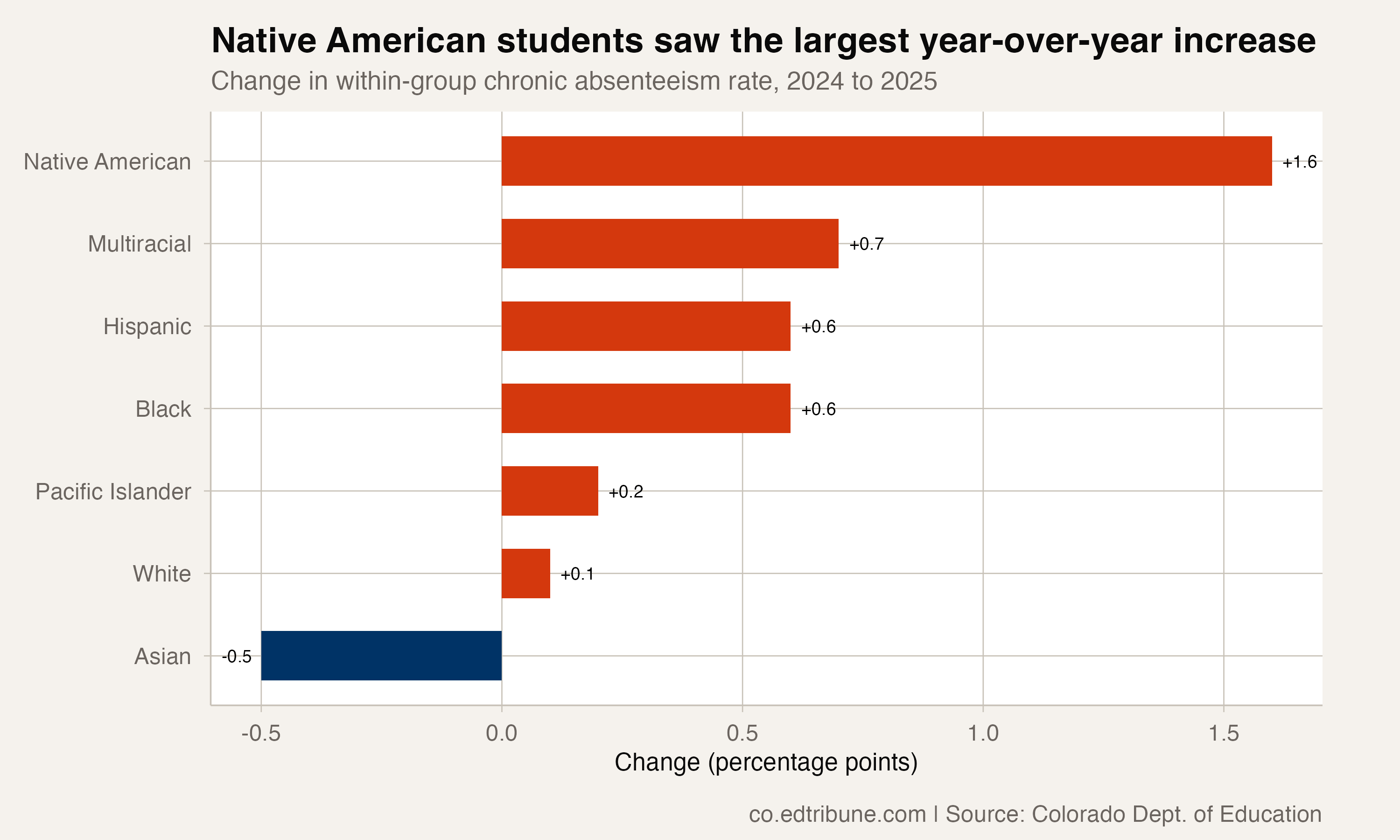
Native American students experienced the largest increase at 1.6 points. Multiracial students rose 0.7 points. Black students rose 0.7 points and Hispanic students 0.5 points. White students barely moved at 0.1 points. Asian students were the sole group to improve, dropping 0.5 points.
The pattern is consistent with a broader trend in Colorado's data: the groups already facing the highest chronic rates are also the groups where those rates are still increasing.
Small population, outsized crisis
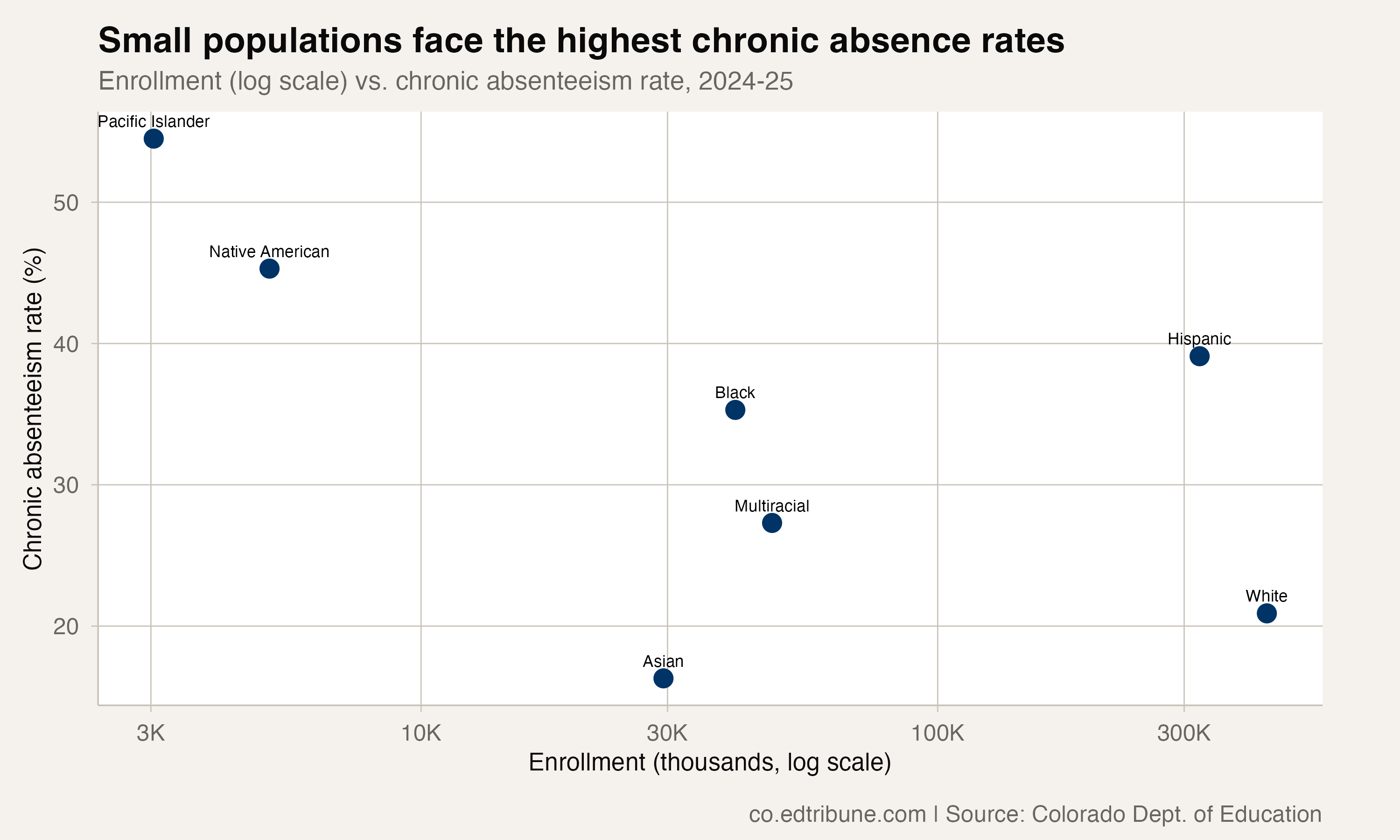
Colorado enrolls 5,090 Native American students, less than 1% of total K-12 enrollment. Pacific Islander students number just 3,038. Together, these two groups, which face chronic rates above 45%, represent fewer than 10,000 students in a system of nearly 900,000.
The small population size creates a policy paradox. These students do not move statewide averages, which means their crisis receives less institutional attention. A 1.6 point increase among 5,090 students adds roughly 81 students who are chronically absent to the state total, barely a rounding error against the 252,756 chronically absent statewide. But for the communities involved, the proportional impact is severe.
Where the rate is much lower
A handful of Colorado districts post Native American chronic absenteeism rates well below the state average, and in some cases below the rate for white students. In Douglas County RE-1, only 23.4% of Native American students were chronically absent. In Cherry Creek 5, the rate was 29.0%. Academy 20 came in at 28.4%, Fountain 8 at 26.6%, and District 49 at 32.3%.
These districts share suburban geography along the Front Range and serve smaller Native American student populations than the highest-rate districts, which complicates direct comparison. But the gap is real: a Native American student in Douglas County is less than half as likely to be chronically absent as one in Denver, Colorado Springs D11, or Mesa County Valley 51. Whatever those districts are doing differently shows up in the attendance data.
The reservation connection
Colorado is home to two tribal nations: the Southern Ute Indian Tribe, whose reservation is served primarily by Ignacio 11 JT, and the Ute Mountain Ute Tribe, whose territory overlaps with Montezuma-Cortez RE-1 and other Southwest Colorado districts.
In Ignacio 11 JT, 56.2% of Native American students were chronically absent. In Montezuma-Cortez, 51.0%. These rates reflect challenges specific to reservation communities: geographic isolation, limited transportation, intergenerational trauma, and economic hardship that can make daily school attendance a lower priority than immediate survival.
But the data also shows that high Native American chronic absenteeism is not a reservation phenomenon alone. Denver's 58.6% rate involves 269 students in an urban setting with very different structural challenges. Adams-Arapahoe 28J posts 54.8%. Jefferson County posts 52.1%. The crisis follows Native American students across geography, suggesting that race-specific factors, not just place-specific factors, drive the disparity.
The 45.3% statewide rate means that the default experience for a Native American student in Colorado public schools is at best a coin flip between regular attendance and chronic absence. For nearly half of these students, the public school system is not functioning as a daily institution.
Detailed code that reproduces the analysis and figures in this article is available exclusively to EdTribune subscribers.
Discussion
Sign in to join the discussion.
Loading comments...