Correction: An earlier version of this article described the grade-by-grade chronic absenteeism gradient as monotonic, climbing with each successive grade. The rate rises broadly from 3rd grade (23.2%) to 12th grade (41.2%), but the climb is not strictly step-by-step: 3rd and 4th grade are tied and 9th grade dips slightly below 8th. Two illustrative grade rates were also corrected to 30% in 7th grade and 35% in 10th grade. The article has been updated.
Colorado's chronic absenteeism crisis has a shape, and it runs steeply uphill from third grade to twelfth. In 2024-25, the state's 12th graders recorded a 41.2% chronic absenteeism rate, the highest of any grade level and nearly double the rate for elementary students. More than 30,000 seniors missed at least 10% of their school days.
The gradient climbs steeply from 3rd grade onward: 23.2% in 3rd, rising to 41.2% in 12th. Every high school grade exceeds 30%. Meanwhile, Colorado's class of 2025 graduated at an 85.6% rate, a decade high. The state is simultaneously losing more seniors to chronic absence and graduating more of them than at any point in recent history.
The grade-level staircase
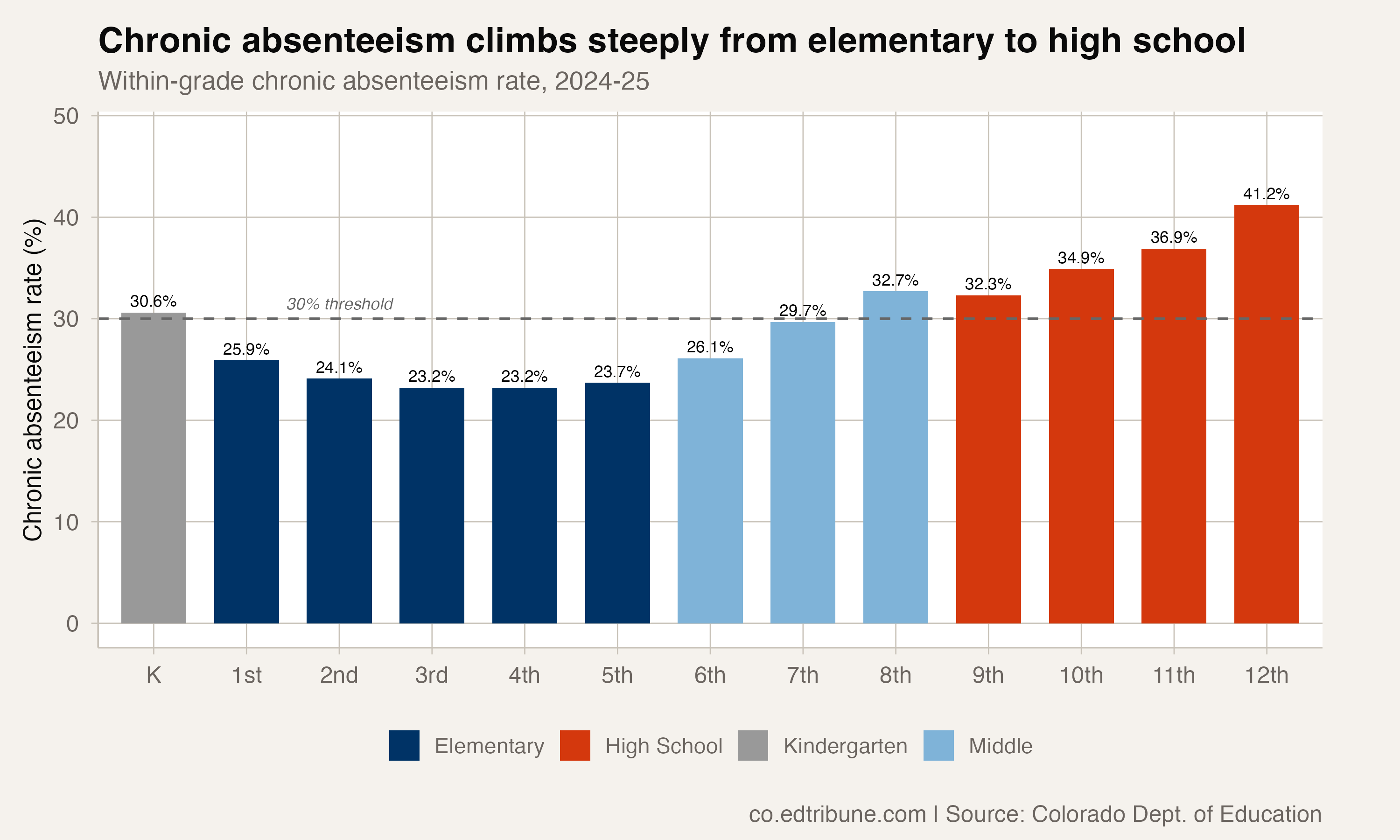
The numbers paint a clear picture of disengagement that deepens as students age. Third grade sits at the bottom at 23.2%. Fourth and fifth grades are nearly identical. Then middle school begins a steady ascent: 6th grade at 26.1%, 7th at 29.7%, 8th at 32.7%. High school carries the climb higher, topping out at 41.2% in 12th grade, though 9th grade dips slightly to 32.3% before the rise resumes.
The elementary school average (grades 1-5) sits at 24.0%. The middle school average (grades 6-8) reaches 29.5%. And high school (grades 9-12) averages 36.3%, half again as high as elementary.
Kindergarten is an anomaly in this pattern. At 30.6%, it sits higher than every grade from 1st through 7th, suggesting that many families treat the year as optional despite Colorado making full-day kindergarten universal. The K rate did improve by 1.0 percentage point from 2023-24, one of the few bright spots in the data.
High school moved in the wrong direction
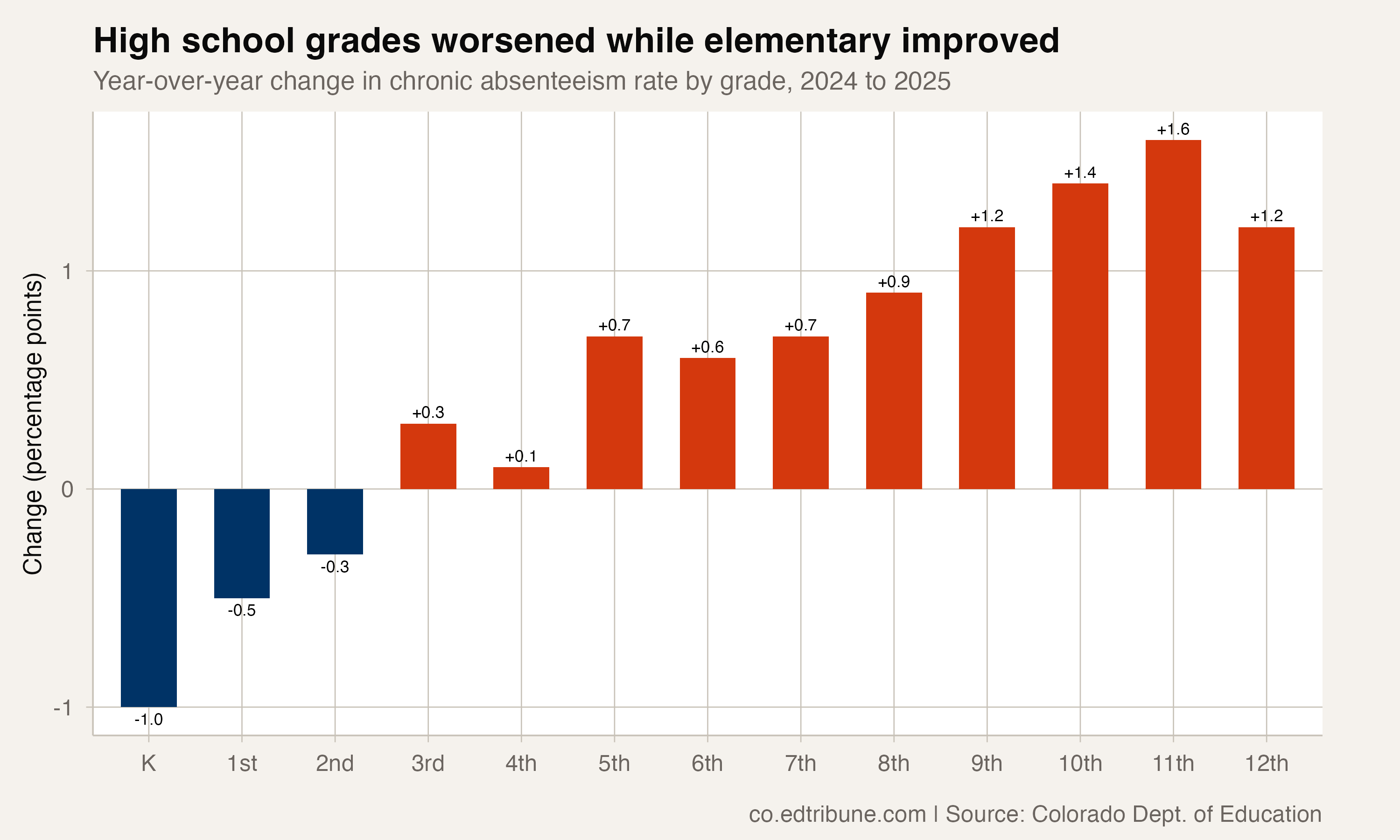
The 2024-25 data reveals a troubling split between grade levels. Elementary grades 1 and 2 improved slightly, dropping 0.5 and 0.3 percentage points respectively. Kindergarten fell a full point.
High school went the other direction entirely. Every grade from 9th through 12th worsened. The increases ranged from 1.2 percentage points in 9th and 12th grades to 1.6 points in 11th grade. This is not random variation. It is a consistent pattern of older students disengaging at accelerating rates.
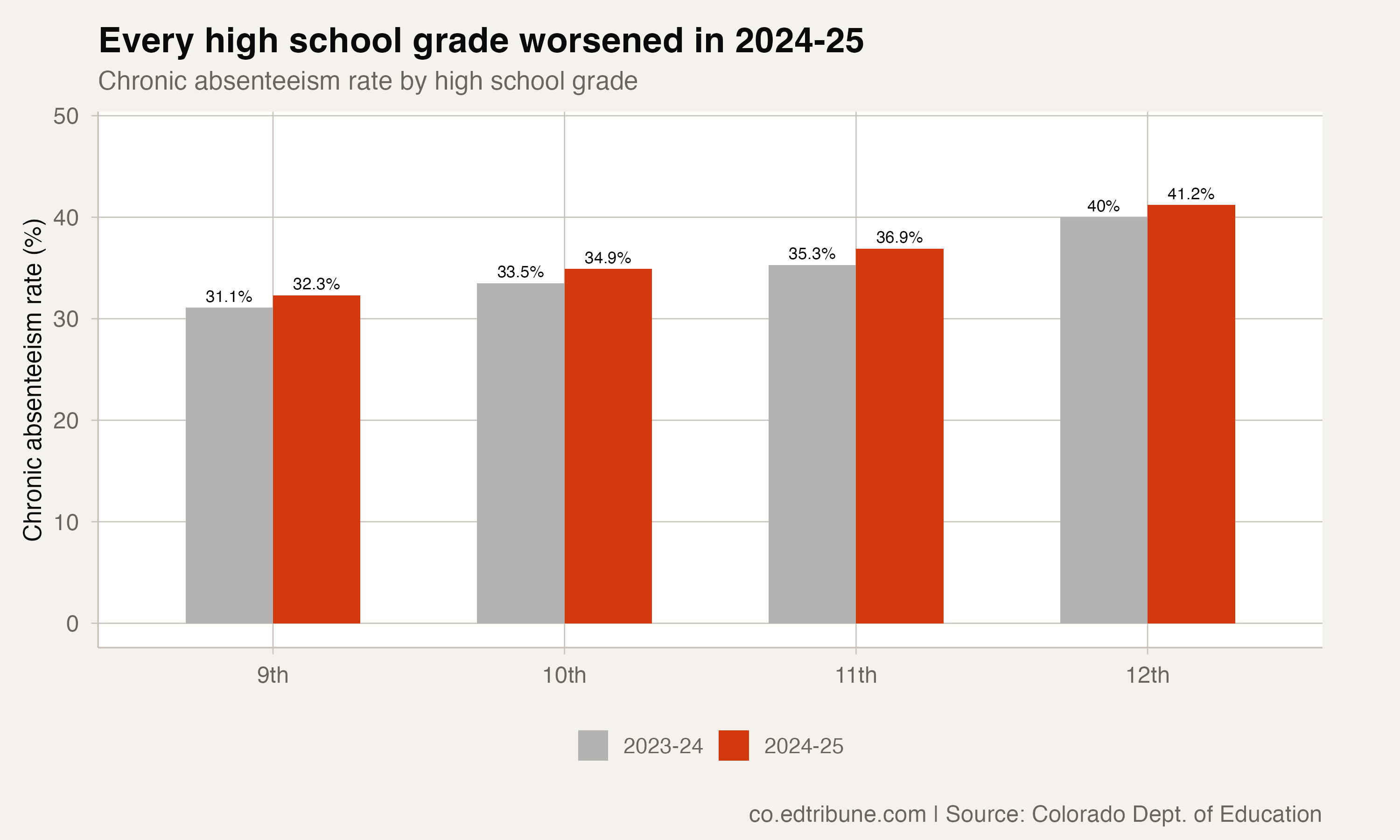
The 11th grade increase of 1.6 points is particularly concerning. Students who become chronically absent in 11th grade enter their senior year with ingrained patterns of absence, and the data suggests those patterns only deepen. The 12th grade rate of 41.2% represents the culmination of years of gradual disengagement.
The graduation paradox
The tension between Colorado's record-high graduation rate and its record-high senior absence rate raises uncomfortable questions. If two in five seniors are missing more than 10% of instructional time and still graduating at 85.6%, what does the diploma represent?
There are several possible explanations, none mutually exclusive. Schools may be extending flexibility to seniors who have earned enough credits, allowing them to miss days without academic consequences. Some seniors may concentrate their absences in the spring after meeting graduation requirements. And some chronically absent students simply may not graduate, their absences hidden in an 85.6% completion rate that still leaves 14.4% without a diploma.
What the data cannot tell us is whether chronically absent graduates leave high school with the same skills and preparation as their peers who attended regularly. A diploma measures credit completion, not learning. When more than 30,000 seniors are missing significant instructional time, the question of what they learned while present becomes as important as whether they crossed the stage.
A structural problem, not a senior-year problem
The steady climb from elementary through high school suggests that senior absenteeism is not something that emerges suddenly in 12th grade. It builds gradually across years. A student who misses 23% of 3rd grade and 30% of 7th grade and 35% of 10th grade is on a trajectory that leads naturally to 41% in 12th. By the time absence rates become alarming in high school, the patterns are years in the making.
This framing shifts the intervention question. Targeting seniors with attendance campaigns may be too late. The data suggests that the compounding of disengagement begins in middle school, where the rate jumps from 26% in 6th grade to nearly 33% by 8th. The middle school transition, when students move to larger buildings with less personal attention, appears to be where the acceleration starts.
Detailed code that reproduces the analysis and figures in this article is available exclusively to EdTribune subscribers.
Discussion
Sign in to join the discussion.
Loading comments...