Douglas County RE-1↗ET is a large-district counterexample. Colorado's third-largest district, with 60,681 students, posted a 16.6% chronic absenteeism rate in 2024-25, nearly 12 points below the state average of 28.5%.
This is not a one-year performance. Douglas County was below the state average in every year from 2019-20 through 2024-25. Its rate fell for three consecutive years and, by 2024-25, sat below its 2019-20 level. Thirty-five Colorado districts have recovered to or below their 2019-20 chronic-absence rate, but Douglas County is the only one that enrolls more than 20,000 students.
Consistently below average
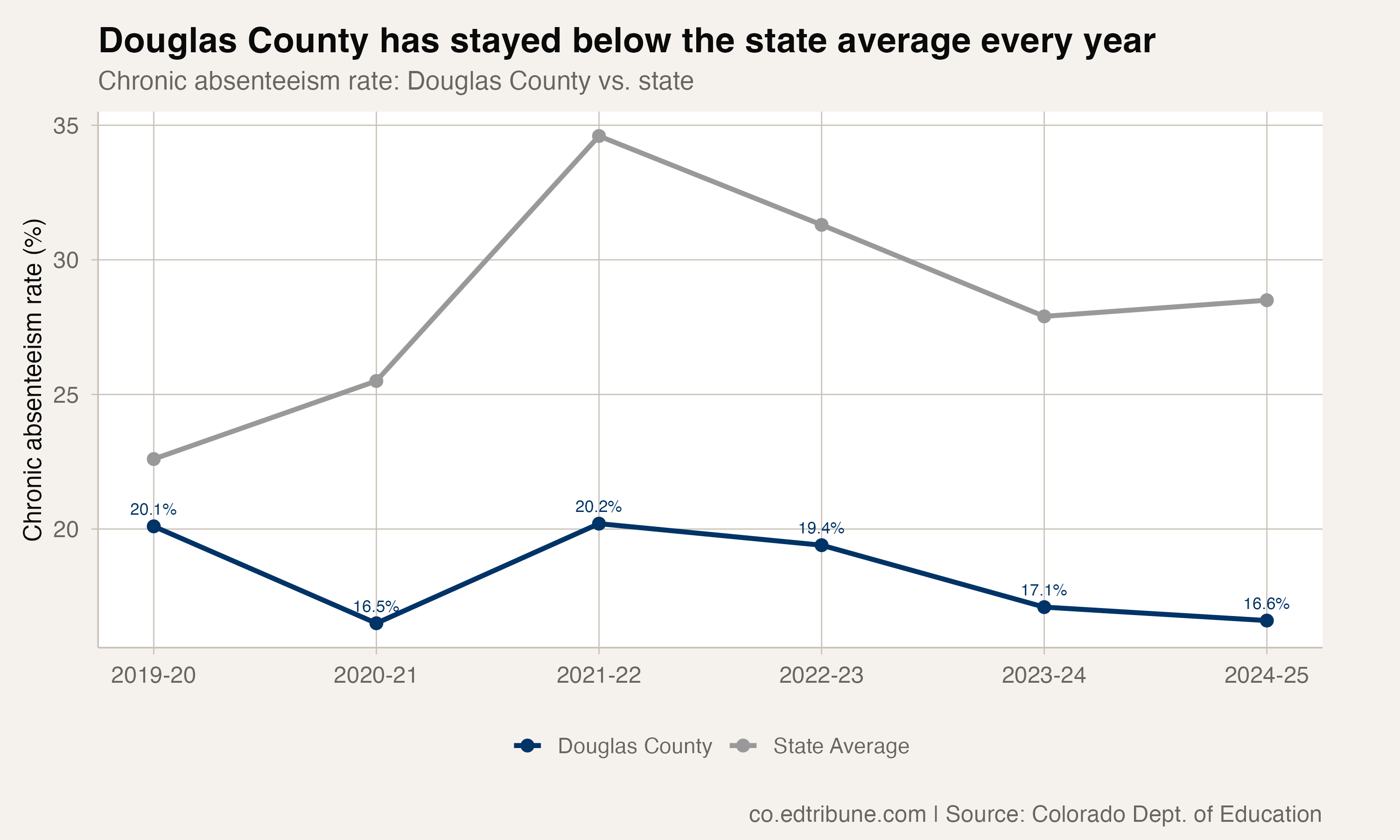
The gap between Douglas County and the state has been remarkably stable, ranging from 2.5 percentage points in 2019-20 to 14.4 points at the pandemic peak in 2021-22. Even when Douglas County's rate rose during COVID, reaching 20.2% in 2021-22, the increase was far less dramatic than the state's surge to 34.6%.
The three-year improvement streak from 19.4% (2022-23) to 17.1% (2023-24) to 16.6% (2024-25) represents incremental but sustained progress. Unlike some districts that posted large single-year gains, Douglas County's improvement has been gradual and consistent.
Among large-district peers
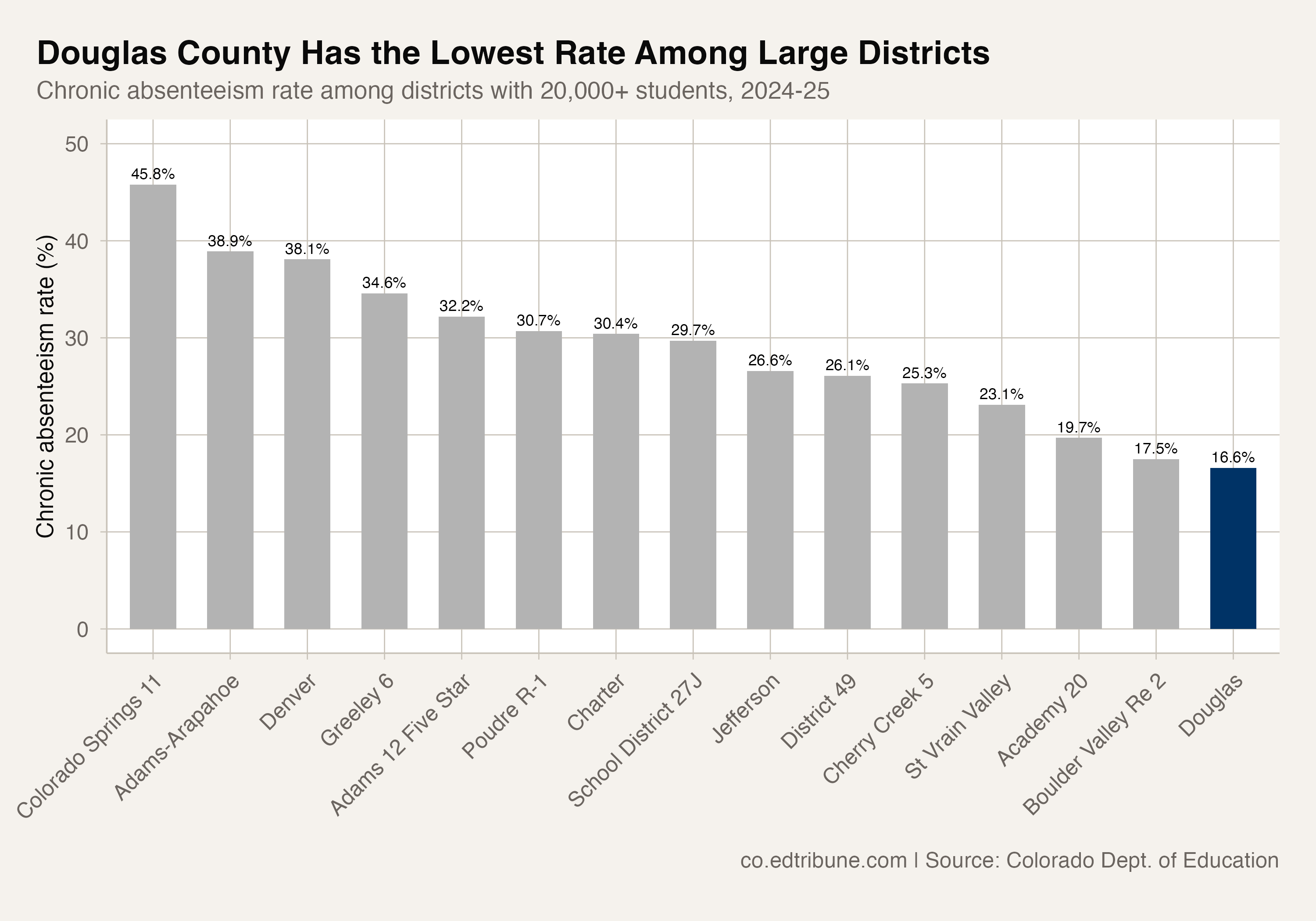
Among the 15 Colorado districts enrolling more than 20,000 students, Douglas County leads by a significant margin. Boulder Valley↗ET (17.5%) and Academy 20↗ET (19.7%) are the next closest. The median for this group is roughly 30%, meaning Douglas County's rate is barely half the typical large-district rate.
At the other end, Colorado Springs D11 sits at 45.8%, Denver↗ET at 38.1%, and Adams-Arapahoe 28J at 38.9%. The 29.2-point spread between Douglas County and D11 illustrates how dramatically chronic absence rates can differ within the same state.
The equity question
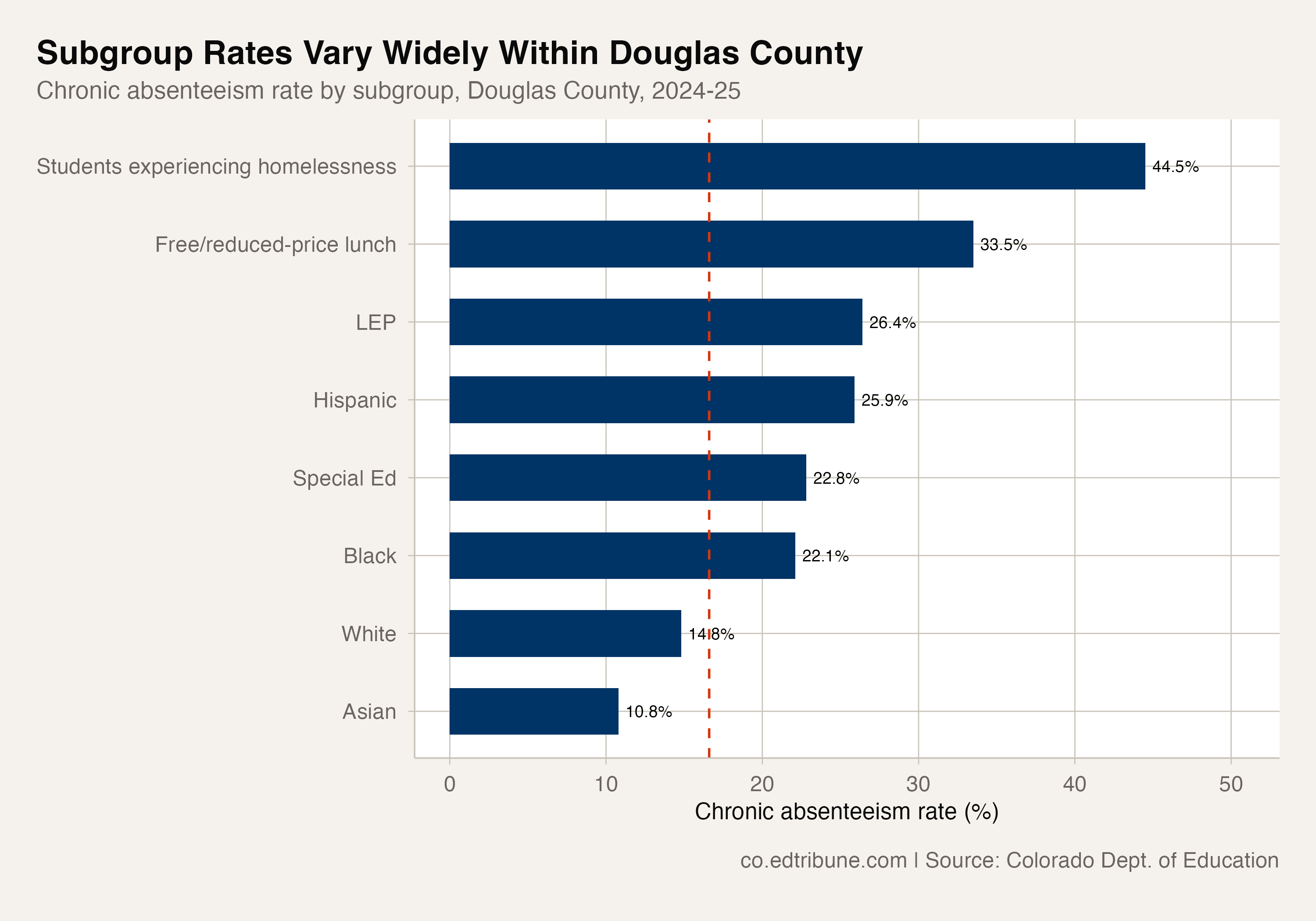
Low overall rates do not eliminate disparities. Within Douglas County, students eligible for free or reduced-price lunch have a 33.5% chronic rate, more than double the 14.8% rate among white students. Students identified as English learners sit at 26.4%. Hispanic students at 25.9%. Students experiencing homelessness are furthest out, at 44.5%.
Two of those figures sit above Colorado's 28.5% rate for all students, not below it. The district's headline advantage does not reach its lowest-income students or its students without stable housing, and a district-wide rate of 16.6% says nothing about either group on its own. For a district that already knows its overall number is good, that is the more useful comparison.
The comparison with Jefferson County↗ET shows that large suburban districts do not move in lockstep. Jefferson County posted 26.6% in 2024-25, ten points higher than Douglas County.
What the model shows
The attendance data do not identify why Douglas County's rate is lower. They establish only that large districts can have very different results: in 2024-25, Douglas County's rate was 16.6%, compared with 38.1% in Denver County, a 21.5-point gap.
Detailed code that reproduces the analysis and figures in this article is available exclusively to EdTribune subscribers.
Discussion
Sign in to join the discussion.
Loading comments...