Correction: The historical comparisons now use the complete original annual membership files and require a continuous record under the same organization identifier. The earlier “all-time” and “half of districts” descriptions overstated the comparison. Fiscal predictions and causal explanations not established by these records have been removed.
Colorado’s original annual files place 81 reporting organizations at their lowest enrollment in the examined period in 2025–2026, last school year and the most recent published data. The comparison includes 185 organizations with complete histories across 12 reporting years, beginning in 2014–2015. Every organization counted at the low reached a unique minimum, rather than tying an earlier count.
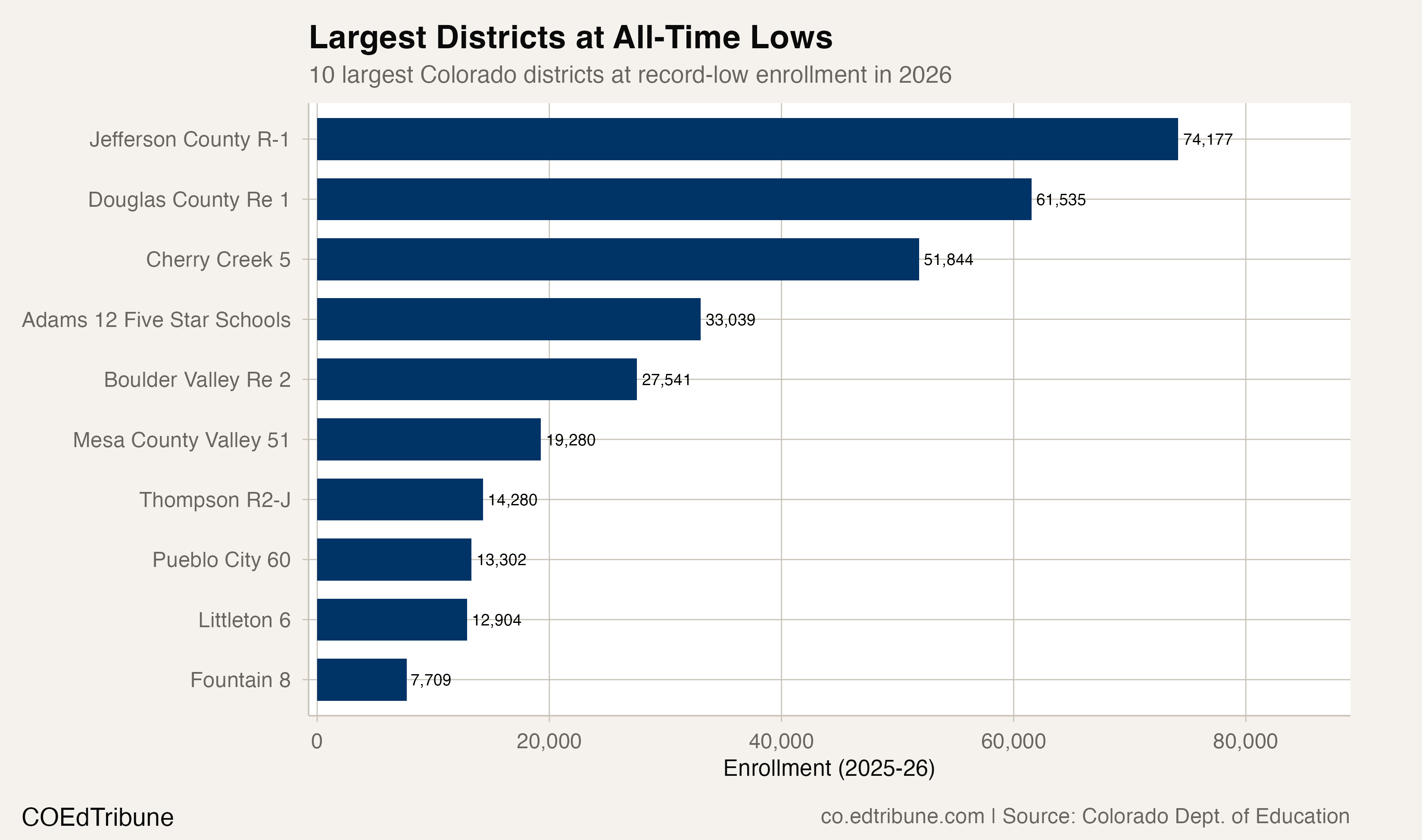
The list includes Jefferson County R-1↗ET, with 74,177 students, Douglas County Re 1↗ET, with 61,535, and Cherry Creek 5↗ET, with 51,844. Those counts put substantial enrollment behind the organization tally. The result is not confined to places where a small change in families can move a tiny total.
What the historical comparison includes
The latest annual file contains 186 organization totals. One organization in that file lacks a continuous history under the same identifier across the entire comparison period and is excluded from the historical extrema. Its absence from this calculation does not mean its current enrollment was dropped from Colorado’s statewide total.
The records have an earlier organization identifier present only near the beginning of the period and another present only later. They are not stitched together to manufacture a longer series. Each included organization has an observed total in every examined year, and adjacent comparisons require adjacent reporting years.
The state’s membership reports include BOCES schools, detention centers and alternative schools. The organization records also retain membership reported outside a named school. This is therefore a comparison of reported educational organizations, rather than interchangeable geographic school districts or buildings.
The word “lowest” has a specific boundary here: the minimum in these original annual files. It does not assert that enrollment was never lower before the examined period. Later web summaries can revise earlier values, so their revisions are not inserted into this history piecemeal.
Size changes the planning implications
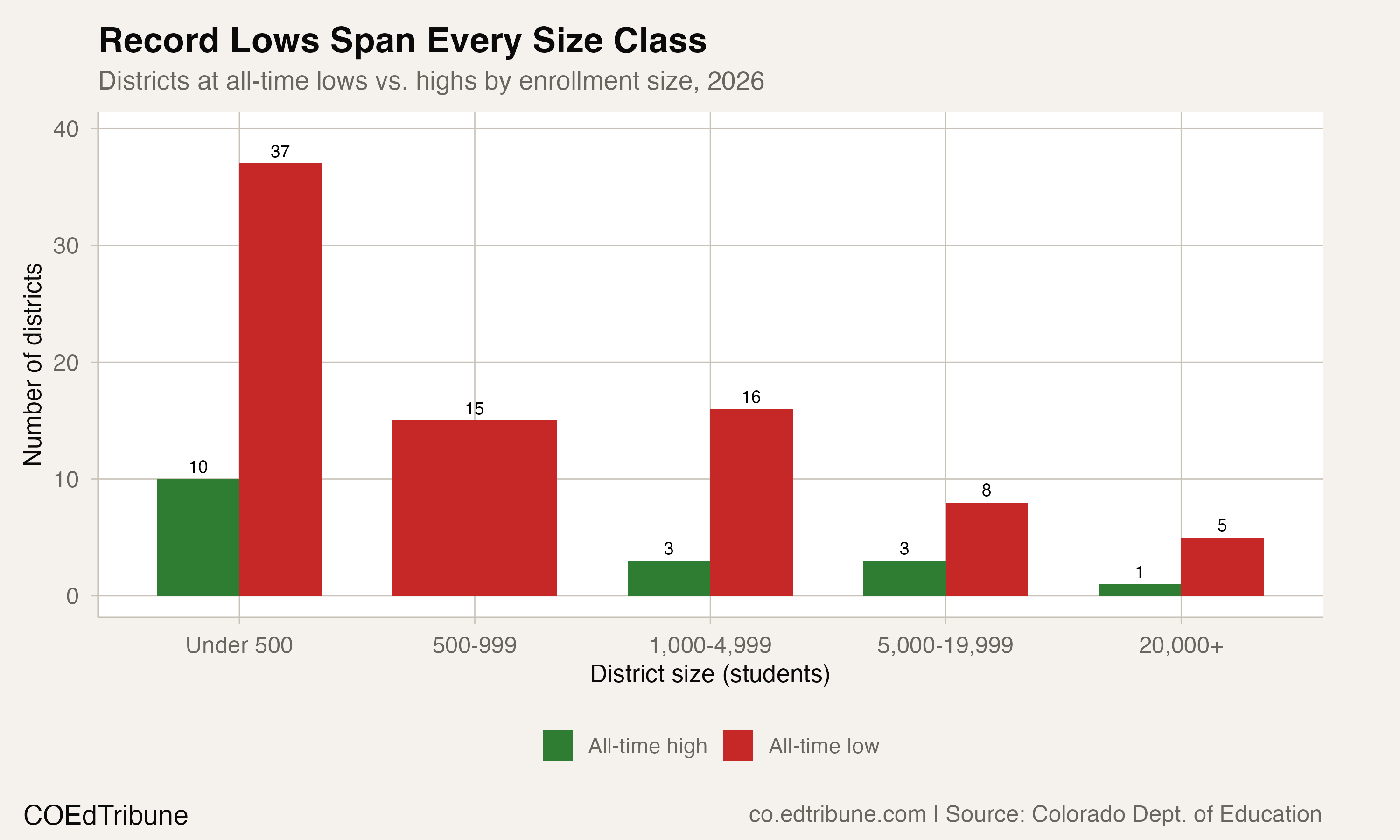
Among the organizations at their minimum, 37 reported fewer than 500 students. At the other end, 13 reported more than 5,000, and 5 reported more than 20,000. These thresholds describe size; they do not determine eligibility for the historical comparison.
Adams 12 Five Star Schools↗ET reported 33,039 students, and Boulder Valley Re 2↗ET reported 27,541. Pueblo City 60↗ET, at 13,302, was also at its lowest observed annual count in this period.
The organizations at their minimum together reported 390,091 students. That is 44.8% of Colorado’s published statewide total of 870,793. The statewide total remains the denominator; the selected organizations’ membership is not treated as a complete substitute for the state.
A large organization and a small one may both reach a historical minimum without facing the same facility choices. Membership alone does not show which buildings have available space, which services students need or which costs would change with a closure. The records identify the enrollment condition; they do not calculate a budget shortfall.
Lower counts can coexist with growth elsewhere
The full latest-year comparison found 138 organizations with lower enrollment than the preceding year, 46 with higher enrollment and two with the same count. This annual comparison uses the latest complete pair of years, so its population differs from the longer historical panel.
Within the complete historical panel, 16 organizations were at their maximum observed count last school year. Of those, 15 reached a unique high; the remaining organization tied an earlier maximum. The low and high groups are defined by the same available years, rather than by different historical windows chosen for each place.
School District 27J↗ET, with 24,290 students, and Weld RE-4, with 8,883, were among the organizations at a high. Education reEnvisioned BOCES and Byers also appeared in that group. Their presence reinforces why an organization ranking should not be read as a ranking of geographic districts or instructional settings.
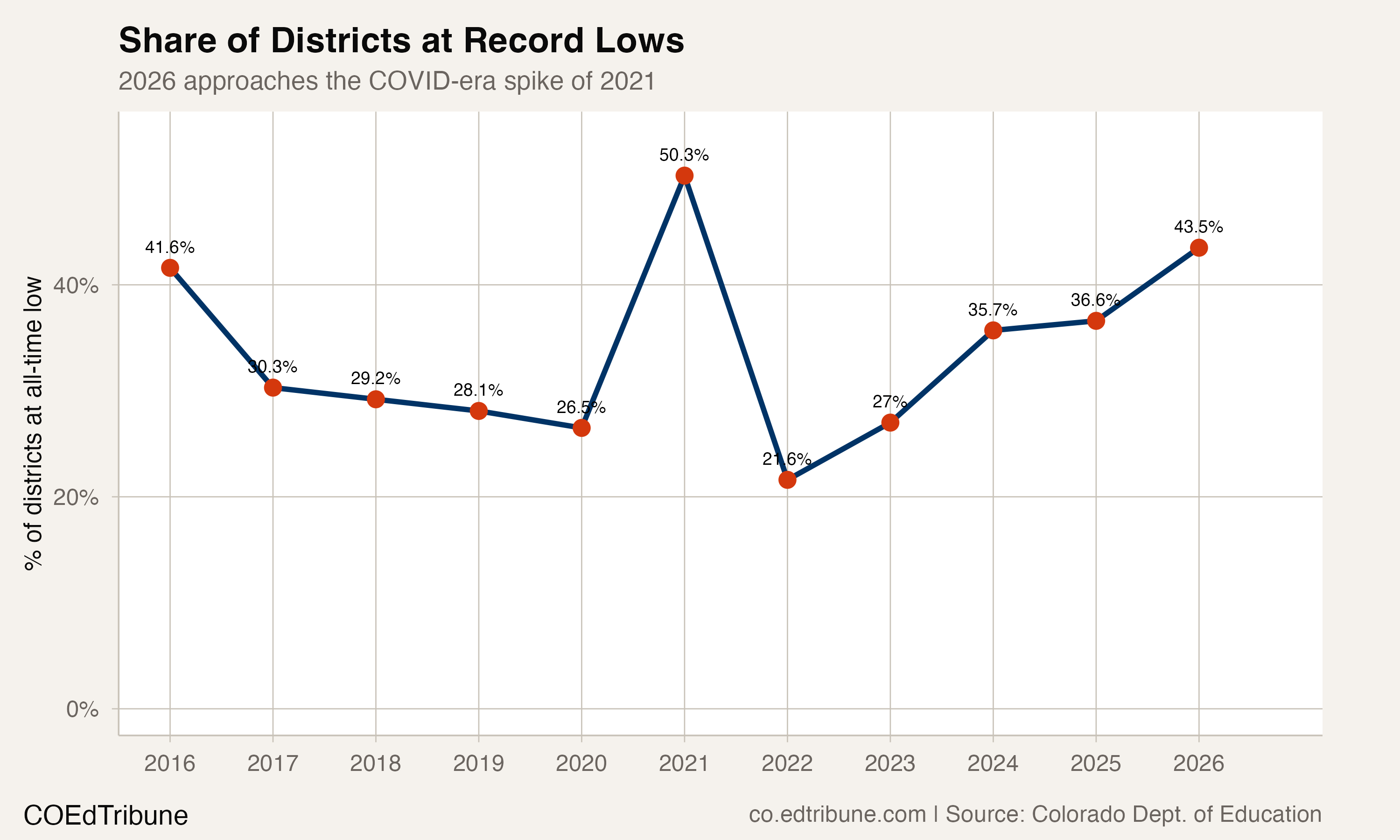
The running-minimum chart compares each year only with the original observations available up to that year. It uses the same complete-identity population throughout. The count increased across the annual comparisons after the post-pandemic rebound, but the chart does not compare an earlier year with data that had not yet been reported.
The planning significance is a broad measured decline with variation still visible inside it. A historical minimum is a description of reported membership, not proof that a place has reached an irreversible floor or that a particular policy caused its losses. Local evidence remains necessary to decide what the smaller count means for schools and services.
Detailed code that reproduces the analysis and figures in this article is available exclusively to EdTribune subscribers.
Discussion
Sign in to join the discussion.
Loading comments...