Friday, May 29, 2026

Colorado Now Has 17,500 More Seniors Than Kindergartners

Colorado's K-to-12th grade ratio collapsed from 105 to 77 in a decade, with 61% of districts now graduating more seniors than they enroll in kindergarten.

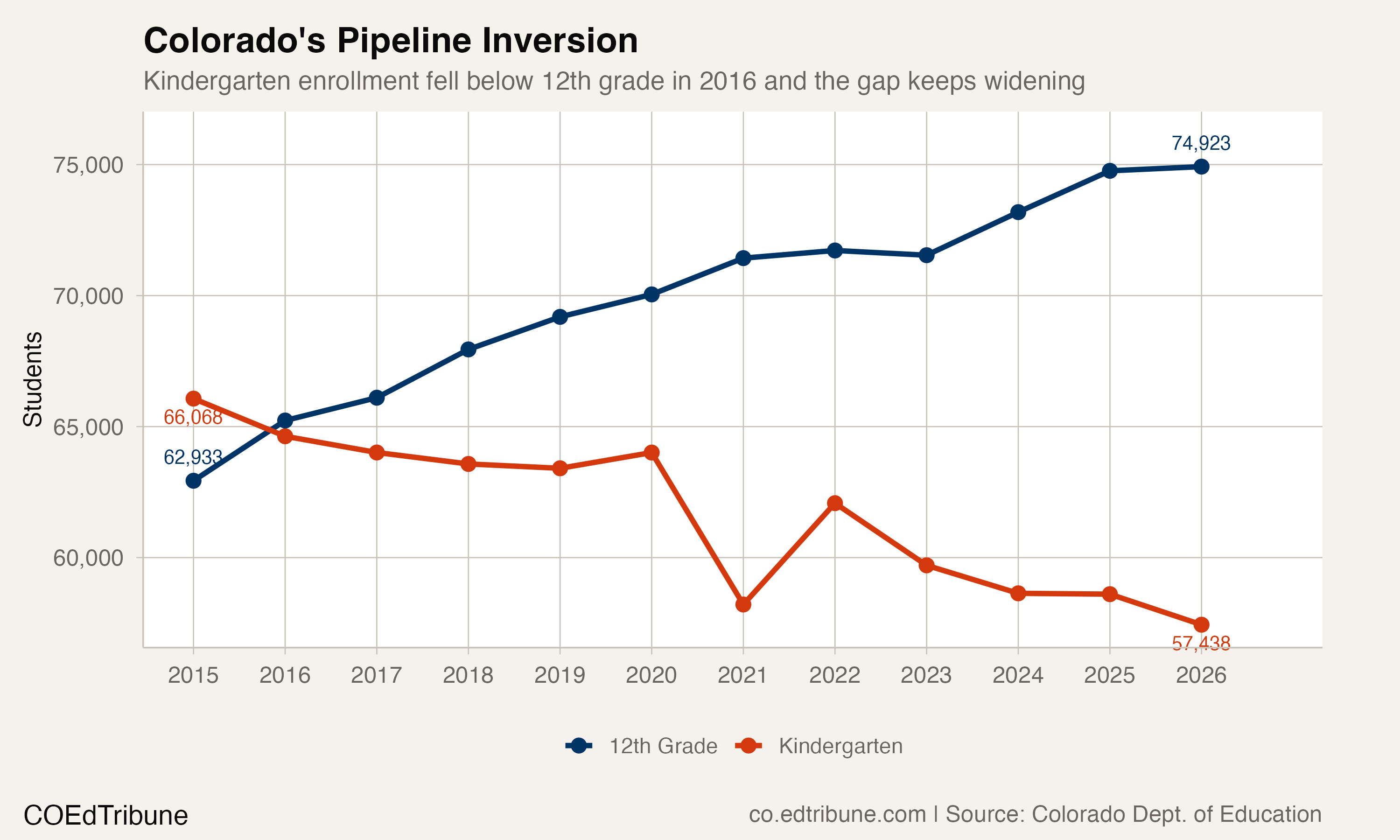
In the 2014-15 school year, Colorado enrolled 66,068 kindergartners and graduated 62,933 seniors. More children entered the pipeline than exited it. That relationship has not held since.

By 2025-26, kindergarten enrollment had fallen to 57,438, a 13.1% decline, while the 12th-grade class had swelled to 74,923, a 19.1% increase. The gap: 17,485 more seniors than kindergartners, a structural deficit that did not exist a decade ago.

Colorado's pipeline inversion: K vs 12th grade enrollment, 2015-2026

A 28-Point Ratio Collapse

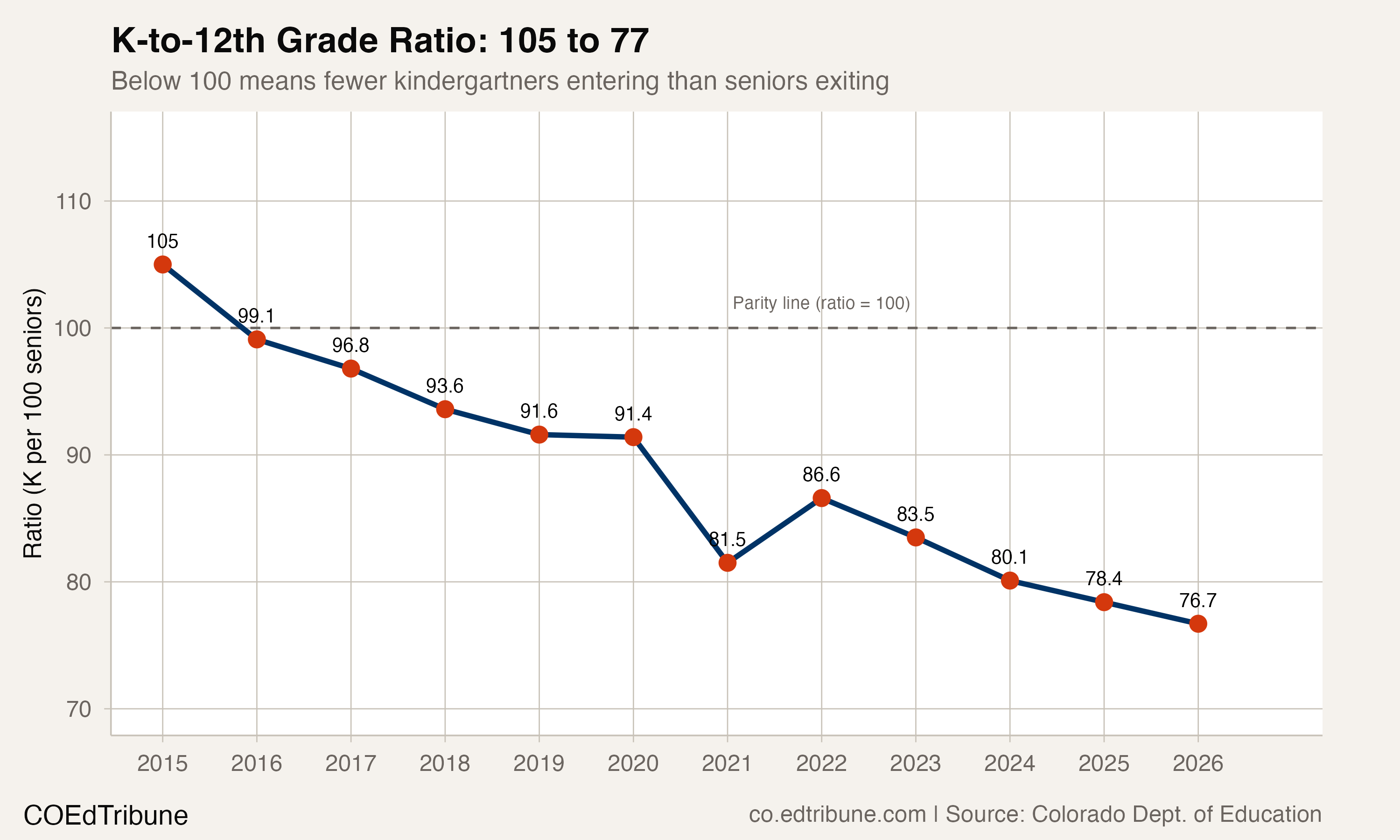
The kindergarten-to-senior ratio offers the simplest measure of a state's enrollment pipeline. At 100, input matches output. Above 100, growth. Below 100, contraction.

Colorado crossed below 100 in 2016 and has never returned. The ratio fell from 105.0 in 2015 to 76.7 in 2026, a 28.3-point decline. For every 100 seniors graduating this spring, Colorado enrolled just 77 kindergartners.

K-to-12th grade ratio over time

The decline was steady before the pandemic, dropping roughly 3 points per year from 2015 to 2020. COVID compressed a decade of pipeline erosion into a single year: the ratio plunged from 91.4 in 2020 to 81.5 in 2021 as kindergarten enrollment cratered by 5,800 students, a 9.1% single-year loss. A partial rebound in 2022 (ratio of 86.6) proved temporary. The ratio resumed its slide and has now fallen to its lowest point on record.

The Staircase Effect

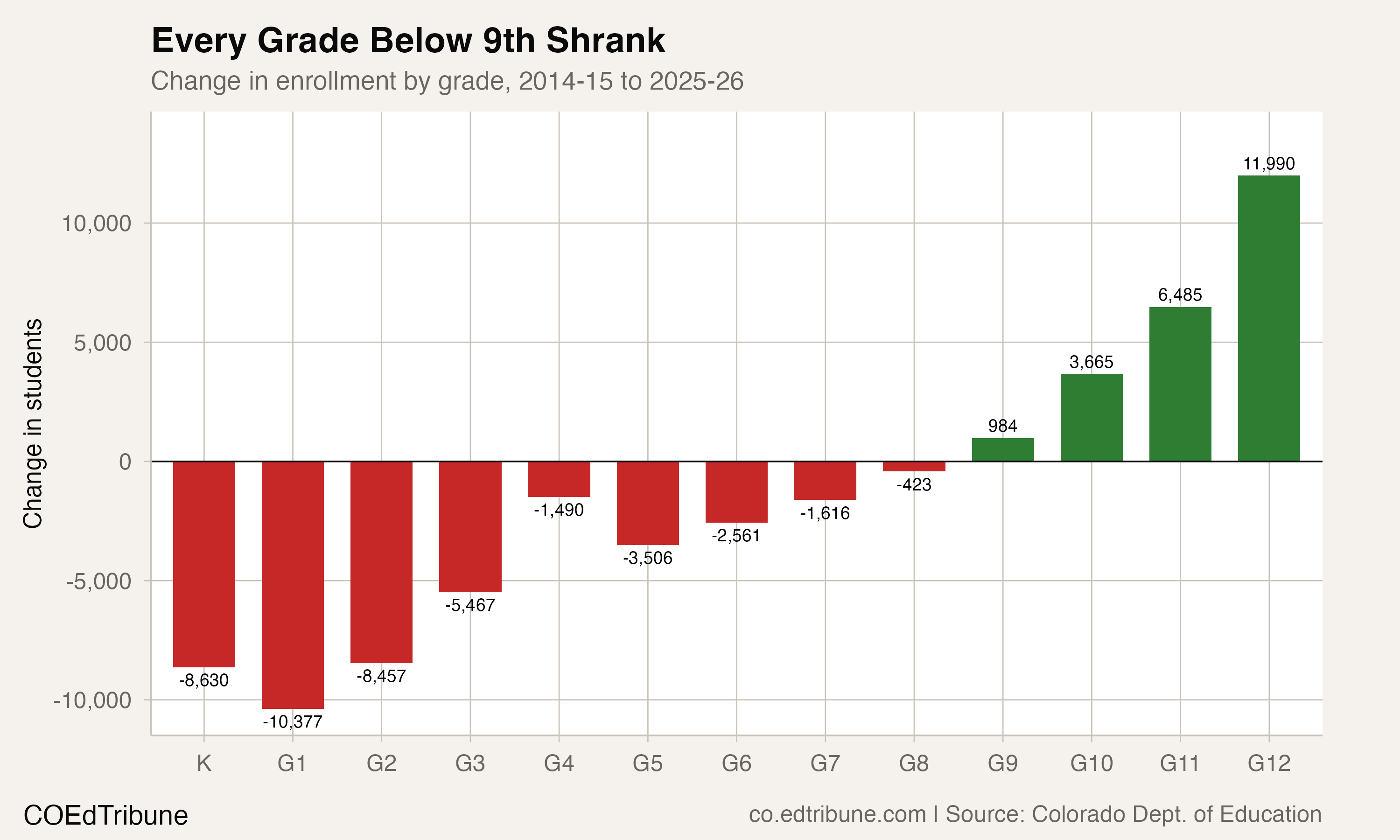
The grade-level breakdown reveals a pattern that looks less like a uniform decline and more like a staircase. Every grade from kindergarten through 8th lost students between 2015 and 2026. Every grade from 9th through 12th gained.

First grade absorbed the steepest loss: 10,377 fewer students, a 15.1% decline. Kindergarten lost 8,630 (-13.1%) and second grade lost 8,457 (-12.3%). The losses diminish steadily moving up the grade ladder, shrinking to just 423 students (-0.6%) in 8th grade before flipping positive at 9th.

Change in enrollment by grade, 2015 to 2026

At the top, 12th grade gained 11,990 students (+19.1%), 11th grade gained 6,485 (+10.6%), and 10th grade gained 3,665 (+5.8%). The 12th-grade gain is disproportionately large relative to the other high school grades, which could partly reflect improved graduation persistence or delayed graduation alongside the larger cohort sizes. But the pattern across all four high school grades is consistent: these are the large pre-pandemic cohorts, born before Colorado's birth rate decline accelerated, now working their way out the exit.

High School Just Peaked

The three grade bands tell the story in sequence. Elementary (K-5) has been contracting since 2016, losing 37,927 students overall, a 9.4% decline. Middle school (6-8) peaked in 2020 at 209,975 and has since shed 16,810 students, an 8.0% drop.

High school (9-12) grew for nine straight years, from 254,456 in 2015 to a peak of 282,741 in 2024. That peak has now passed. High school enrollment fell by 405 students in 2025 and then by 4,756 in 2026, a combined decline of 5,161 from the peak. The pipeline squeeze has arrived at the high school level.

Elementary, middle, and high school enrollment bands

This is the leading edge of what districts have been warned about for years. The smaller cohorts that entered kindergarten around 2016-2018 are now reaching 8th and 9th grade. Within three to four years, those cohorts will reach high school. The high school enrollment decline that began in 2025 is not a blip. It is the front of a structural wave.

Where the Pipeline Has Broken

Across 181 districts with both kindergarten and 12th-grade enrollment in 2026, 111 now have more seniors than kindergartners. That is 61.3% of Colorado districts operating with an inverted pipeline.

The largest absolute kindergarten losses have concentrated in the state's biggest districts. Jefferson County R-1ET lost 1,200 kindergartners since 2015, a 19.6% decline. Denver County 1ET lost 1,080 (-14.3%). Adams-Arapahoe 28JET lost 917 (-26.1%). Adams 12 Five Star SchoolsET lost 782 (-27.0%). Cherry Creek 5ET lost 674 (-18.2%).

Top 10 districts by kindergarten enrollment loss

Some of the percentage declines are striking. Pueblo City 60ET lost 39.1% of its kindergarten class, falling from 1,503 to 916 students. Westminster Public SchoolsET lost 43.2%.

Denver's ratio collapse stands out: in 2015, the district enrolled 167 kindergartners for every 100 seniors (7,560 vs. 4,514). By 2026, that ratio had fallen to 99.7 (6,480 vs. 6,500), essentially parity. Denver went from having two-thirds more kindergartners than seniors to having equal numbers in 11 years.

Fewer Babies, Fewer Students

The primary driver is straightforward: Colorado women are having fewer children. The state's general fertility rate has fallen 25.1% compared to the 2001-2010 average, the third-largest decline among all states. Colorado's total fertility rate now stands at 1.5 births per woman, below the national average of 1.6 and well below the 2.1 replacement rate.

The decline is not recent. Colorado births have been falling since 2007, meaning the children entering kindergarten today were born into some of the lowest birth-year cohorts the state has recorded. In Jefferson County alone, births fell from 6,194 in 2007 to 5,521 by 2022, a decline that maps directly onto the kindergarten losses now showing up in enrollment data.

A secondary factor is the growth of alternatives to traditional public schools. Online enrollment across Colorado increased by approximately 1,000 students to 34,617 in 2025-26, and the number of homeschool students jumped by nearly 550 to 10,367. Part-time homeschoolers increased by about 2,750 to 18,740. These alternatives disproportionately affect elementary enrollment, where families have the most flexibility.

Immigration had been partially offsetting birth rate declines. Hispanic enrollment growth, driven in part by new arrivals, sustained some districts through the mid-2020s. But that dynamic reversed in 2026: Hispanic enrollment dropped by 4,395 statewide after years of growth, with some recent arrivals departing Colorado.

Schools Built for Cohorts That No Longer Exist

The operational consequences are already visible. Jeffco, the state's second-largest district, has closed 21 schools since 2021 and currently operates 18 schools at less than 60% capacity. Projections show that number could grow to 28 schools by 2027-28. The district cut at least 150 jobs in late 2025, part of a $45 million spending reduction driven by enrollment that has dropped nearly 13% since 2014.

"We're looking at an unfortunate victim of the privilege of choice for families." — Jeffco school board member, discussing school closures, Chalkbeat Colorado, Feb. 2025

The fiscal challenge is structural. Colorado's school funding formula allocates dollars per pupil. When enrollment drops, revenue drops, but fixed costs for buildings, administration, and debt service do not. The 2025 School Finance Act increased per-pupil funding to $11,852, up from $8,123 in 2018-19, and includes a "hold harmless" provision ensuring no district receives less than the prior year. But 21 districts with steep enrollment losses are now dependent on that hold-harmless cushion, a buffer that could erode if the decline accelerates.

The state demographer projects that the statewide enrollment decline will continue through approximately 2028, driven by the combination of falling births and reduced in-migration. Colorado Education Commissioner Susana Cordova has noted that the decline reflects "fewer births over 20 years, population decreases in 30% of Colorado counties, and increased enrollment in part-time and online programs."

What Comes Next

The pipeline data is unambiguous about direction, even if the pace is uncertain. The 57,438 children who entered kindergarten this year will become the 12th-grade class of 2038-39. If Colorado's birth rate holds near its current level, the kindergarten classes entering between now and then will be no larger.

High school enrollment, which just peaked, will decline for at least the next several years as smaller cohorts replace the large pre-pandemic classes. Middle schools are already six years into their contraction. Elementary schools have been shrinking for a decade.

Colorado's K-12 system is going to get smaller. The pipeline has already decided that. What it hasn't decided is whether the 2028 trough the state demographer projects is actually a floor, or just a pause on the way down.

Detailed code that reproduces the analysis and figures in this article is available exclusively to EdTribune subscribers.

Discussion

Loading comments...