Correction (October 8, 2026): This article now uses the original annual-file counts, correct category rankings and annual additions. Unsupported explanations and quotations have been removed. Kindergarten and district comparisons describe measured shares rather than inferred causes.
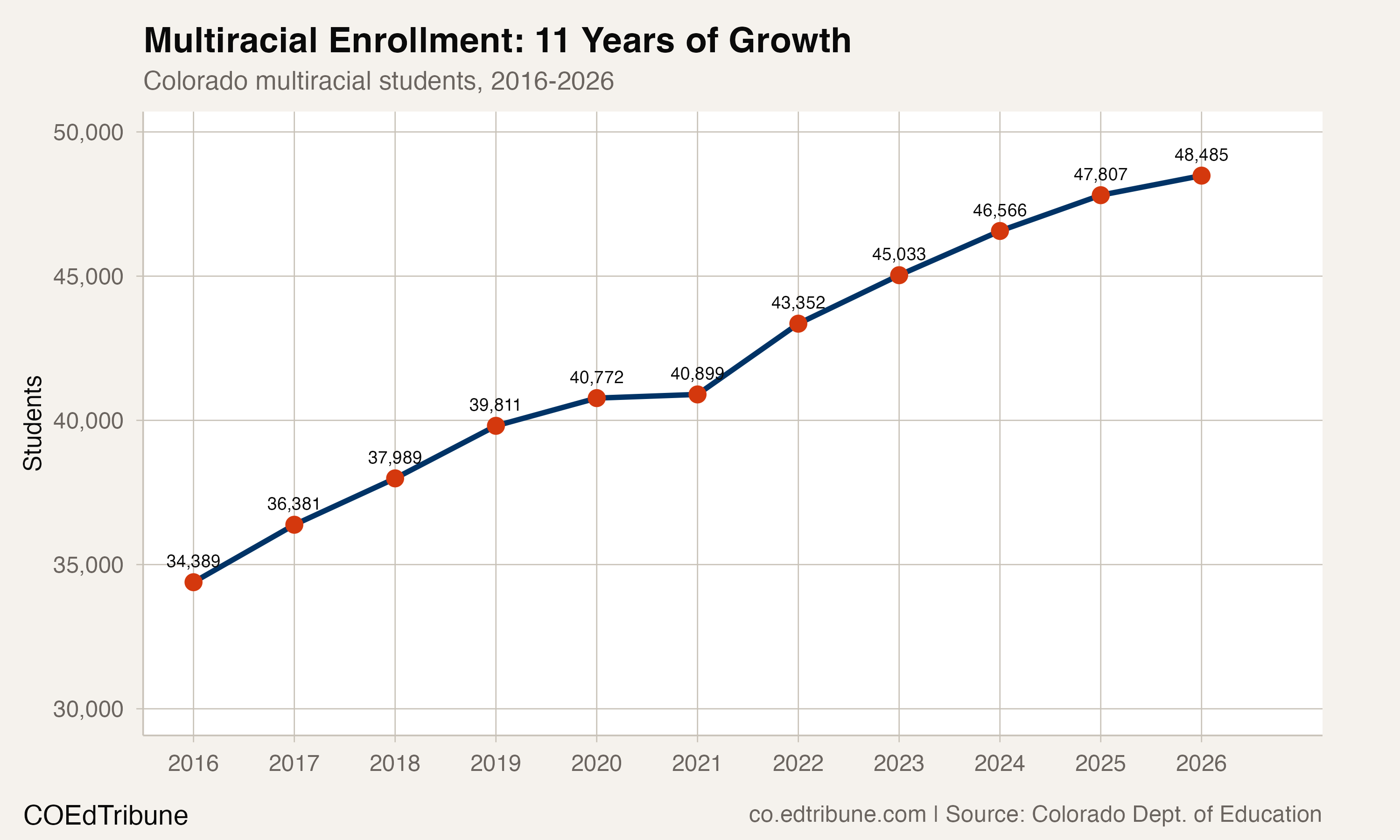
Colorado reported 48,485 multiracial students in 2025–2026, last school year's membership and the most recent published data. That was up from 34,393 in 2015–2016, a gain of 14,092 students, or 41.0%, while statewide membership declined by 28,319 students over those same endpoints.
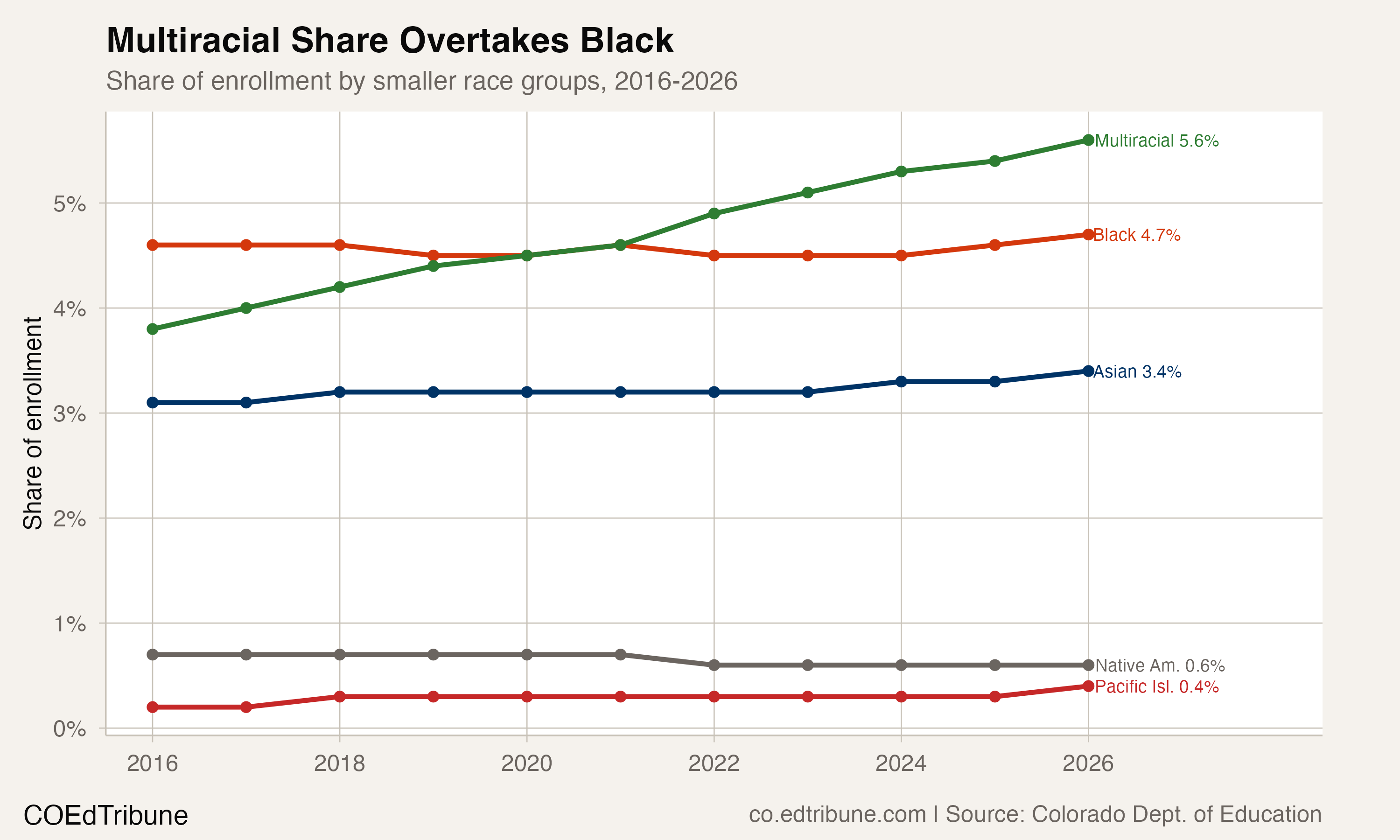
The multiracial count increased in all ten annual comparisons in the checked window. It was the only one of the state's seven published racial categories to do so. Its share of the independently published statewide total rose from 3.8% to 5.6%.
This history keeps each year's original annual file from the Colorado Department of Education's membership collection. Later landing-page revisions are not substituted for individual years in the panel.
The category moved up in the ranking
Multiracial membership was the fourth-largest published racial category at the starting endpoint and the third-largest at the final endpoint, behind White and Hispanic membership.
In 2019–2020, the multiracial count was 40,794, still below the Black count of 41,554. In 2020–2021, the order changed: multiracial membership reached 40,904, compared with 40,420 Black students. That was the first crossover in the checked window, and multiracial counts remained higher thereafter.
By 2025–2026, the corresponding shares were 5.6% and 4.7%. Both use the same published statewide total; the ranking is based on actual counts, rather than equality after rounding percentages.
Annual additions became smaller after the peak
Multiracial membership added 968 students in 2019–2020 and 110 in 2020–2021. The following year added 2,449, the largest annual gain in this checked history.
The subsequent gains were smaller in each comparison: 1,689 in 2022–2023, 1,528 in 2023–2024, 1,237 in 2024–2025 and 678 in 2025–2026. Membership continued to grow, but the size of the annual addition declined after that peak.
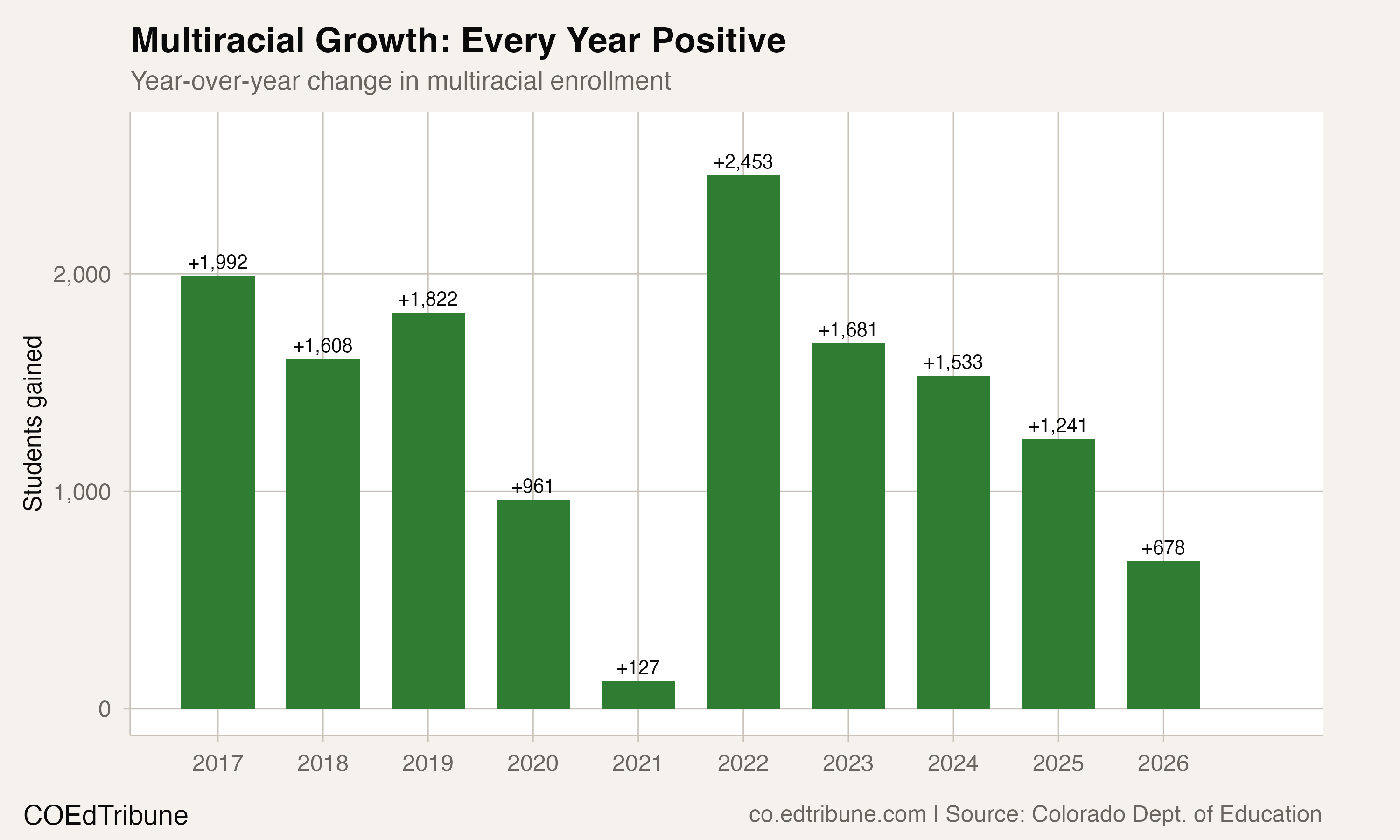
Those changes do not identify a ceiling for future enrollment or establish why growth slowed. They describe the annual differences already recorded.
Selected districts and kindergarten shares
The multiracial share increased in each of the selected district histories. Cherry Creek 5↗ET rose from 6.2% to 10.1% between the endpoints. District 49↗ET, reported under its earlier district name in the starting file, rose from 6.8% to 10.3%. Academy 20↗ET rose from 6.1% to 9.0%, and Colorado Springs 11↗ET from 7.4% to 9.5%.
These are named district comparisons, rather than a claim about a complete geographic or military-community universe. Each share uses the district's independently published total for that school year. The seven reported categories reconcile to those totals at both endpoints.
Statewide, the multiracial kindergarten share was 4.5% at the starting endpoint and 6.2% at the final endpoint. Both exceeded the corresponding all-grade share, using the separately published kindergarten total as the denominator. This difference does not demonstrate whether new families, category reporting or another factor caused the growth, nor does it establish a trend for every incoming cohort.
The state's files show increasing reported multiracial membership over this window. They do not connect individual students across categories or record why families chose a category. The measured trend therefore cannot allocate growth among births, migration, military moves or changes in classification.
Detailed code that reproduces the analysis and figures in this article is available exclusively to EdTribune subscribers.
Discussion
Sign in to join the discussion.
Loading comments...