Wednesday, April 8, 2026

District 27J adds 7,187 students as Denver's northern suburbs absorb the growth

Colorado lost nearly 18,000 public school students between 2014-15 and 2025-26. School District 27J gained 7,187.

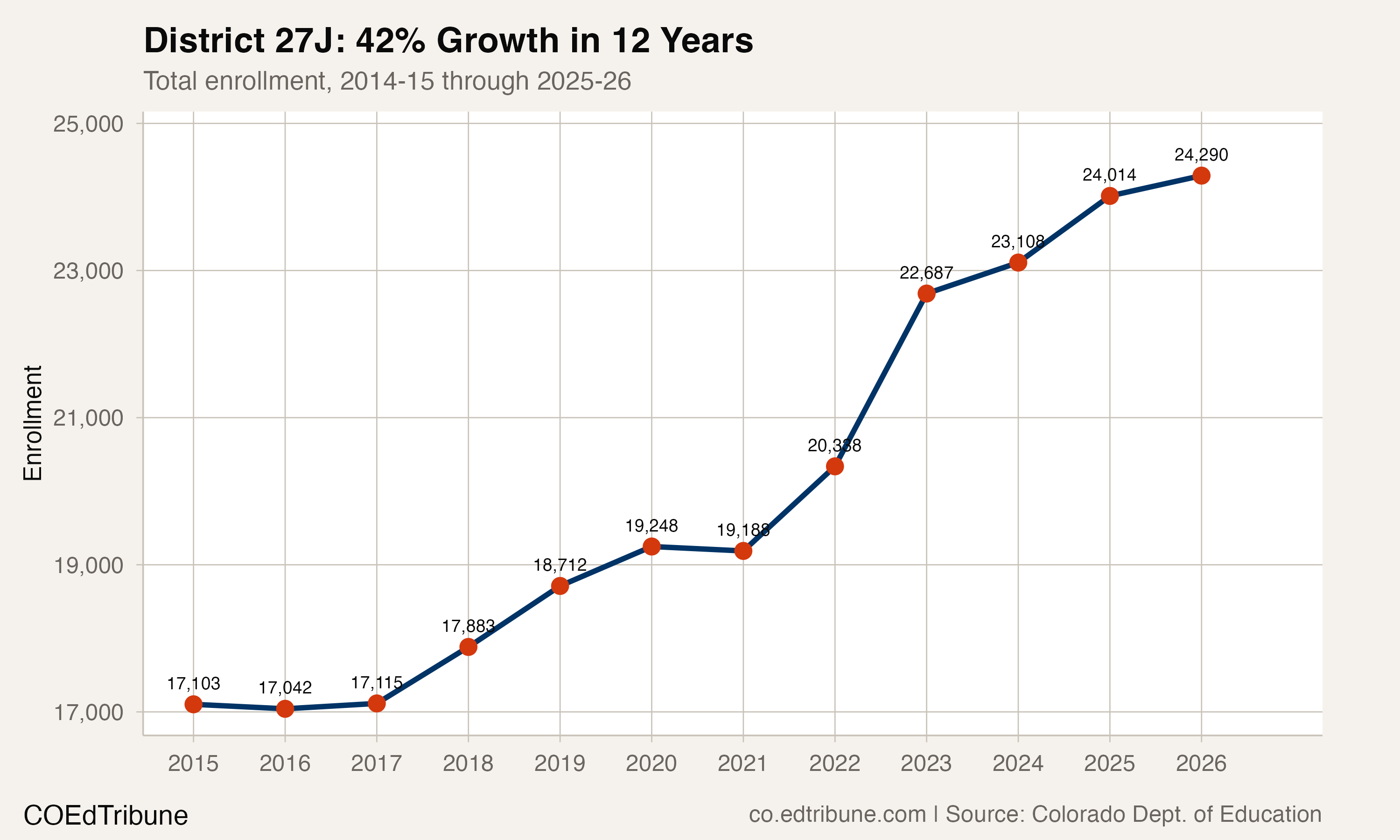
The district, which serves Brighton, Commerce City, and parts of Thornton along the I-76 corridor north of Denver, grew from 17,103 students to 24,290 over those 12 years, a 42.0% increase. It is the only metro Denver district that currently enrolls more students than it did before the pandemic. Among Colorado's 186 districts, 27J added more students than any other traditional district.

That growth came in two distinct phases. From 2015 to 2021, the district added roughly 2,000 students at a steady pace. Then something shifted. Between 2021 and 2026, 27J absorbed 5,102 new students, more than double the total from the prior six years. The single biggest jump, 2,349 students in 2022-23, exceeded the total enrollment of 138 of the state's 185 districts that year.

District 27J enrollment trend, 2015-2026

The post-pandemic acceleration

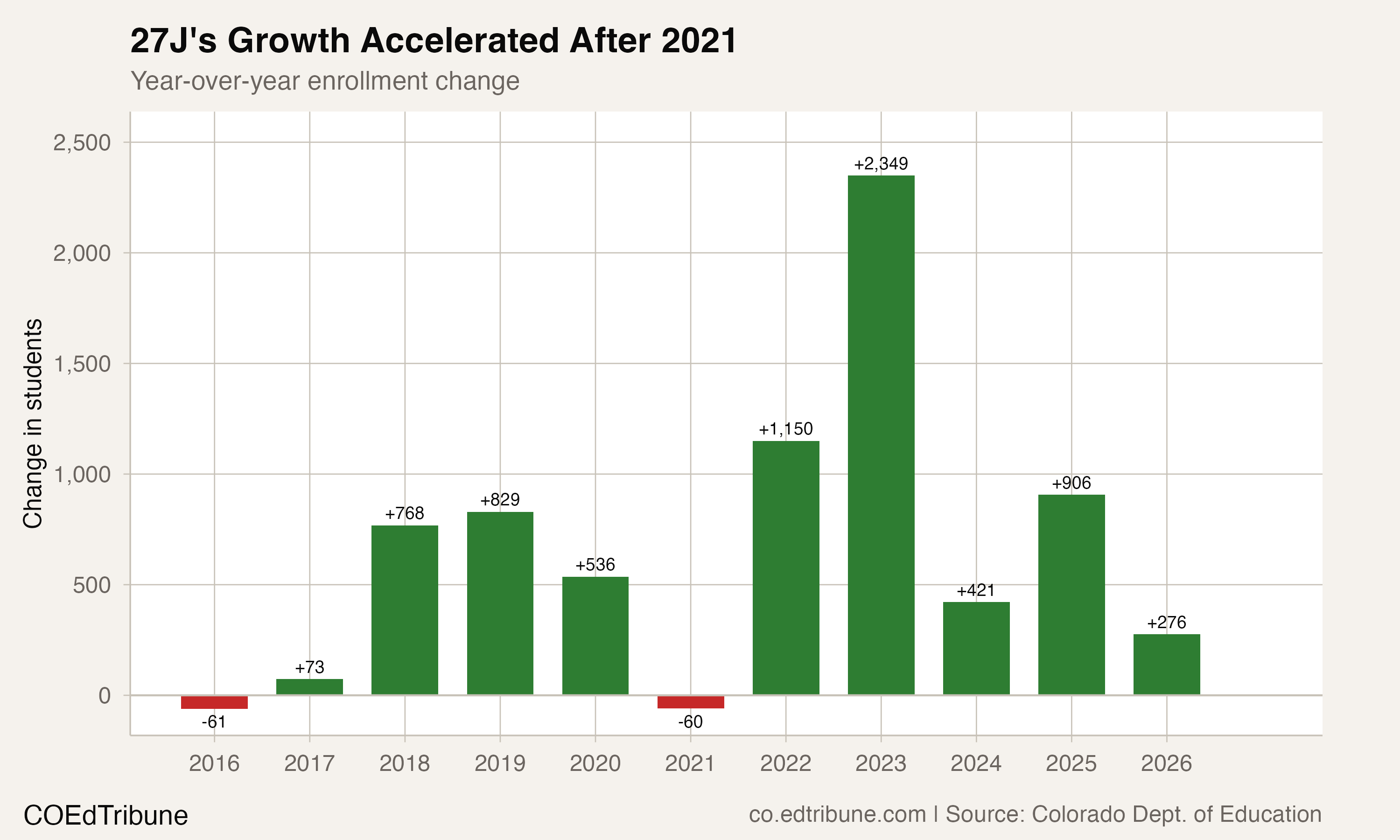
The year-over-year pattern tells the sharper story. 27J's growth flatlined during the pandemic, dipping by 60 students in 2020-21 as COVID disrupted enrollment patterns statewide. But 2021-22 marked a rupture: 1,150 new students arrived, followed by the explosive 2,349-student surge in 2022-23.

Growth has moderated since that peak, from 421 in 2023-24 to 906 in 2024-25 to 276 in 2025-26. The deceleration is notable. Whether it signals the corridor is approaching saturation or merely reflects a construction cycle between new school openings is an open question.

Year-over-year enrollment change for 27J

The district climbed from 16th-largest in Colorado in 2015 to 12th in 2026, passing established districts that were shrinking. Its share of statewide enrollment nearly doubled from 1.9% to 2.8%.

Housing and the I-76 corridor

The most likely driver of 27J's surge is residential construction in Brighton and Commerce City. Commerce City is one of the fastest-expanding communities in the Denver metro area. New homes in Commerce City start around $330,000, well below the metro Denver median, drawing families priced out of closer-in suburbs.

The I-76 corridor itself is undergoing large-scale transformation. BroadRange Logistics signed a lease for 1.1 million square feet at the 76 Commerce Center in Brighton, a deal that accounted for nearly half of metro Denver's industrial leasing volume in the second quarter of 2024. BNSF Railway is building an intermodal facility in nearby Lochbuie. The corridor that BizWest described as undergoing changes that will "forever transform the once-rural corridor" is generating both jobs and rooftops.

27J has responded with construction. A 2021 bond program is funding three new schools scheduled to open in 2027: a comprehensive high school, a middle school, and an elementary school. The district opened Discovery Magnet School, a K-8, in August 2023 with 650 students. As CBS Colorado reported, the district has been building schools to meet growing demand even as most Colorado districts grapple with empty seats.

Superintendent Chris Fiedler has projected the district's long-term buildout capacity at approximately 50,000 students, more than double the current enrollment.

The northern corridor divergence

27J is not an isolated case. It anchors a broader northern Front Range growth corridor that is diverging sharply from established metro Denver districts.

Windsor RE-4, 60 miles north on I-25, grew 74.1% over the same period, from 5,102 to 8,883 students. Greeley 6 added 1,595 students (+7.5%). Johnstown-Milliken RE-5J grew 12.7%. All four northern corridor districts gained enrollment since 2015.

The established metro districts went the opposite direction. Jefferson County lost 12,360 students (-14.3%). Adams 12 Five Star Schools lost 5,662 (-14.6%). Adams-Arapahoe 28J lost 3,532 (-8.5%). Even Denver, the state's largest district, is essentially flat at +371 students over 12 years, with its chief financial officer telling Chalkbeat Colorado that the district is "not seeing continued inflows of students."

Northern corridor vs metro district enrollment trends

The pattern is a suburban donut in motion. Families are leapfrogging the inner-ring suburbs, where housing costs have escalated, and landing in communities along the I-76 and I-25 corridors where new construction offers more affordable options. The older, larger districts are left absorbing the losses.

A district that is also diversifying

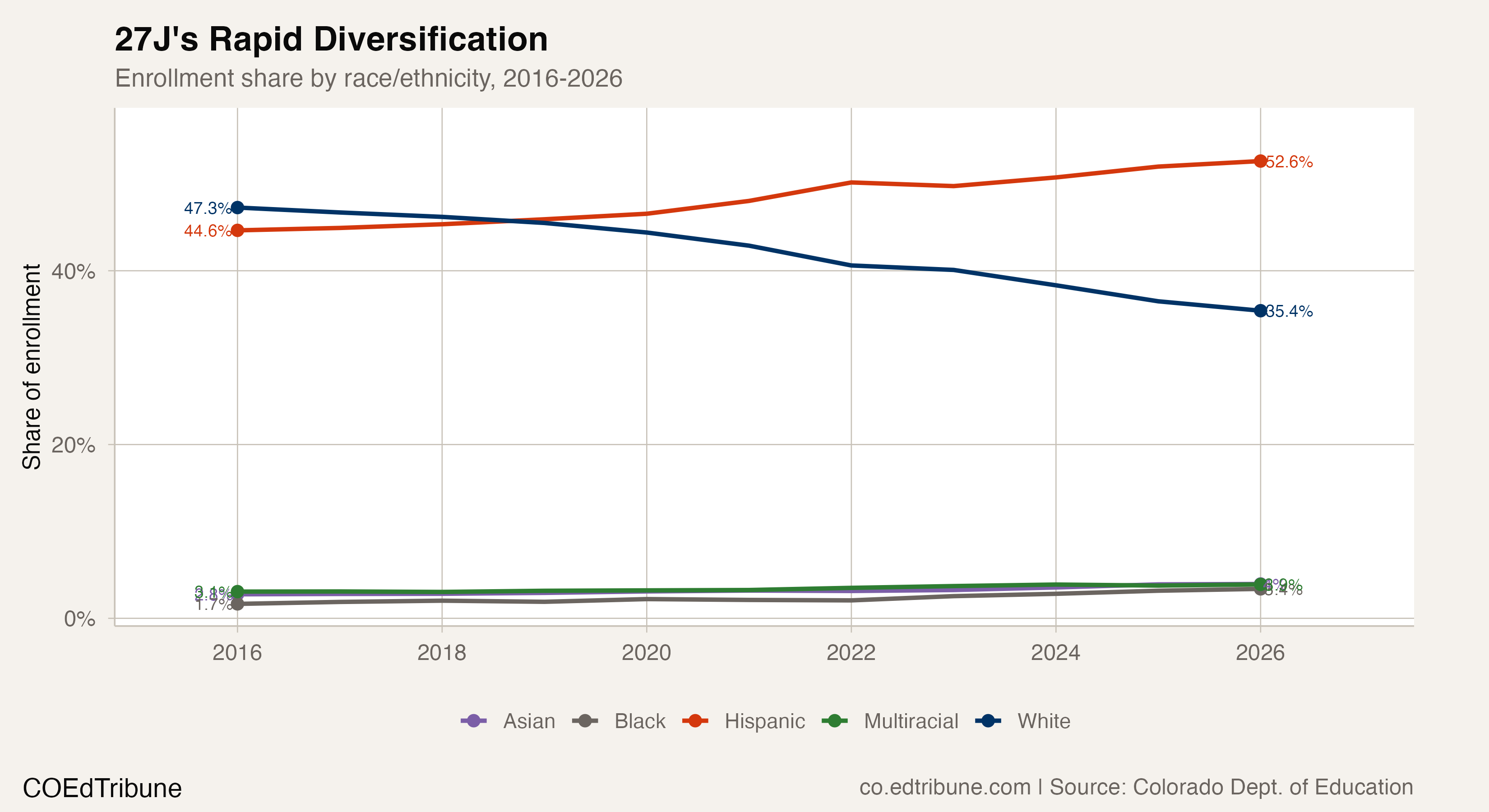
27J's growth has been accompanied by rapid demographic change. In 2016, the district was 47.3% white and 44.6% Hispanic. By 2026, Hispanic students comprised 52.6% of enrollment while white students fell to 35.4%, a swing of nearly 20 percentage points.

The shift is driven partly by composition and partly by volume. Hispanic enrollment grew by 5,173 students (+68.0%), accounting for 72% of the district's total growth. White enrollment also grew in absolute terms, adding 543 students (+6.7%), but white students' share of the expanding total dropped 11.9 percentage points.

Black enrollment nearly tripled from 283 to 823 students. Asian enrollment more than doubled from 471 to 960.

Demographic composition of 27J enrollment

The diversification mirrors the broader pattern in Adams County, which the Colorado state demographer's office has identified as a younger county likely to see greater upticks in births compared to aging counties elsewhere in the metro area.

Funding under pressure

Growth carries its own fiscal strain. Fiedler told CBS Colorado that the district is "doing 100% of the work with about 80% of the revenue" compared to surrounding districts.

That gap reflects a structural problem. Colorado's per-pupil funding follows students, but rapid growth means districts must build facilities and hire staff before the funding catches up. 27J voters have approved five of nine bond measures but rejected all seven attempts at a mill levy override, which would fund ongoing operations rather than construction. The district is building schools without the operating revenue to fully staff them.

The Common Sense Institute, in a May 2025 report on Colorado's declining birth rates and school enrollment, found that Colorado experienced a 25.1% reduction in its general fertility rate compared to the 2001-2010 average, the third-largest decline nationally. But growth districts like 27J face the opposite of the enrollment crisis consuming most of the state. Their challenge is absorbing demand, not managing decline.

How long can it last

The state demographer projects statewide enrollment declines continuing through approximately 2028, driven by reduced birth rates and decreased migration. But that projection reflects a statewide average that masks enormous geographic variation.

27J's growth decelerated to 276 students in 2025-26, the smallest gain since 2017. Whether that signals a cooling housing market, the temporary absence of a new school opening, or the beginning of a plateau will become clearer when the 2027 school openings absorb their first cohorts.

Top growing Colorado districts by enrollment change

The northern Front Range corridor has three new schools, a logistics hub, and an intermodal rail facility either under construction or recently completed. The infrastructure is being built for continued growth. The question is whether the families will follow at the pace 27J experienced in 2022 and 2023, or whether the district's trajectory is settling into something more sustainable.

For a state losing 10,000 students a year, 27J is the exception that frames the rule. Colorado's enrollment is not declining everywhere. It is relocating.

Detailed code that reproduces the analysis and figures in this article is available exclusively to EdTribune subscribers.

Discussion

Loading comments...