Correction: This article has been revised to distinguish recent identified charter-school membership from incomplete historical classifications. The earlier decade-long sector comparison and claims about a fixed enrollment ceiling have been removed.
Schools identified as charters in Colorado’s annual files reported 136,627 students in 2025–2026, last school year and the most recent published data. That was an addition of 409 students, following an addition of 995 in the preceding annual comparison.
The smaller addition supports a limited finding: identified charter-school membership increased more slowly in the most recent comparison. It does not establish a permanent enrollment ceiling, an explanation for the change, or an exact decade-long charter-sector trend.
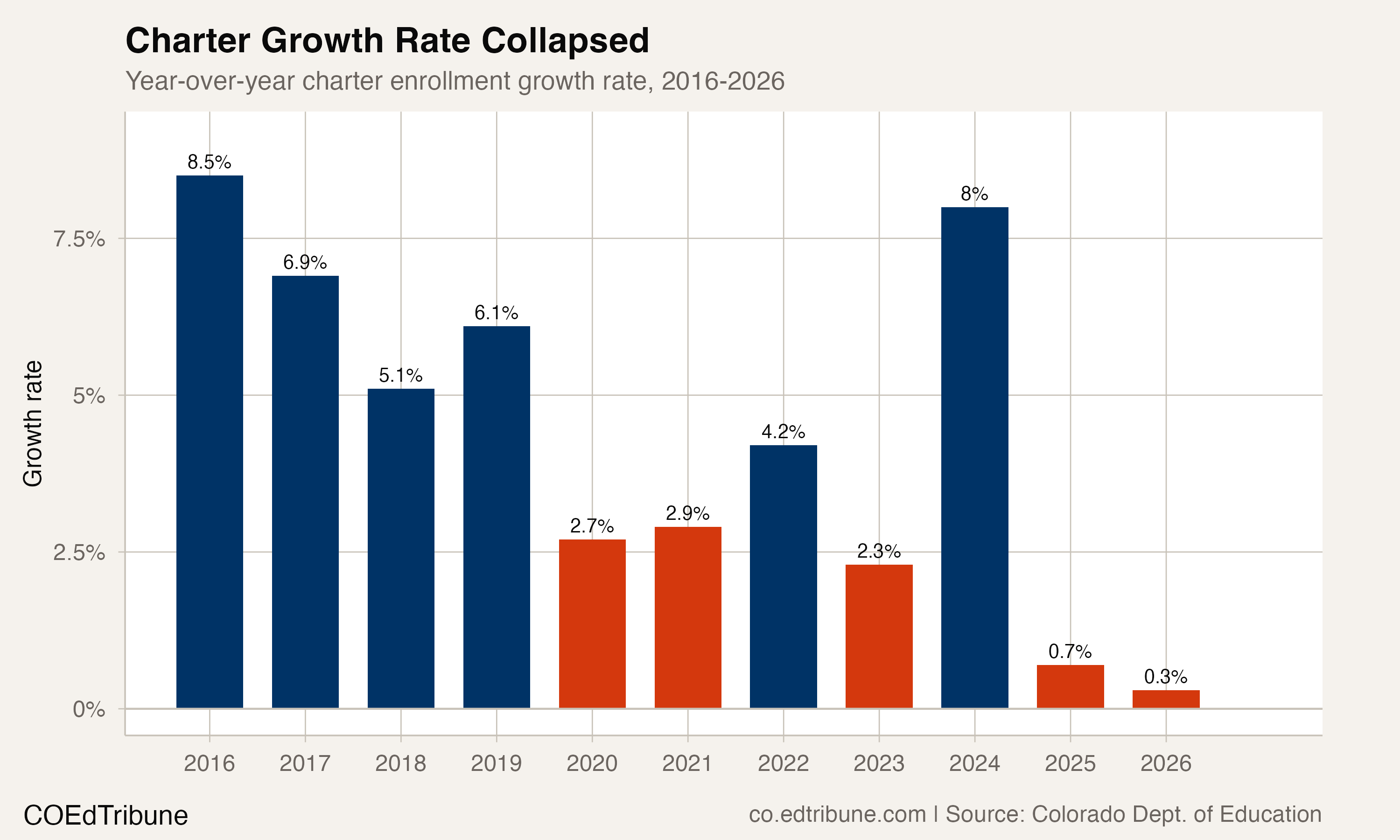
Recent membership rose, while the annual gain narrowed
The recent sequence is consistent across the original annual membership files. Identified charter schools reported 135,223 students in 2023–2024, followed by 136,218 in 2024–2025 and 136,627 in 2025–2026.
The files identified 261 charter campuses in the first of those years and 262 in each of the following years. A stable count of identified campuses does not prove that no schools opened or closed: the count alone does not trace individual openings, closures or changes in classification.
Every school membership count used in this recent comparison is published, and each school has an explicit charter classification for its own reporting year. The comparison does not borrow a later school’s classification to fill an earlier gap.
Shares use the statewide total and retain the gap
Colorado’s separately published statewide total was 870,793 students in the most recent year. Dividing identified charter membership by that total gives a lower-bound share of 15.7%. The corresponding lower bounds were 15.3% in 2023–2024 and 15.5% in 2024–2025.
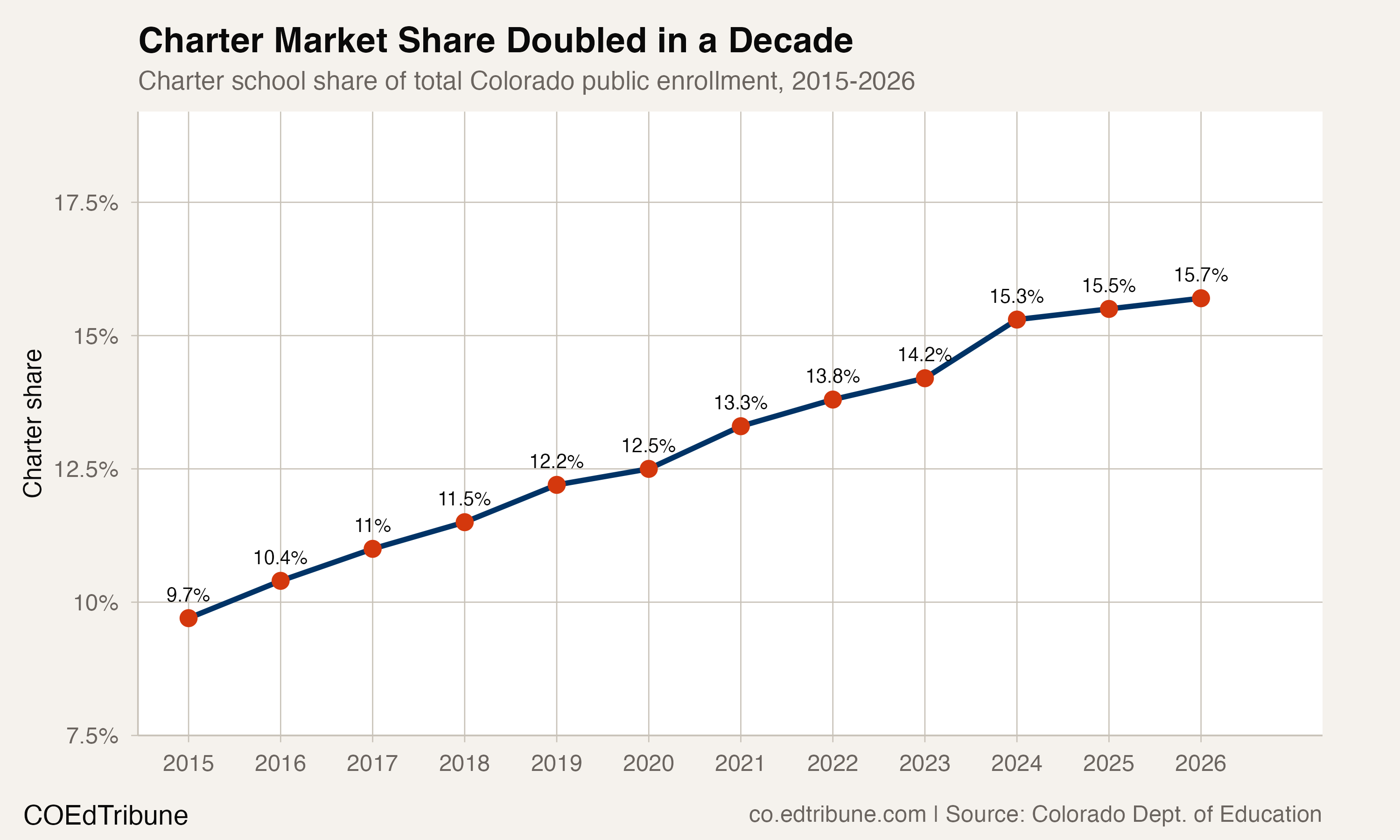
These shares use the published statewide enrollment as the denominator, not a smaller total assembled from whichever school rows are available. In the most recent year, statewide enrollment exceeded the sum of known school membership by 184 students. The corresponding differences were 193 and 173 in the preceding files.
That residual is retained as unallocated membership. It is not assigned to charter or non-charter schools. The identified charter numerator supports a lower bound, while subtraction cannot create an independently verified “traditional school” population.
The Colorado Department of Education’s membership collection includes preschool through high school and several kinds of reported organization. A school-level classification table and the broader statewide total therefore need an explicit coverage check rather than an assumption that every statewide student has a classified school row.
Identified membership differs across organizations
The largest reported concentration of identified charter membership in the most recent file was under the Charter School Institute↗ET: 20,966 students across 48 campuses. Denver County 1↗ET reported 20,767 across 52 identified charter campuses.
Douglas County Re 1↗ET reported 16,976 students across 17 identified charter campuses, and District 49↗ET reported 12,612 across 10.
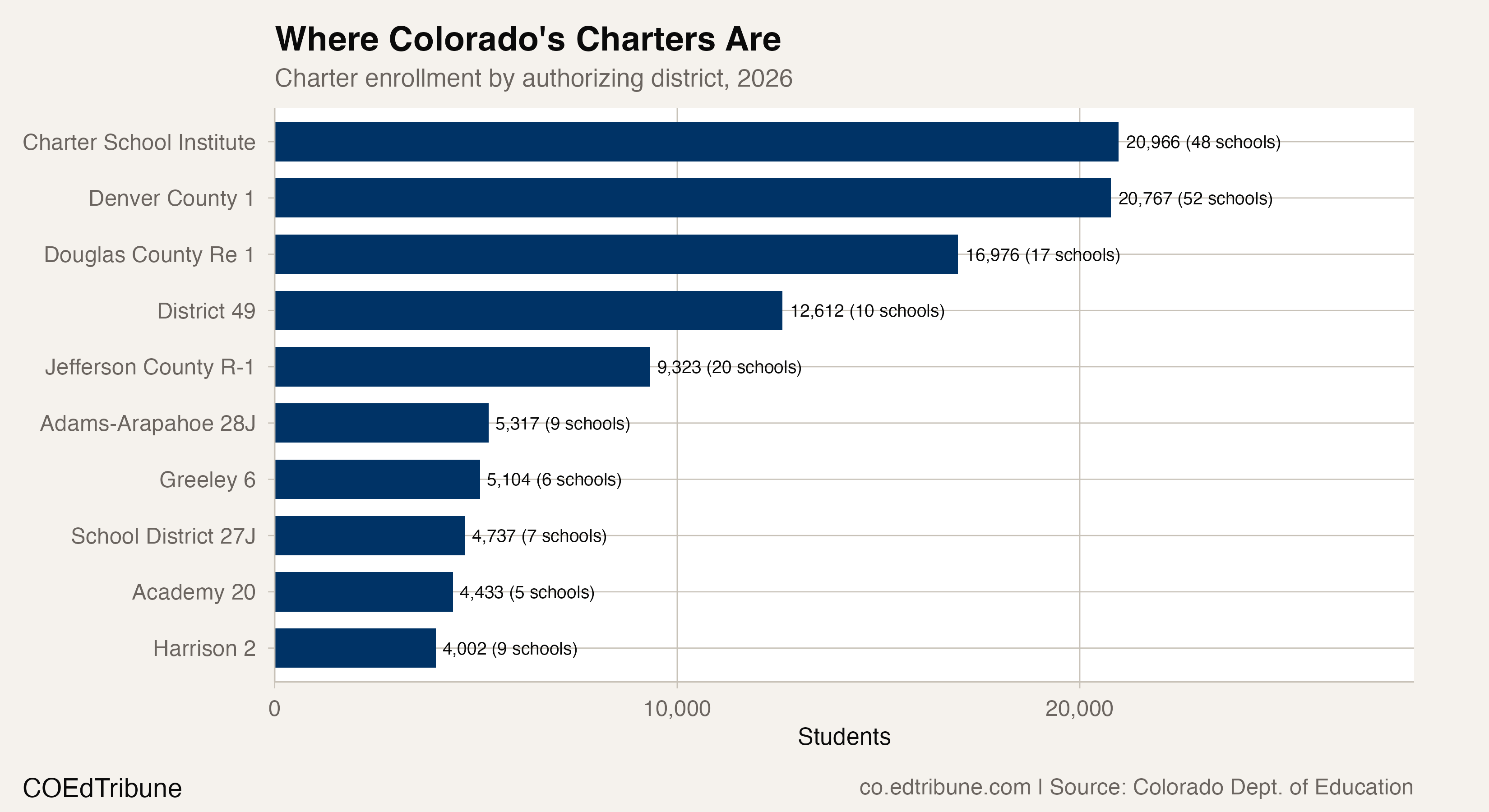
These are charter-campus totals grouped under the reporting organization. They are not the organization’s entire enrollment, nor do they mean every organization plays the same institutional role.
The Charter School Institute’s identified charter membership was below its earlier recent count: it fell from 23,013 in 2023–2024 to 20,966 in 2025–2026, a reduction of 2,047. Statewide identified membership nevertheless rose over the same interval. An overall sector increase can coexist with a decline under a particular reporting organization.
Why the historical ceiling claim has been withdrawn
Earlier annual sources identify some charter schools positively while leaving other school classifications unknown. One historical year has no admitted same-year charter classification. Treating every unknown school as non-charter would manufacture a complete comparison that the records do not support.
That limitation prevents a verified claim here that charter schools doubled their statewide share across the decade or reached a permanent ceiling. Recovering authentic positive historical classifications improves the record, but it does not turn nonlisted schools into confirmed non-charters or prove a complete historical universe.
The recent result remains measurable: identified charter-school membership increased, its annual addition narrowed, and its lower-bound share of the published statewide count rose. The files do not establish whether births, housing, homeschooling, particular closures or transfers between school types caused those changes.
Detailed code that reproduces the analysis and figures in this article is available exclusively to EdTribune subscribers.
Discussion
Sign in to join the discussion.
Loading comments...