Correction: The earlier article treated whole organizations and an individual school as interchangeable virtual operators. That classification was not established by the membership files. Its combined virtual total, classroom-enrollment subtraction and funding estimates have been withdrawn. The comparisons below identify the records actually measured.
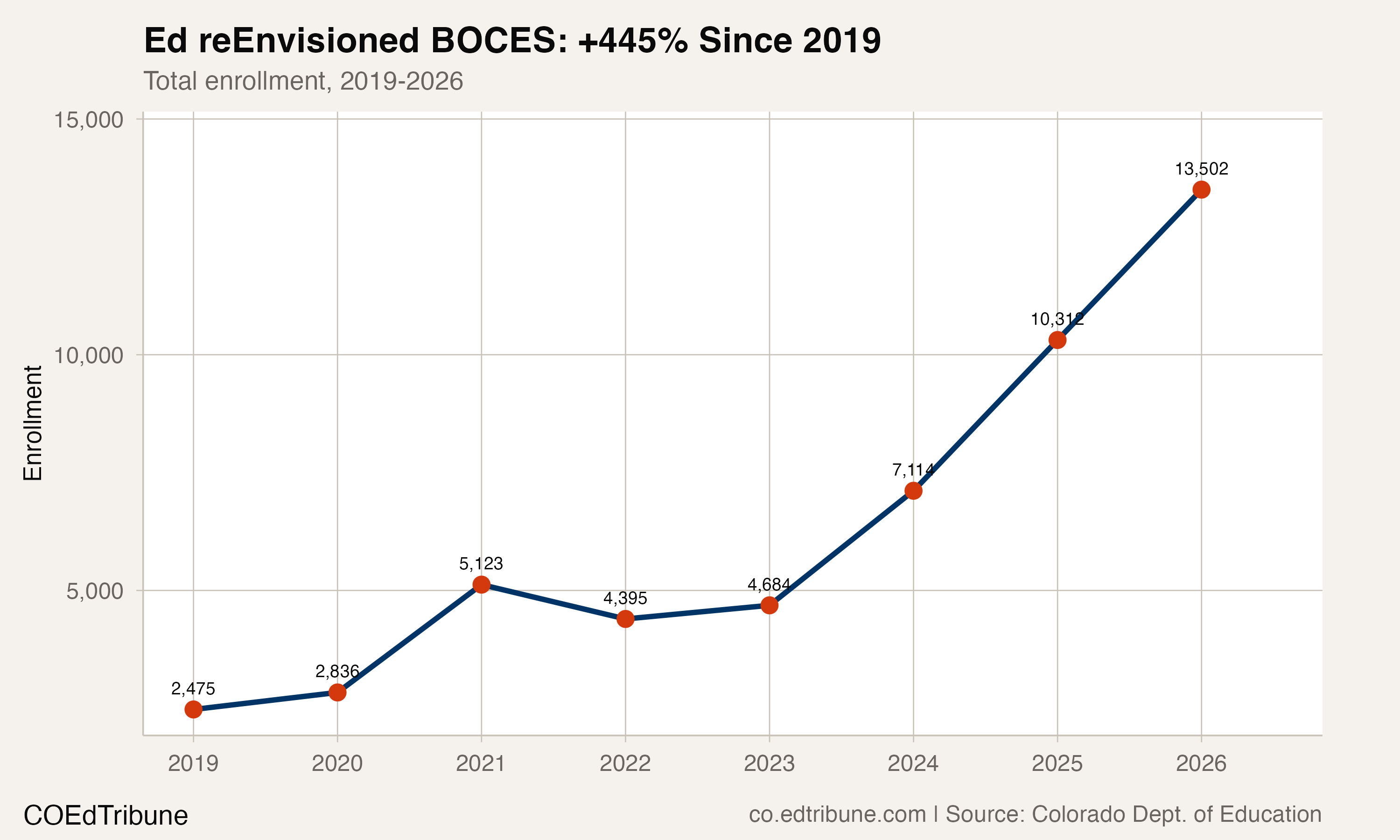
Education reEnvisioned BOCES↗ET reported 13,502 students in 2025–2026, last school year and the most recent published membership data. Its original annual file for 2018–2019 reported 2,475. The increase of 11,027 students, or 445.5%, stands out within a period when Colorado’s statewide total fell.
That growth is a verified change in the cooperative’s reported enrollment. It does not show that every student attended exclusively online, nor that those students moved from a particular geographic district. The enrollment records identify organizations and schools; they do not turn an authorizing organization’s entire membership into a count of a single instructional setting.
Organization growth within a statewide decline
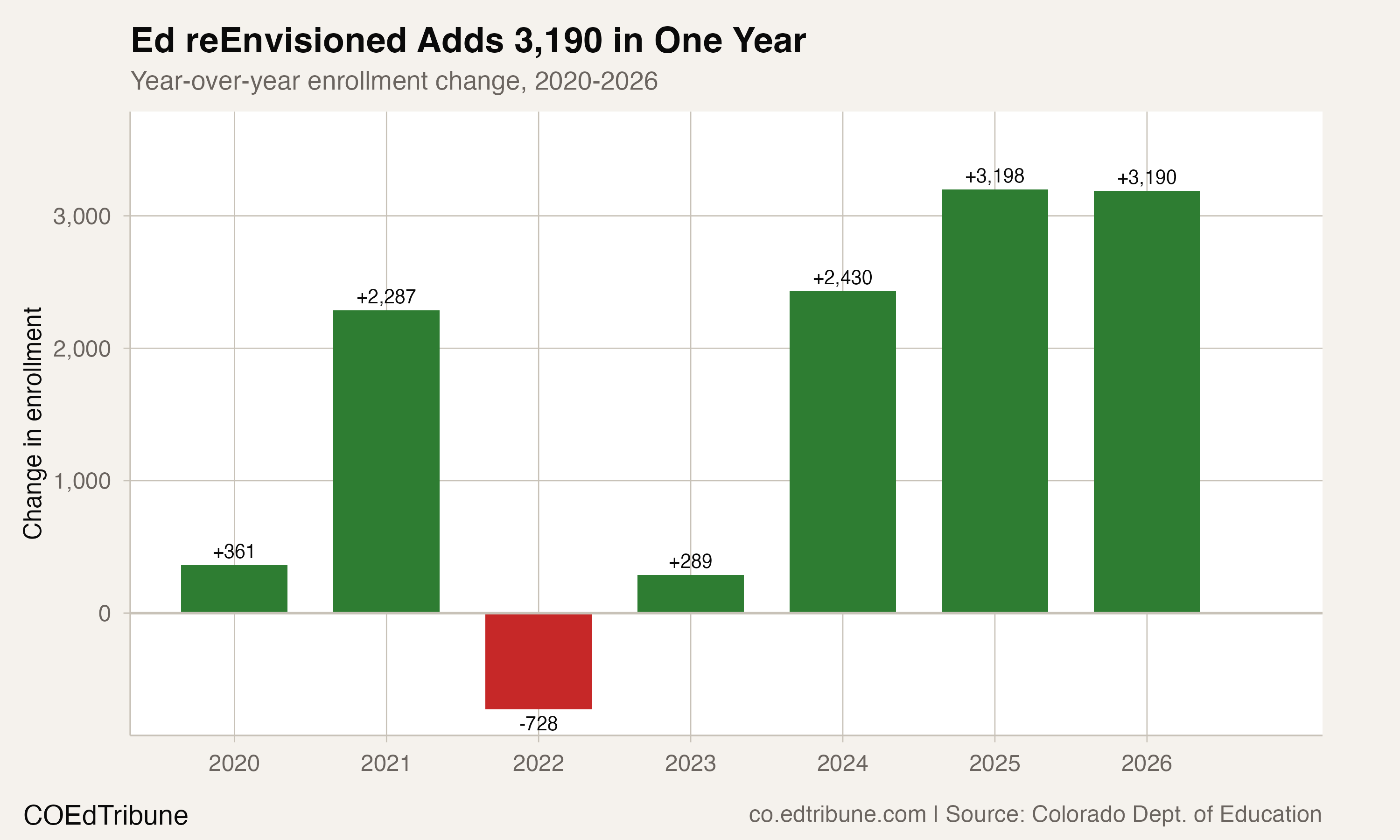
Education reEnvisioned added 2,430 students in the 2023–2024 comparison, 3,198 in the following year and 3,190 in the most recent one. Those increases are changes between adjacent annual organization totals, rather than a forecast of continued growth.
Its most recent count was larger than Pueblo City 60↗ET, which reported 13,302 students. Education reEnvisioned ranked eighteenth by membership among the 186 reporting organizations in the annual file. That is an organization ranking, not a claim that every organization operates like a geographic school district.
Colorado’s original annual files reported 913,223 students in 2019–2020 and 870,793 last school year. The reduction was 42,430 students, or 4.6% of the earlier published total. Education reEnvisioned’s growth and the statewide decline can both be true without one explaining the other.
The cooperative’s last published count represented 1.6% of Colorado’s published statewide membership. That share uses the state’s total as its denominator, including membership outside the organizations highlighted here.
Byers and GOAL are different units of comparison
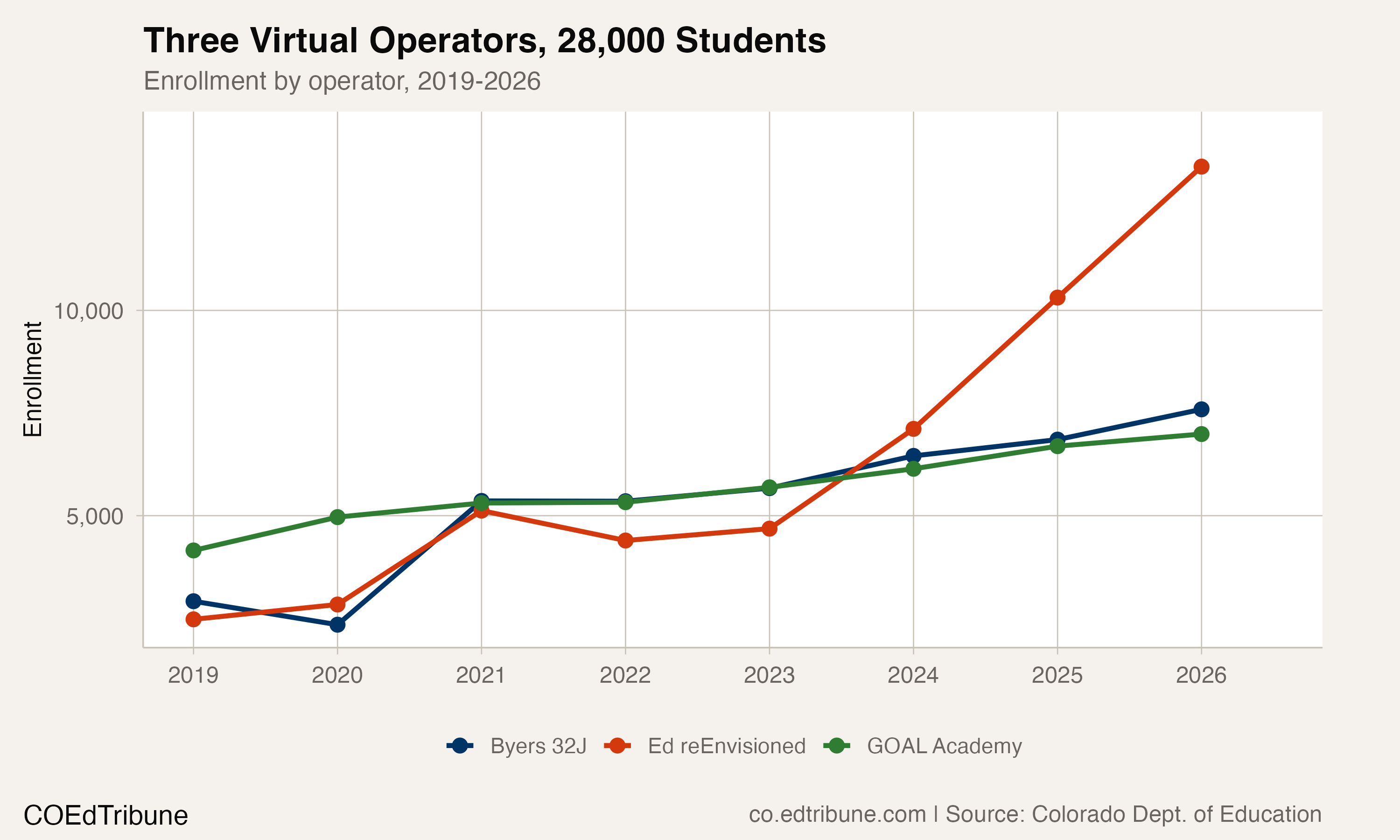
Byers 32J↗ET reported 7,590 students last school year, compared with 2,916 in 2018–2019. Those are whole-district totals.
The district’s official school listing includes Byers Elementary and Byers Junior/Senior High. Describing all district membership as students without buildings would extend beyond what either the totals or that listing establishes.
GOAL Academy’s school record reported 6,988 students last school year, compared with 4,153 in 2018–2019, an increase of 68.3%. That is an individual-school comparison, selected by its school identifier within District 49↗ET.
The state’s official school profile identifies GOAL Academy as a charter school and alternative education campus within District 49. Its online-school directory also lists GOAL under that authorizer. These current directory descriptions provide context; they do not retrospectively classify every student in the whole Byers or Education reEnvisioned organization.
District 49’s published organization total was 26,423 last school year. GOAL Academy accounted for 26.4% of that total. Adding GOAL’s school count to District 49’s entire membership would count the school again. Keeping the two units distinct is essential whenever a school-level observation is placed alongside an organization-level total.
What these records cannot establish
The earlier combined figure selected entire organizations for some students and an individual school for others, then labeled their sum virtual enrollment. A sum can be arithmetically correct while its classification is wrong. The annual membership totals alone do not establish a complete universe of exclusively virtual students.
For the same reason, subtracting that selected sum from statewide membership does not produce a verified classroom-enrollment count. The remainder would still contain students in settings that the subtraction never identified. It would not measure students who transferred, a funding loss or the counterfactual enrollment Colorado would have had without these programs.
The descriptive comparison remains useful. A reporting organization can grow rapidly even as the statewide total contracts, so statewide change does not describe every institution’s experience. Differences in educational structure also mean that a membership ranking should not be read as a ranking of buildings, geographic attendance areas or instructional delivery models.
The history here uses each original annual file, preserving its reporting year and source vintage. Later online summaries may revise earlier values; those revisions are not inserted into this series piecemeal. Current directory descriptions are identified separately from the historical membership counts.
The verified planning question is therefore narrower than the earlier article suggested: how does growth in these particular records affect the services their organizations and schools provide? Answering that requires local program, facility and student-location evidence alongside enrollment. The annual totals establish scale and change; they do not establish an oversight failure or a statewide shift out of classrooms.
Detailed code that reproduces the analysis and figures in this article is available exclusively to EdTribune subscribers.
Discussion
Sign in to join the discussion.
Loading comments...