Colorado's kindergarten classrooms in 2025-26 look nothing like they did a decade ago. White kindergartners numbered 27,385 in the October 2025 count, down 7,400 from 34,785 in 2016. That is a 21.3% decline. Hispanic kindergarten enrollment over the same period barely budged: 21,693 to 21,211, a loss of just 482 students, or 2.2%.
The gap between white and Hispanic kindergartners has collapsed from 13,092 students to 6,174. At the current pace, Hispanic kindergartners will outnumber white kindergartners within a few years. Kindergarten is where the demographic future of a school system first becomes visible, and what Colorado's K classrooms are showing is a state that will look fundamentally different by the time the 2025-26 kindergartners graduate in 2039.
The white K decline accounts for all of it
Total kindergarten enrollment in Colorado fell by 7,193 students between 2016 and 2026, an 11.1% decline. White kindergartners alone lost 7,400, more than the total drop. Every other major racial group either grew or held roughly steady: multiracial kindergartners rose 22.7% (from 2,922 to 3,585), Asian kindergartners increased 9.0% (1,814 to 1,977), and Black kindergartners dipped just 3.1% (2,883 to 2,795).
Put differently, white students accounted for more than 100% of the net kindergarten loss. The slight gains among multiracial and Asian kindergartners partially offset losses that would have been even steeper.
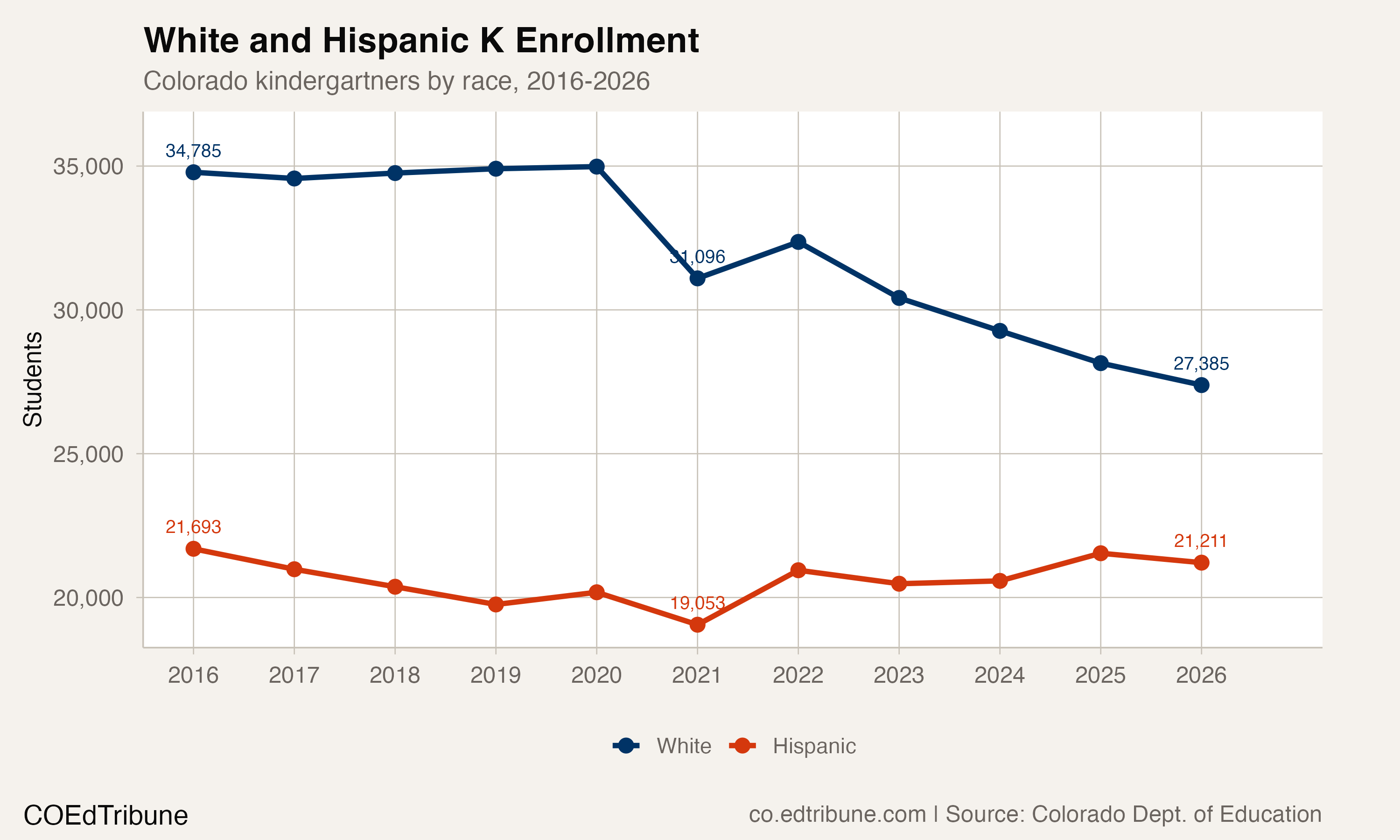
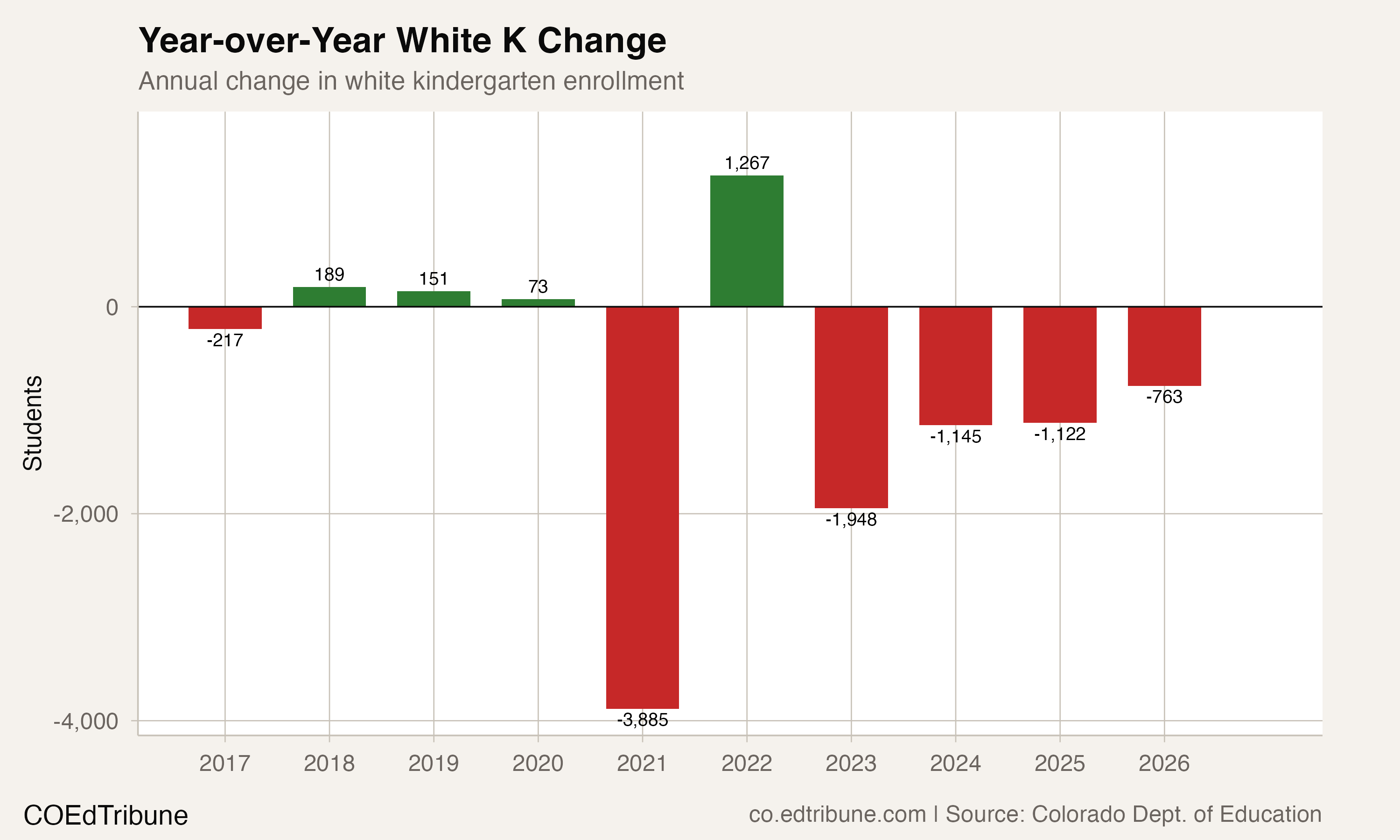
The trajectory is not a straight line. White K enrollment was essentially flat from 2016 to 2020, hovering near 34,800. Then it cratered during COVID, plummeting by 3,885 in a single year to 31,096 in 2021. A partial bounce-back to 32,363 in 2022 proved temporary. Since then, white K enrollment has declined every year, dropping by 1,948, then 1,145, then 1,122, then 763. The current streak of four consecutive years of decline shows no sign of reversing.
Kindergarten crossed the line first
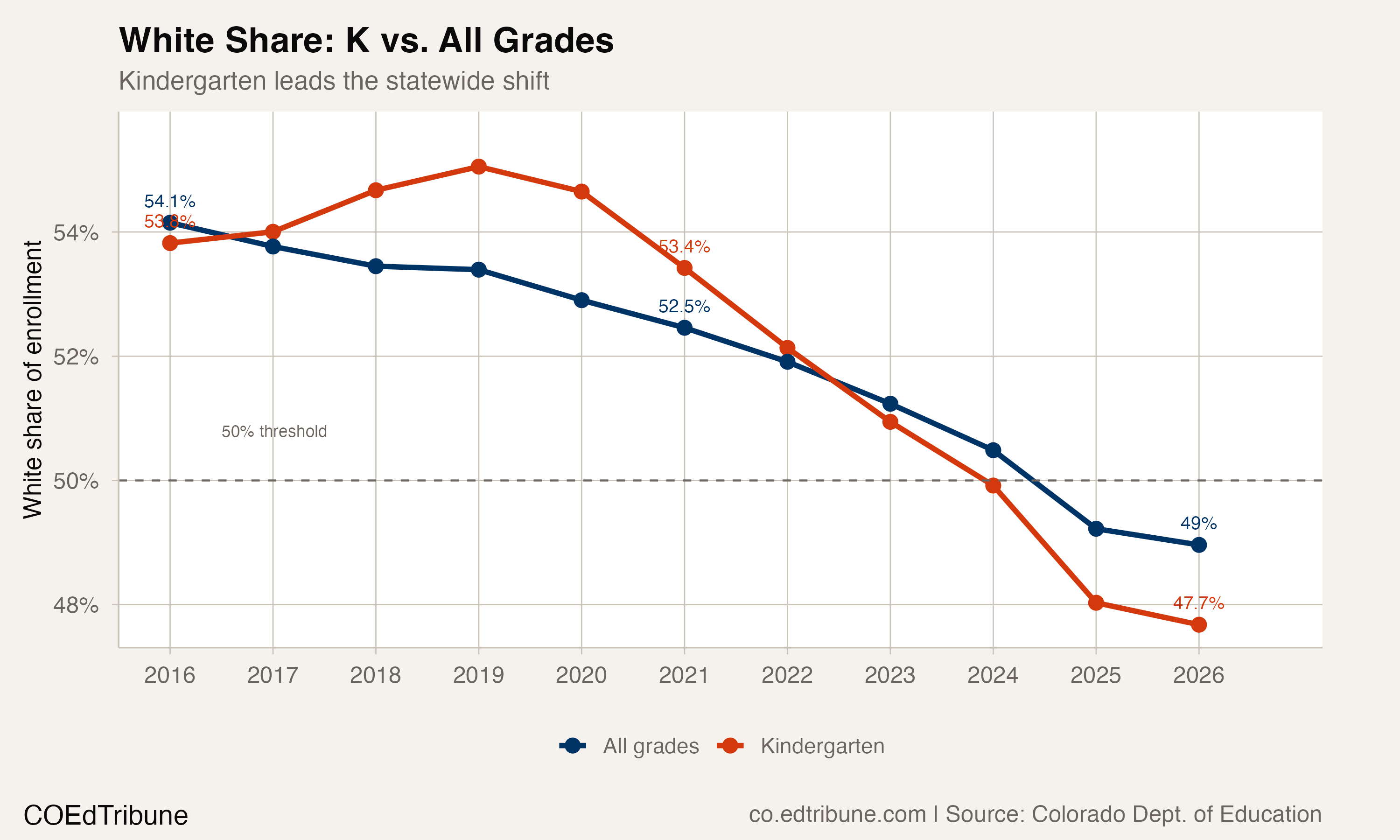
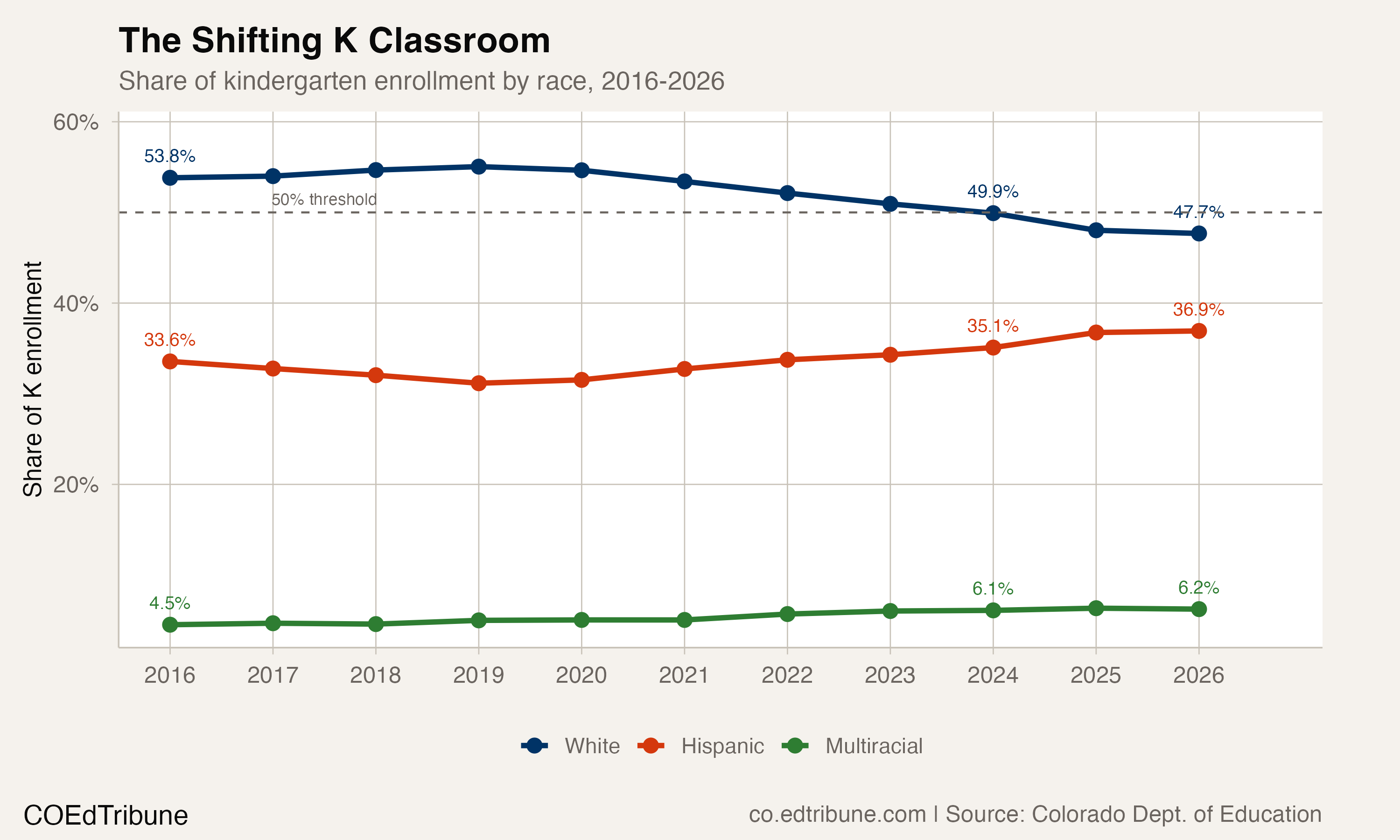
White students fell below 50% of kindergarten enrollment in 2024, reaching 49.9%. That was a full year before white students fell below 50% statewide in 2025. By 2026, white kindergartners comprised just 47.7% of the K class, compared to 49.0% of all students statewide.
Kindergarten consistently runs ahead of the statewide average. In 2016, white students were 53.8% of kindergartners and 54.1% of all students, nearly identical. By 2026, the kindergarten white share had fallen 6.1 percentage points while the statewide share fell 5.2 points. The gap between the two lines on the chart is widening.
Meanwhile, Hispanic kindergartners have risen from 33.6% of the K class in 2016 to 36.9% in 2026, and multiracial kindergartners have grown from 4.5% to 6.2%. The classroom that 2025-26 kindergartners enter is already majority-minority. The classroom they will graduate from in 2039 will be even more so.
Where the losses are concentrated
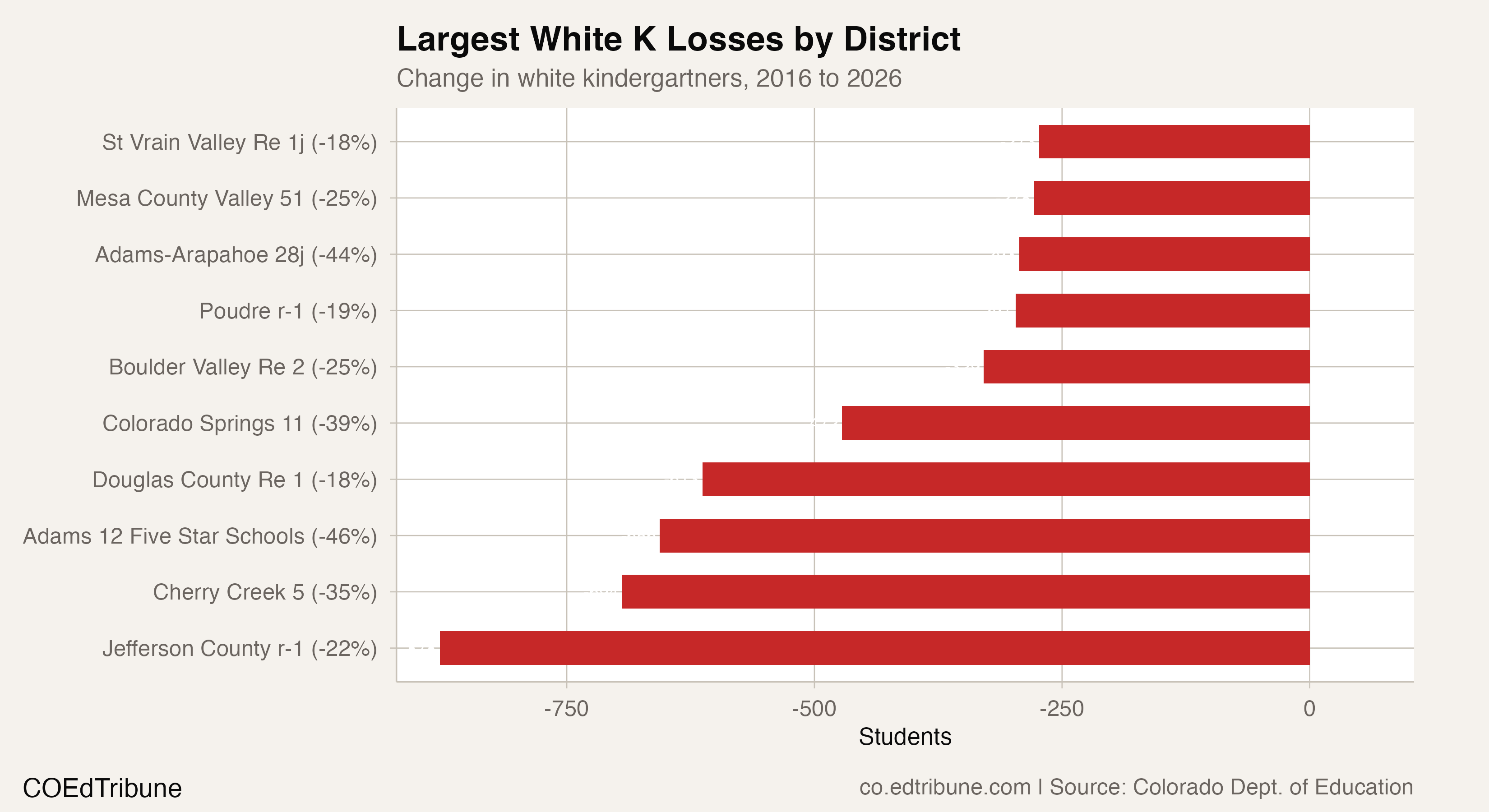
Five suburban districts account for nearly half the statewide white K loss. Jefferson County R-1↗ET lost the most: 878 white kindergartners, a 21.7% decline from 4,052 to 3,174. Cherry Creek 5↗ET lost 694 (-35.2%), Adams 12 Five Star Schools↗ET lost 656 (-46.2%), Douglas County Re 1↗ET lost 613 (-18.5%), and Colorado Springs 11↗ET lost 472 (-38.9%).
The percentage declines in some districts are staggering. Adams 12 Five Star lost nearly half its white kindergartners. Adams-Arapahoe 28J↗ET lost 44.5%. Cheyenne Mountain 12, a district in suburban Colorado Springs, lost 47.6%.
The white K share shift is most pronounced in the suburban ring north of Denver. School District 27J lost 18.4 percentage points of white K share (51.1% to 32.7%). Johnstown-Milliken RE-5J dropped 19.0 points. Adams 12 Five Star fell from 51.1% to 36.1%. These are districts where white kindergartners were the majority a decade ago and are now a clear minority.
Fewer babies, not just migration
The most likely driver is Colorado's birth rate, which has been falling for two decades. Colorado's general fertility rate has declined 25.1% compared to its 2001-2010 average, the third-largest drop in the nation. The state's total fertility rate stands at 1.5 births per woman, below both the national average of 1.6 and far below the 2.1 replacement threshold.
Denver County experienced the second-largest decline in births among the 100 most populous U.S. counties between 2021 and 2022, with births falling 6.3% in a single year. Jefferson County births dropped from 6,194 in 2007 to 5,521 in 2022.
The decline in white births appears to be outpacing declines in other groups, though state-level birth data by race is incomplete. Nationally, white birth rates have fallen faster than Hispanic birth rates for over a decade. In Colorado, white births accounted for 56.2% of all births during 2021-2023, but white students now make up just 47.7% of kindergartners, a gap that suggests either differential birth rates, delayed kindergarten entry, or movement to private schooling.
A secondary factor is the growth of multiracial identification. Some families that might previously have identified children as white now select multiracial. The 22.7% growth in multiracial kindergartners, from 2,922 to 3,585, partially reflects reclassification rather than a net change in the student population. Disentangling "fewer white babies born" from "more families choosing multiracial on the enrollment form" is not possible with this data.
School closures follow the shrinking pipeline
The operational consequences are already visible. Jefferson County Public Schools has closed 21 schools over the past three years as enrollment fell from 86,708 in 2015-16 to roughly 76,000.
"If we didn't migrate people to the state, we would age really fast." -- State Demographer Elizabeth Garner, Colorado Sun, August 2024
Denver Public Schools closed seven schools in 2025 and has projected losing approximately 6,000 more students by 2029. Westminster Public Schools announced three school closures in February 2026. Douglas County voted to close three elementary schools effective July 2026 after enrollment fell 7% over the past decade.
Colorado's new school finance formula, approved by the legislature in 2025, is phasing in over seven years and directs more resources toward rural and underserved districts, as well as toward English learners and students with disabilities. That formula change means per-pupil funding will shift toward the student population that is growing, not the one that is shrinking.
What the kindergarten pipeline signals
The kindergarten class is a 13-year forecast. The children who entered K in fall 2025 will graduate around 2039. If the racial composition of kindergarten holds approximately steady at 47-48% white and 36-37% Hispanic, Colorado's high school graduating class in 2039 will look very different from the class of 2026, where white students still made up 48.7% and Hispanic students 37.5%.
The state demographer expects birth rate declines to continue through about 2028 before potentially leveling off. That means at least two or three more kindergarten cohorts smaller than the current one. For districts already closing schools and consolidating programs, the pipeline offers no relief.
The question is whether the narrowing white-Hispanic K gap will eventually close. At the 2016-2026 pace, Hispanic kindergartners would outnumber white kindergartners around 2032. Whether that pace holds depends on variables that enrollment data alone cannot answer: whether immigration patterns into Colorado's Front Range resume, whether housing costs continue to push young families out of the Denver metro area, and whether the birth rate decline has a floor.
Detailed code that reproduces the analysis and figures in this article is available exclusively to EdTribune subscribers.
Discussion
Sign in to join the discussion.
Loading comments...